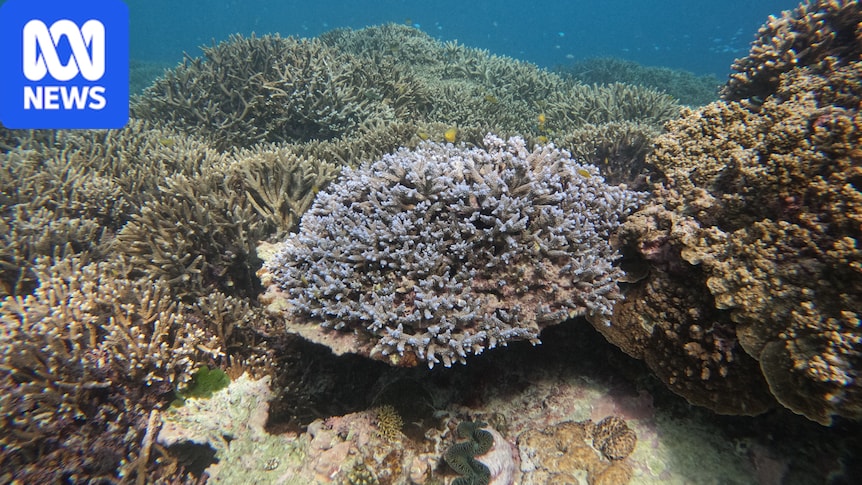
As Queenslanders waited for Cyclone Alfred to make landfall, its meander along the coastline brought relief to heat-stricken corals.After widespread coral bleaching in the Great Barrier Reef in the summer of 2024, the cyclone's formation in February 2025 brought cooler water to the World Heritage marine park.The effect of that cool change can be seen most dramatically around Lady Elliot Island, the reef's southernmost coral cay.Before: Bleached coral around Lady Elliot Island February 2024. . After: Regenerated healthy coral in early 2026.. .Instructions: Use left and right arrow keys to control image transition Before and after imagesSLIDE Bleached coral around Lady Elliot Island February 2024 / Regenerated healthy coral in early 2026.About 90 per cent of the island's bleached coral has returned to good health, and scientists are now eagerly awaiting a spawning event later this year."The water temperatures dropped about 2 degrees Celsius," Erin Watson, marine biologist and master reef guide, said. Erin Watson says the reef around the island has recovered well from the 2024 bleaching event.()"Now if you go out for a snorkel, the corals that did bleach, you wouldn't even notice had bleached in the first place."What is bleaching?When coral is under stress, it expels the algae that lives in its tissues.The algae, called zooxanthellae, provides food and gives the coral colour.Without it, the coral cannot feed and its tissue turns transparent, exposing the white calcium carbonate skeleton. Algae lives inside the coral's tissue, providing food and colour.(Supplied: Jessica Blackmore)One of the key reasons for coral bleaching is rising water temperatures due to climate change.But coral bleaching is not always a death knell."If those environmental conditions like water temperature start to go back down again, the coral takes back its algae and it recovers," Ms Watson said."Because we didn't get a bleaching event [in 2025], we actually got a little coral spawning event." 2024 was the first time much of the southern part of the reef, including Lady Elliot Island, experienced coral bleaching.(ABC Wide Bay: Johanna Marie)While there has been strong recovery in southern parts of the reef, other areas have not been as fortunate.The Australian Institute of Marine Science (AIMS) said the 2024 bleaching event was the most severe and geographically extensive in its 40 years of monitoring the reef. Mike Emslie says cyclones are a double-edged sword.(ABC News: Baz Ruddick)Research team leader Mike Emslie said it caused "substantial mortality" with 40 per cent of reefs experiencing their largest annual decline in coral cover.Dr Emslie described cyclones as a double-edged sword."They're known to have what's called this 'cooling wake' effect and can reduce the temperature of the water," he said."But the other side of the coin with cyclones is that they also produce a really large storm swell, and that storm swell can obviously impact the fragile coral skeletons and break them apart."Christine Dudgeon is the project manager for Leaf to Reef, which is a research and rehabilitation program based on Lady Elliot Island. Christine Dudgeon says frequent bleaching events do not give coral time to recover.(ABC Wide Bay: Grace Whiteside)"We're seeing incredible recovery," she said."The really big challenge of bleaching that we've seen in many parts of the Great Barrier Reef is when we have these back-to-back events or prolonged events … happening so readily."It doesn't give the environment time to recover in between."Dr Dudgeon said because of Lady Elliot Island's proximity to the continental shelf, it had traditionally been more protected from environmental issues that affected the northern part of the reef. Christine Dudgeon has been monitoring the reef's recovery.(Supplied: Christine Dudgeon)"We have lots of cold water upwelling," she said."It has a potential buffer against things like coral bleaching where the water can cool down and help the coral to survive and thrive a bit longer."From bleaching to spawningResearchers and staff on the island were hopeful this year's conditions would be favourable for reproduction. Erin Watson is hoping for a significant spawning event this year.(ABC Wide Bay: Grace Whiteside)"After corals have bleached, it takes them a few years to build up their energy reserves to be able to spawn," Ms Watson said."Hopefully at the end of this year, we're going to get a really big spawning event."Dr Emslie agreed it was likely to be a good year for spawning across the Great Barrier Reef."I'd say there'll definitely be spawning happening this year," he said."Most corals can recover quickly enough following that physiological stress imposed by bleaching to put the energy into reproduction."
Bleached coral's 'incredible recovery' as cyclone cools water temperature
Full Article
Original Source
Read the full article at Abc →KhanList aggregates and links to publicly available news content. We do not host full articles from third-party sources. Always verify important information with original sources.