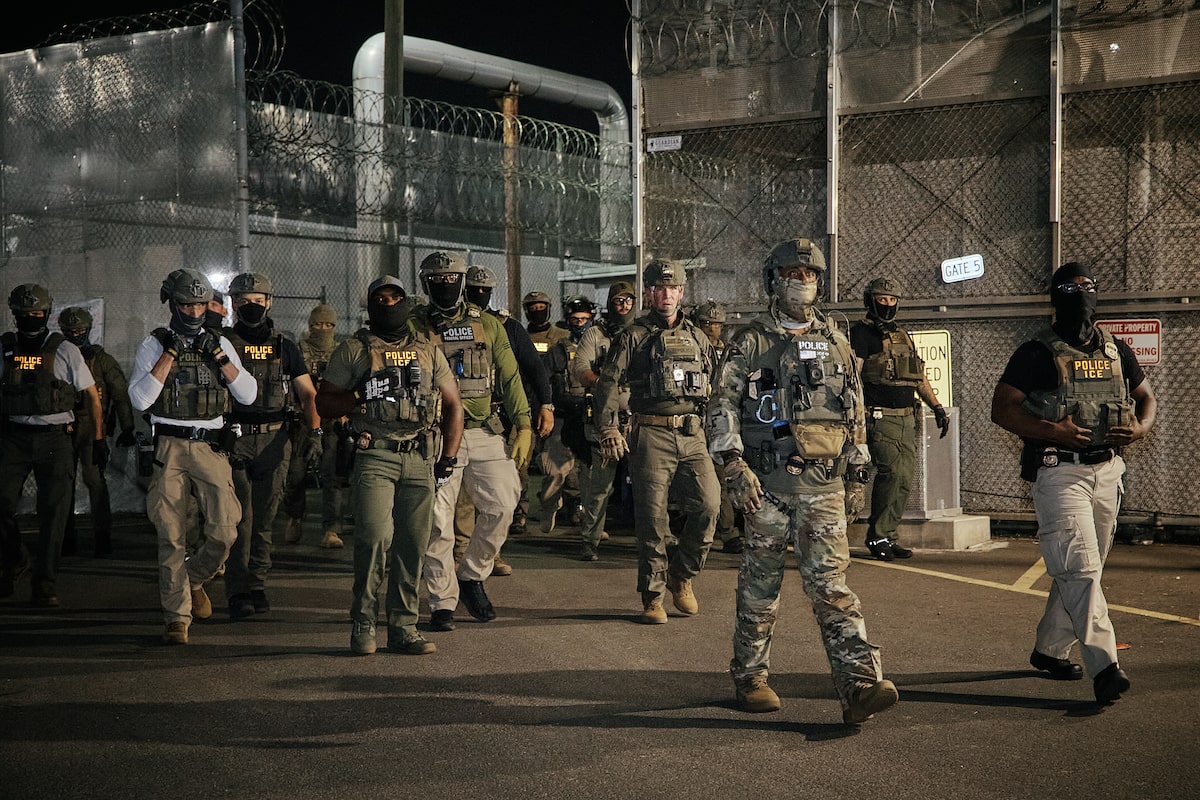
Open this photo in gallery:ICE agents arrive to clear protesters from a gate outside the Delaney Hall detention facility during a demonstration in June, in Newark, New Jersey.Andres Kudacki/Getty ImagesGoing abroad to study is a nerve-wracking endeavour at the best of times, involving moving away from friends and family and navigating a foreign culture. If you’re a student heading to the United States under President Donald Trump, it also means potentially having to deal with Immigration and Customs Enforcement.For Chinese parents whose children still want to attend an American university, a new business has popped up: overseas security training camps. China sends more students to the U.S. than every country, excluding India. However, this number has declined in recent years, from a record-high of 373,000 in 2019-20 to 277,00 in 2023-24, the last year for which data was available. State-media coverage often depicts the U.S. as unsafe and hostile to Chinese nationals, fuelling concerns about discrimination and crime. Reports of aggressive ICE raids targeting immigrants of all nationalities, and the detention of several Chinese students, has only compounded such fears.“More than 95 per cent of our participants intend to study in the United States,” said Zhang Meng, who runs Western Study Security Training Camp, one of a handful of companies offering such services across China. Mr. Zhang said his company’s standard camps, offered in Beijing, Shanghai, and Shenzhen, run five days and four nights, and is separated into two core modules. The first covers defence against direct or indirect violence, such as armed robbery, kidnapping and scams targeting international students and their families. The second module focuses on responding to law enforcement, including ICE.U.S. deportation roundups are surging out of the public eyeSome drills can be very realistic: Lulu Lu, a student from Beijing, told the South China Morning Post how an instructor in her camp barged into her dorm late at night and ordered her to lie on the floor. The actor blindfolded Ms. Lu, tied her hands and made her record a phone message begging her parents to pay a ransom. “I hope I never have to use any of this, but I definitely feel more alert after learning it,” Ms. Lu told the newspaper. Mr. Zhang said his company runs such kidnapping simulations at any time – during meals, in classroom sessions or in dorms – to keep students on their toes. “We coach students on how to answer questions about family finances, avoiding claims of total poverty or extreme wealth, both of which escalate risk,” he said. The enforcement-focused course teaches students how to properly document and prove their legal visa status, and how to deal with ICE agents. That includes learning “compliant response protocols for ICE questioning” during surprise inspections at school, student housing or on the street. The White House has mostly stopped publicizing ICE raids since federal agents gunned down two U.S. citizens in January during immigration operations in Minneapolis, sparking huge backlash. However, deportation roundups have continued apace. ICE arrested 39,563 people in June, its highest-ever monthly total, and in the same month, Republican lawmakers approved a further US$70-billion for immigration enforcement. ICE won’t end traffic stops, Trump says, contradicting new policy to halt themSuch raids have primarily focused on areas of the country with high Latino populations, but Asian diaspora communities have not been exempt, with a high-profile raid last October targeting New York’s Chinatown. Multiple Chinese human rights activists, fleeing repression by Beijing, have also been caught in the immigration dragnets. Open this photo in gallery:ICE agents walk a detainee out of the Ventura County Government Center in California, on July 27.BLAKE FAGAN/AFP/Getty ImagesLast year, Mr. Trump scrapped restrictions on ICE agents operating in “protected areas” – such as schools, hospitals and places of worship – and broadened conditions under which federal officers can forcibly enter homes. In many cases, people with the legal right to be in the country have been detained, including dozens of U.S. citizens. Students who have participated in protests against Israel’s war in Gaza or people who publicly criticized the White House have been targeted. Others have been denied re-entry to the country after agents searched their social media and found posts they deemed inappropriate. In January, the U.S. State Department boasted of revoking 100,000 visas, including around 8,000 student visas, in a social media post featuring a dancing Mr. Trump. Last May, Secretary of State Marco Rubio promised to “aggressively revoke visas for Chinese students,” though Mr. Trump later appeared to walk this back amid warming relations with Beijing.“The prolonged threat of deportation takes a profound psychological toll on international students, causing chronic stress, sleep disturbances and anxiety disorders,” Nuo Chen, an international postgraduate student at the University of Southern California and mental health counsellor, wrote in an October column. “The constant fear of being targeted can push students into social isolation, alienation and difficulty in concentration.”Mr. Zhang said the increasingly hostile environment in the U.S., far from driving more business, is actually lowering the number of customers he gets. “The inconsistent and frequently changing policies in the U.S. create massive uncertainty for both student families and all overseas study service providers,” he said. Many students who had signed up for summer safety camps this year cancelled after their visas were rejected or delayed. Destinations seen as safer and more welcoming of Chinese students, including Hong Kong, Singapore, Malaysia and Japan, have all seen a spike in enrolments, according to research by the Beijing-based Cheung Kong Graduate School of Business. The prestige of an international education has also diminished in China as domestic universities have climbed up the rankings and nationalist sentiment has grown.“Employers no longer view overseas degrees as a major competitive advantage,” Mr. Zhang said. “In some industries, foreign study experience has become neutral or even a disadvantage in hiring decisions.” With reports from Alexandra Li in Beijing and Adrian Morrow in Washington
In China, security training camps prepare international students to face ICE
Full Article
Original Source
Read the full article at Theglobeandmail →KhanList aggregates and links to publicly available news content. We do not host full articles from third-party sources. Always verify important information with original sources.