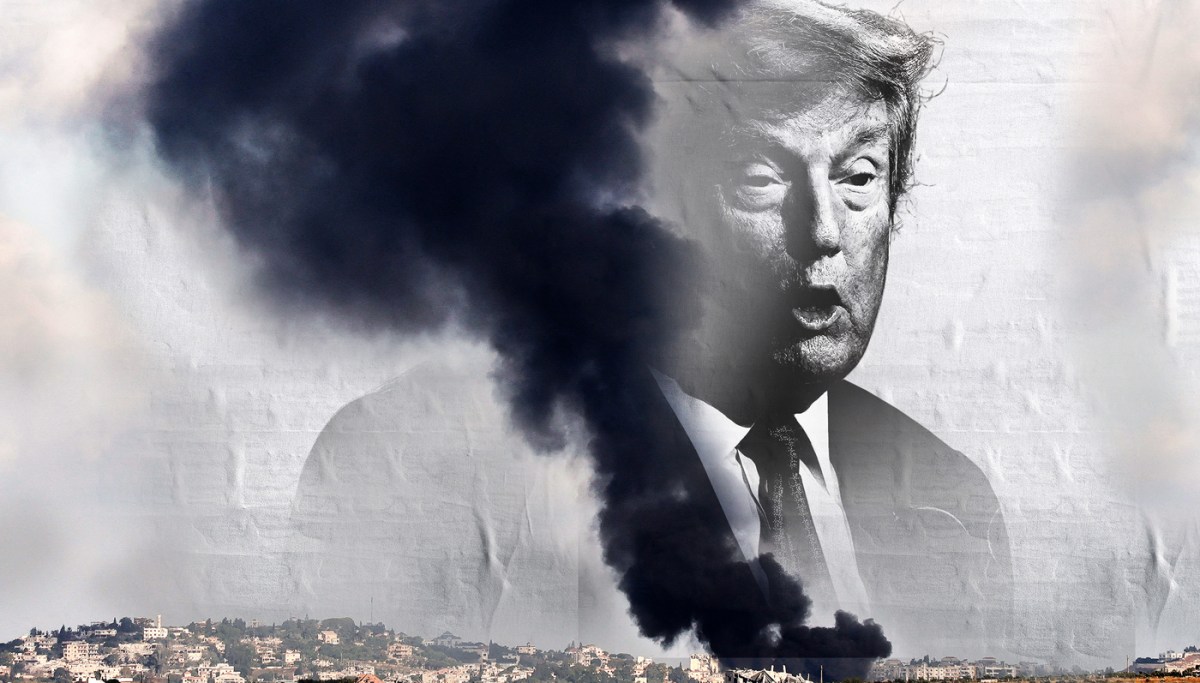
On March 17, 2025, newly appointed C\chief Pentagon spokesman Sean Parnell opened his first briefing with a grandiose pledge of transparency.“In line with the secretary’s vision to make this the most transparent Department of Defense in history, I gave you my personal commitment to make these briefings more routine,” Parnell said on behalf of Defense Secretary Pete Hegseth. “So today, it is the first of many.”It was, in fact, the first of many promises of openness and accountability that would prove to be, to put it politely, “inoperative.” Parnell briefed reporters one more time in July of that year, six months into President Donald Trump’s second, nonconsecutive term, before ending the practice of routine press briefings, a tradition dating back to World War II, when the Pentagon was built.(Washington Examiner illustration; AFP via Getty Images; Alex Brandon/AP; Getty Images) In the ensuing 12 months, Hegseth has methodically undermined the Pentagon’s own principles of information, which require the department to make available “timely and accurate information” to “the public, the Congress, and the news media” and that “information will not be classified or otherwise withheld to protect the Government from criticism or embarrassment.”Hegseth has demonized the legacy media as “dishonest, unpatriotic, and Trump-hating,” while, in contrast, instituting restrictions on reporting anything but officially authorized information. It’s a move that prompted most Pentagon reporters to turn in their credentials and give up their desks in the building.Still, independent news organizations, including veteran journalists with decades of experience and deep sources, have been able to report on the good, the bad, and the ugly of the Iran war.Keeping vital information from the public During prior wars of the 21st century, reporters were embedded with U.S. troops, the Pentagon would brief almost daily, and civilian casualties when they happened would be acknowledged, investigated, and the results reported.In this war, a shroud of secrecy obscures even the most mundane details. And never is heard a discouraging word from the podium in the briefing room.On Day 1 of the Iran war, in what was almost certainly a tragic accident, more than 150 civilians, including 120 schoolgirls, were killed when two U.S. Tomahawk cruise missiles struck their school, in what appears to have been a case of outdated intelligence.When confronted with uncomfortable questions or inconvenient facts, Pete Hegseth’s go-to playbook is to respond with ad hominem attacks and accuse journalists of “Trump derangement syndrome.” (Jacquelyn Martin/AP) The investigation has been over for months but has not been released, providing the Trump administration with convenient, if not really plausible, deniability.“It’s horrible what happened,” Trump said in the Oval Office on June 24. “But missiles were flying all over the place. And somebody said it was our missile. Well, maybe it wasn’t our missile. But I’ve seen nothing to lead me to believe it was. There were plenty of missiles being flown by other people.”No other country has Tomahawk missiles, certainly not Iran.When confronted by reporters with uncomfortable questions or inconvenient facts, Hegseth’s go-to playbook is to respond with ad hominem attacks and accuse journalists of “Trump derangement syndrome”“A dishonest and anti-Trump press will stop at nothing — we know this, at this point — to downplay progress, amplify every cost and call into question every step,” Hegseth said at a March briefing. “Sadly, TDS is in their DNA. They want President Trump to fail. Report the reality. We’re winning decisively and on our terms.”As the war dragged into months two and three, the Pentagon held fewer briefings, and U.S. Central Command became more secretive.Where once it bragged about how many bombs were dropped and missiles fired, now CENTCOM no longer discloses how many targets were hit, even exactly what the targets were.When word leaked out that U.S. munitions stocks were being depleted, especially the expensive high-end interceptor missiles needed to protect U.S. troops at bases in the region, the response was furious denial.The U.S. has “far more munitions than anyone in the world, and far more than we need,” Trump said in a statement to the Wall Street Journal.Then on NBC’s Meet the Press, Mike Waltz, the U.S. ambassador to the United Nations, at first seemed to confirm the shortfall, blaming a “depleted military” inherited from the Biden administration, only to, in the next breath, suggest anyone spreading such treasonous lies should be behind bars. “And I have to tell you, the people that are leaking this nonsense deserve to be in jail.”An independent assessment by the Center for Strategic and International Studies found that Iranian attacks have “required extensive use of interceptors” and that Patriot inventories have dropped from 2,330 to under 1,000, and Terminal High Altitude Area Defense inventories are down to about 250 from 452 before the war.“There are no good alternatives to Patriot and THAAD for ballistic missile defense,” the report notes, suggesting, “Diminished stockpiles may force the United States and its coalition partners to take more risks with interceptions.”Trump eventually confirmed that while the military has what he called “a lot of the mid-level stuff” … “for some of the more sophisticated stuff,” he said, “I’d like to have more, to be honest.”The Pentagon has also tried to keep citizens from realizing how much damage has been done to U.S. bases that have come under Iranian attack, despite its ballistic missile capability supposedly having been wiped out.One study from the American Enterprise Institute estimated $5 billion for base damage. And both the New York Times and the Wall Street Journal have used publicly available satellite imagery and social media video to establish substantial damage at U.S. bases whose locations are well known, including Naval Support Activity Bahrain, headquarters of the U.S Fifth Fleet.“The extensive damage done to America’s sole naval base in the Middle East — along with hits to at least 20 U.S. sites across the region, including military installations and diplomatic facilities — has the U.S. re-evaluating its entire footprint in the region,” the Wall Street Journal reported.The U.S. military often declines to identify bases that are under attack if there are no fatalities, only injuries or wounds.Lawmakers are in the dark, too Even members of Congress can’t pry the real numbers on losses out of the Pentagon.“I get reports from people who know a service member at a base in Jordan or Iraq, or someone says, ‘Yeah, we heard there was an attack. There’s 20 or 30 people wounded,’” Rep. Adam Smith (D-WA), top Democrat on the House Armed Services Committee, said on CNN. “The Pentagon doesn’t say anything about it.”Similar information has reached former Rep. Adam Kinzinger, an Illinois Republican who served from 2011 to 2023 and, during the latter part of his tenure and beyond, has been a fierce Trump critic.“Obviously, American infrastructure has been hit overseas,” Kinzinger, a retired Air Force and Air National Guard officer, said on CNN. “I talked to friends of mine that are still in the military that tell me crazy stories about what has been hit that they’re near.”“I think the president and the Pentagon and the administration in general need to level with the American people,” Kinzinger said. “America is willing to bear some sacrifice in this if they know what the objective is. But this president will not tell us what the objective is, pretends like this war has been over from Day 1. And now, they’re just trying to hide the real impact, it seems.”In May, a Congressional Research Service report revealed that 42 fixed-wing or rotary-wing aircraft were reportedly lost or damaged in the war up to that point, something the Pentagon has not publicly confirmed.But nothing has raised more concern about the true cost of war than the numbers of wounded troops posted to an obscure Pentagon website, with no context as to severity.The Defense Casualty Analysis System lists 14 dead, 417 wounded in Operation Epic Fury and another four dead and 225 wounded in a nebulous category called “Overseas Operations” that lists casualties starting July 7, just before Trump declared a short-lived ceasefire over.No one but the families knows how badly those 642 warriors are wounded.“Injuries in the military encompass everything from minor sprained ankles during routine training to incidents entirely unrelated to combat operations,” Parnell posted on X, noting that the “vast majority of injuries experienced were minor concussions,” which can also be serious traumatic brain injuries.But in Trump’s mind, the most unpatriotic thing anyone in the media or at think tanks can do is suggest the war, after five months, is going poorly, even though almost all military analysts think that’s the case.Take, for instance, retired Army Gen. Wes Clark, former top NATO commander, author of Waging Modern War, and commander of the successful 1999 NATO war in Yugoslavia.“The fact is that the Iranians still have their missiles,” Clark said. “The Chinese and Russians are supporting them. We have not isolated Iran from outside assistance. The [Islamic Revolutionary Guard Corps] feels that they’re winning. We have not opened the Strait of Hormuz. So from their perspective, they’re on top.”“They requested a meeting,” Trump told reporters on Air Force One. “They would not have requested the meeting if we were doing poorly.”That was one day before Iran launched a surprise attack on U.S. troops in Jordan, and Trump was back to telling Fox News, “We’re going to beat the f***ing s*** out of them.”But when veteran New York Times reporter David Sanger asked Trump on Air Force One en route from China, “What would the use be of repeating the bombing? You did it for 38 days, and you did not get the political changes in Iran,” Trump bristled.“I actually think it’s treason when you write like they’re doing well militarily and they have no Navy, no Air Force, no anti-anything,” Trump said.“I had a total military victory,” Trump griped. “But the fake news, guys like you, write it incorrectly. I actually think it’s sort of treasonous what you write. But you and the New York Times and CNN, I would say, are the worst.”Trump has a PR problem that is two sides of the same coin. He can’t convince the American public he’s winning, and he can’t convince Iran it’s losing.Trump, it would seem, can’t quite wrap his arms around the concept that a tactical victory that doesn’t achieve political goals is no victory at all.TRUMP: US WILL ‘BEAT THE F**ING S*** OUT OF’ IRAN AFTER SURPRISE ATTACK“The American people don’t believe that, Mr. President,” Fox host Lawrence Jones reassured him. “They understand who’s winning this war.”“The New York Times writes an article, ‘They’re stronger today than they were four months ago,’” Trump said. “These people are sick. I actually think it’s treasonous, Lawrence. I think it is.”Jamie McIntyre (@jamiejmcintyre) is the Washington Examiner’s senior writer on national security.
‘All the fight we cannot see’ — Trump administration views reporting on reality of Iran war as treason
Full Article
Original Source
Read the full article at Washingtonexaminer →KhanList aggregates and links to publicly available news content. We do not host full articles from third-party sources. Always verify important information with original sources.