
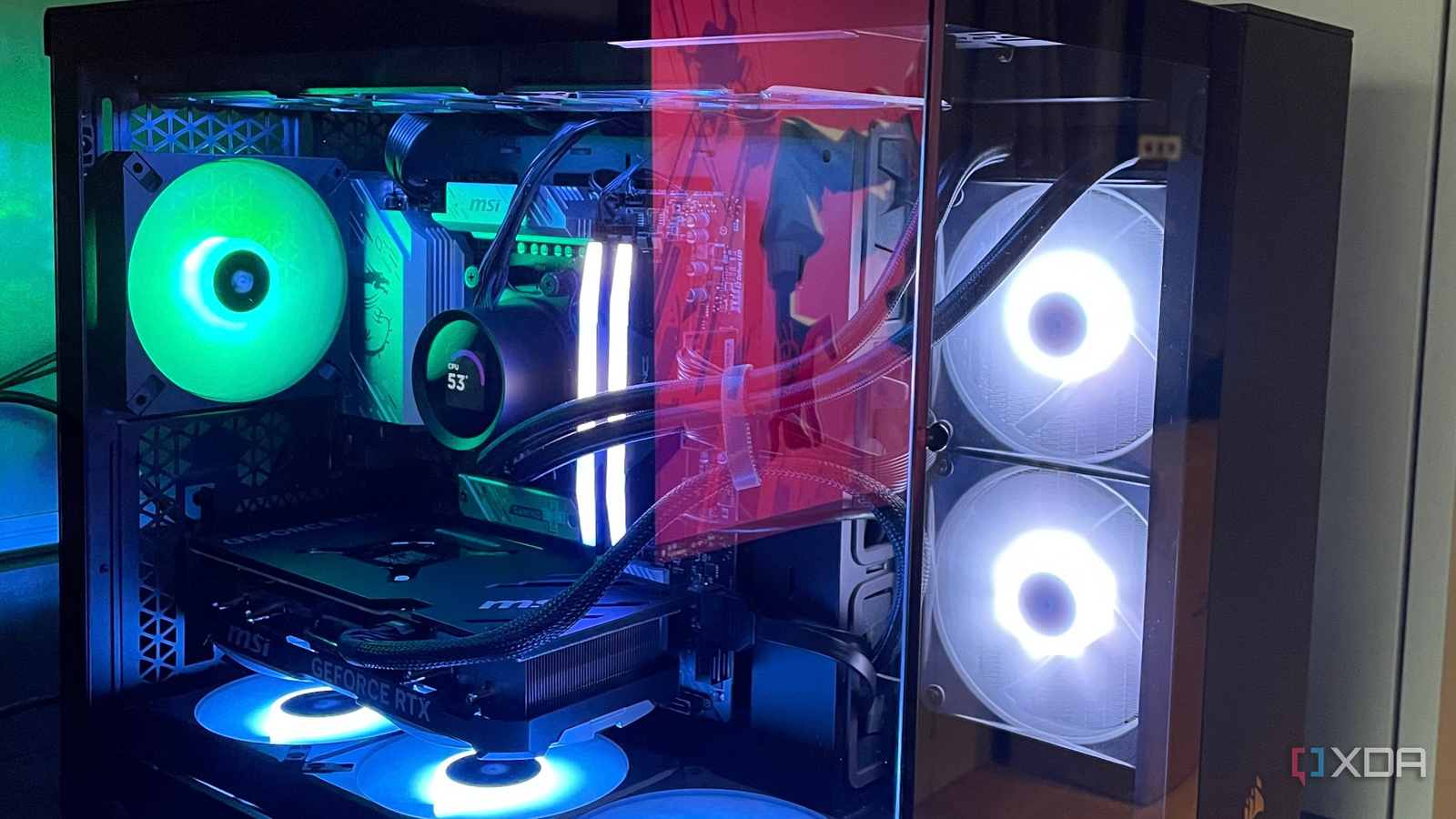
Published Oct 8, 2026, 4:30 PM EDT Abhinav pivoted from a career in banking to pursue his first love in writing. Even while working full-time, he continued contributing as an editor-at-large, a role he has held for more than 7 years. A lifelong tech enthusiast who has built three gaming and productivity powerhouse PCs since 2018, his passion for technology keeps him closely following the semiconductor industry, from NVIDIA and AMD to ARM. His MSc dissertation explored how artificial intelligence will reshape the future of work, reflecting his curiosity about the wider social impact of emerging technologies. In fall 2023, I built what most would call a mid-range PC. Some would argue that "mid-range" is strictly related to the "tiers" of the chips in the system and where they sit in the product hierarchy, some relate it to an output resolution, most commonly 1440p. And then finally, there's the economic argument, which is the most widely referenced among OEMs, stating that a mid-range PC is one that delivers maximum performance against its price. The past year has seen some rather unprecedented shifts in the PC hardware economy, largely due to the rising demand from the hyperscalers and AI industry, and the place where it's most pronounced is in DRAM pricing. The crisis has persisted for so long now that the very notion of what it means to have a mid-range PC has been altered, perhaps permanently. This has also led to a rare inversion in hardware economics, in that, a depreciating asset like my workstation from 2023 has appreciated in its value in fall 2026. Curious to know exactly by how much, I did the math myself. My PC from 2023 is worth more now than when I built it The cost accounting has changed, but bookkeepers didn't get the memo In every bookkeeping framework I have come across, computing hardware is classed as a depreciating asset, because a PC loses performance headroom relative to what's being released, the warranty windows closing, and the resale market thinning out as newer parts arrive on the market. Three years, going by that framework, is usually enough to knock a mid-range build down to a fraction of its retail price, and that is exactly the trajectory that my PC was on until the beginning of the DRAM crisis. If you've been keeping up with the news, or if you have been in the market for a new PC, you'll know that this trajectory of depreciation over time has seen a reversal. This isn't something entirely new, since it has happened in the PC DRAM market between 2016 and 2018 under the first wave of hyperscaler data center buildouts, and the GPU market between 2020 and 2022 due to the COVID-19 supply shortage and crypto boom. Not all components inside the case have uniformly appreciated, though. The motherboard, CPU, the NZXT AIO cooling unit, and the PSU are all worth less, but the increase comes from three parts that are all caught in the same supply crunch, including the DDR5 memory, the GPU, and most recently, my PCIe Gen 4 NVMe SSD. The 32GB of DDR5 accounts for most of it It's all about constrained supply and increased demand I dug up through my Amazon invoices from 2023 to work out exactly what I had paid for this PC, and DDR5 prices felt like they belonged to an alternative reality where the data centers didn't leave consumer computing for dead. In September 2023, I paid £118.99 (about $157.20) for 32GB of Corsair Vengeance DDR5-6000 CL30 AMD EXPO memory. Today, the exact same SKU is listed at £529.99 (about $700) at Scan.co.uk. Best Buy in the US has it listed at $549.99 at the time of writing. That is a near 400% move in three years on the same piece of hardware, and naturally, the two sticks of RAM are the biggest reasons for the appreciation in the effective price of the entire build. On the secondary markets in the US, there isn't much respite from the extortionate pricing either. On average, the same SKU with the same specs sells for around $475, including open-box and refurbished listings. Even the cheapest open-box kit I could find on offer costs roughly thrice as much as what I paid for a sealed, retail-boxed unit. Pricing 32GB Corsair Vengeance DDR5-6000 CL30 2023 retail $157 2026 retail $549 2026 secondary (average) $475 And there are two more components worth more 3 years later Meet VRAM and NAND, the newest victims of the AI boom The next two big reasons for the supposed appreciation of the value of my build are the graphics and the storage, both of which have components that hyperscalers continue to require more of, seemingly with each calendar quarter. Those are VRAM and NAND flash in particular. It's worth qualifying here that I bought my MSI RTX 4070 Ti Super a little later in January 2024 close to its MSRP of $799 which replaced my aging RTX 2070 Super. It's hard to find a new one retailing right now, especially since the Ada Lovelace GPUs have been superseded by the Blackwell series. On the few Amazon listings that I could find, it was priced between $1,500–$1,580, which, against its MSRP, is about 97% more on the higher end. On the secondary marketplace, I found an average retail price of $1,620 across 58 listings for the same card. My 1TB Crucial T500 PCIe Gen4 NVMe in this build tells the same story as well. It launched at a price point of $144 in 2023 and currently retails at around $225 at US retailers, roughly up by 56% compared to launch price and nearly thrice as much as its 2024 flash-sale low of $75. Component Price 2023 (At Purchase) Price 2026 (Effective Retail) Ryzen 5 7600X $237 $180 RTX 4070 Ti Super* $952* (Early 2024) $1,620 Corsair Vengeance DDR5 32GB (CL30) $151 $550 Crucial T500 1TB $104 $225 MSI B650M $170 $185 NZXT Kraken 240 RGB $189 $180 MAG A750GL PCIE5 $108 $100 Total $1,911 $3,040 My PC is worth more than it was before, and that's horrible news Whenever an asset that's owned appreciates in value, it's usually good news for the consumer, but that's something I'd argue does not apply to PC hardware. The natural cycle of components is such that they are supposed to depreciate with time, and newer, more performant and competitive products take their place, ideally at a sustainable price in the market. Unfortunately, that's not what appears to be happening. Nvidia and AMD did not release a new GPU architecture this year, Micron shut down its consumer-facing arm, rising prices are making it impossible for those on older platforms like AM4 to upgrade to AM5. What this inversion and markup of some components (such as the four times rise in memory price) tells me is that I, as a consumer, do not have access to an evolving market that's ready for my evolving needs, and that a single failed memory stick is enough to set me back $250.
I priced out my 2023 gaming PC at today's prices, and it's worth more than I paid for it
Full Article
Original Source
Read the full article at Xda-developers →KhanList aggregates and links to publicly available news content. We do not host full articles from third-party sources. Always verify important information with original sources.