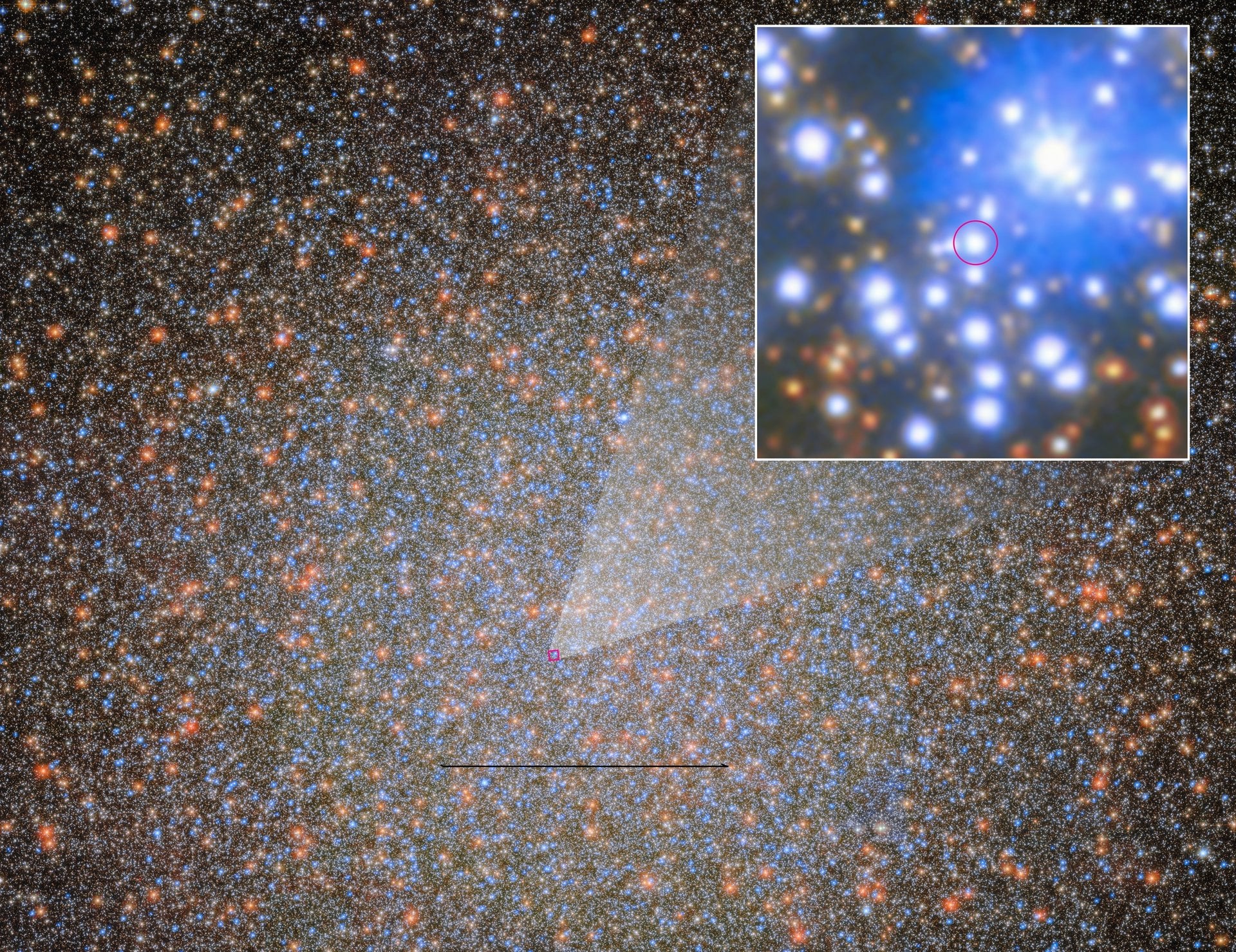
Using over 20 years of archival data from NASA's Hubble Space Telescope (HST) and recent observations from the James Webb Space Telescope (JWST), astronomers have finally located a stellar-mass black hole in the Omega Centauri cluster. For decades, this cluster has mystified astronomers because it previously showed no evidence of stellar-mass black holes. Globular clusters are known to host many black holes that formed when some of their massive stars reached the end of their lives and exploded (i.e., supernovae). The Omega Centauri cluster is located about 18,000 light-years from Earth in the constellation Centaurus. It contains 10 million stars within a diameter of 150 light-years, making it the largest known globular cluster in the Milky Way. While Hubble observations found evidence of an intermediate-mass black hole (IMBH) at its center in 2024, models suggest that it should contain about 10,000 stellar-mass black holes. By discovering the first of these "missing" black holes, astronomers will be able to refine current theories on how black holes form within environments like Omega Centauri. Since black holes neither emit, absorb, nor radiate electromagnetic radiation (light), there are only two ways to detect them. One method is to look for the gravitational perturbations they cause through radial velocity measurements of surrounding stars, or for the radio and X-ray emissions from material accreting onto their surfaces. The location of Omega Centauri is shown relative to stars in the southern sky as seen during early evening in late winter and spring. Credit: NOIRLAB/Carolyn Collins Petersen The recent observations used a different approach, relying on astrometric measurements to detect very small movements of the cluster's stars over time. Once they added the archival Hubble data with more recent Webb data to refine their measurements, the team discovered a star orbiting an invisible, massive object. This object, designated oMEGACat BH-2, is the first stellar-mass black hole found in Omega Centauri and has some interesting qualities. When a different team of astronomers previously observed this binary system, they believed it included a neutron star. By expanding on the Hubble data to include astrometric measurements from 2002 to 2023, and adding data from Webb's Near-Infrared Camera (NIRCam), the Utah-led team was able to better constrain the mass of the star's companion. Based on the precise dataset, the team charted the star's path over more than 20 years, during which time it made a closest approach to its black hole companion and moved at its fastest. Said Matthew Whitaker, a postdoctoral researcher at the University of Utah and the lead author of the paper: With Hubble and Webb data, we were able to see the motion of the visible main-sequence star that is part of this binary, which is about 18,000 light-years away in the dense environment of Omega Centauri. The precision of these measurements is incredible, down to a fraction of a pixel on Hubble and Webb’s detectors. It would not have been possible to find this black hole without these two space telescopes. From the extensive data, the team determined that the visible star orbits oMEGACat BH-2 once every 94 years, making it the longest-period black hole binary ever discovered. This long orbital period also provides clues about the origin of the binary system, suggesting they were unlikely to have formed together, but that the black hole captured its companion within the cluster. They also found that it has less mass than what's expected for stellar-mass black holes. Hubble image of the Omega Centauri globular cluster. Credit: ESA/NASA/Maximilian Häberle (MPIA) Said co-author Anil Seth, a Professor of Physics & Astronomy at the University of Utah: While we already knew that the star was 0.78 solar masses, we can now calculate the black hole’s mass, which is 4.46 solar masses and therefore too heavy to be a neutron star. However, its mass is much lower than would be expected in a metal-poor environment like Omega Centauri. This is surprising and exciting. We now know that a metal-poor star is able to form a black hole like this, and we need to figure out how that happens. This detection is providing some data to those who do that kind of modeling. The researchers further calculated that oMEGACat BH-2 will survive for less than a billion years before being torn apart by encounters with nearby stars. This is a significantly shorter span than the cluster's estimated age of approximately 12 billion years. As Seth explained, all of this data is helping astronomers to tackle the mystery of the Omega Centauri cluster and its "missing" black holes: It's important to understand black hole populations in globular clusters because there's uncertainty about their physics and formation. More specifically, understanding the process of forming black holes and then dynamically forming binaries is vital, because it affects our ability to interpret and understand gravitational wave events. Environments like Omega Centauri are the primary places where we think binaries are merging and creating these waves. The team’s discovery is just the beginning, as so many more still await to be found. In the near future, the team hopes to continue using Hubble and Webb to expand the search of the cluster. Their efforts will be assisted by the Nancy Grace Roman Telescope, scheduled to launch on August 30th, 2026, which will image the galactic bulge and galactic center regularly with the resolution of Hubble, but a much wider field of view. The abilities will assist astronauts hoping to find evidence of "missing" objects within the Milky Way. Further Reading: NASA
Hubble Discovers the First "Missing" Black Hole in this Famous Star Cluster
Full Article
Original Source
Read the full article at Universetoday →KhanList aggregates and links to publicly available news content. We do not host full articles from third-party sources. Always verify important information with original sources.