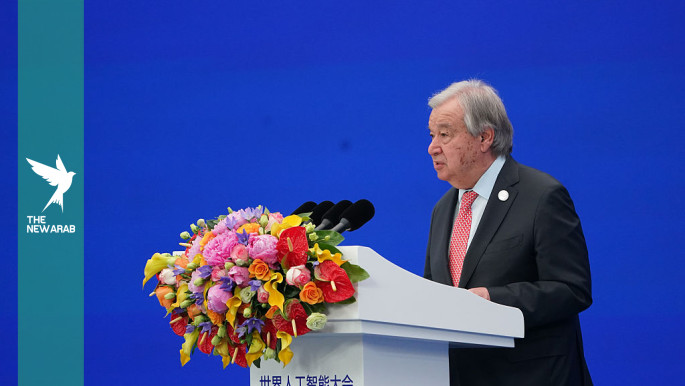
United Nations Secretary-General Antonio Guterres is set to travel to Syria later this week [GETTY]UN Secretary-General António Guterres will travel to Syria later this week, marking the first visit to the country by a sitting UN chief since Ban Ki-moon met Bashar al-Assad in Damascus in 2009. The trip comes 19 months after Assad's fall in December 2024 and will be Guterres's first direct engagement with President Ahmed al-Sharaa's government, a striking marker of how far Syria’s transition has gone. An exact date has not yet been confirmed, but Guterres is expected to meet al-Sharaa, Foreign Minister Asaad al-Shaibani, and representatives of civil society and women's groups in Damascus. He will also visit UN peacekeepers stationed in the buffer zone in the Golan Heights, according to UN Spokesperson Stéphane Dujarric. Why this matters now Deputy UN special envoy to Syria Claudio Cordone said Guterres's stay will "reaffirm the United Nations' commitment to supporting the Syrian government and the Syrian people at this defining period in Syria's history". Dujarric framed the trip as a chance for Guterres to witness firsthand "both the hopes and the challenges" of Syria's political transition and recovery, alongside the lasting toll of prolonged conflict. The visit follows what UN officials called an "institutional milestone" in Syria's transition: the first convening of the country's People's Assembly and the formation of a seven-member Supreme Constitutional Court, which includes two women. At a UN Security Council meeting on Tuesday, Syria's UN ambassador Ibrahim Olabi described these as "the basic pillars for the building of state institutions in the transitional phase". Yet the same Security Council session heard that humanitarian needs remain "vast and underfunded", with 15.6 million people – nearly two-thirds of Syria's population – requiring assistance. That humanitarian strain is starkly illustrated by the ongoing landmine crisis, which underscores just how far Syria's "recovery" still has to go. According to the HALO Trust, Syrians are killed and injured every day by landmines and other explosive remnants of war, with the country still heavily contaminated by mines, bombs, rockets and artillery hidden in crop fields, along roadsides, and in the rubble of homes and schools. At least 800 people have been killed by such explosives since the fall of the Assad regime in December 2024, out of more than 2,300 total casualties – figures the HALO Trust says are likely a significant undercount due to underreporting, compounded by the growing number of displaced Syrians attempting to return home, often to areas that have not been cleared. What to watch for A key question is whether Guterres directly addresses Israeli military activity in the occupied Golan Heights and southern Syria – an issue Security Council members flagged sharply this week, with Turkey citing violations of the 1974 Disengagement Agreement and the UK pressing Israel for a clear withdrawal timeline. The visit lands against a tense regional backdrop. Israeli forces have carried out near-daily incursions, artillery strikes and raids across Quneitra and Daraa since December 2024, with the Syrian Observatory for Human Rights recording 38 attacks on Syrian territory in 2026 alone, killing at least five people and damaging or destroying roughly 13 sites. Just days before Guterres's expected arrival, Israeli forces opened fire on civilians in the Yarmouk Basin village of Jamla, injuring two children, while late June saw Israeli shelling force hundreds of residents to flee villages in western Daraa. His stop with UNDOF peacekeepers in the Golan buffer zone could become a platform for a stronger UN statement on the ceasefire line, especially after independent UN investigators found security conditions in southern Syria remain fragile. Observers will also be watching whether he raises Syria's sovereignty and territorial integrity explicitly – Dujarric has said this will be a theme of the visit, a likely signal aimed at Damascus and outside actors both. Beyond rhetoric, the real test may be whether the trip produces concrete UN commitments – funding pledges, reconstruction support, or an expanded political mission mandate – rather than simply symbolic gestures, given the scale of the underfunded humanitarian response. There is also the question of how al-Sharaa's government responds to Guterres's planned meetings with women's and civil society groups, amid continued international scrutiny of minority rights protections under the new administration. The visit also comes as Guterres nears the end of his second and final term, which concludes on 31 December 2026, with the Security Council currently vetting candidates to succeed him. Any commitments made in Damascus this week will therefore fall to a new UN leadership to sustain from January 2027.
Guterres to visit Syria, first such trip by UN chief since 2009
Full Article
Original Source
Read the full article at Newarab →KhanList aggregates and links to publicly available news content. We do not host full articles from third-party sources. Always verify important information with original sources.