
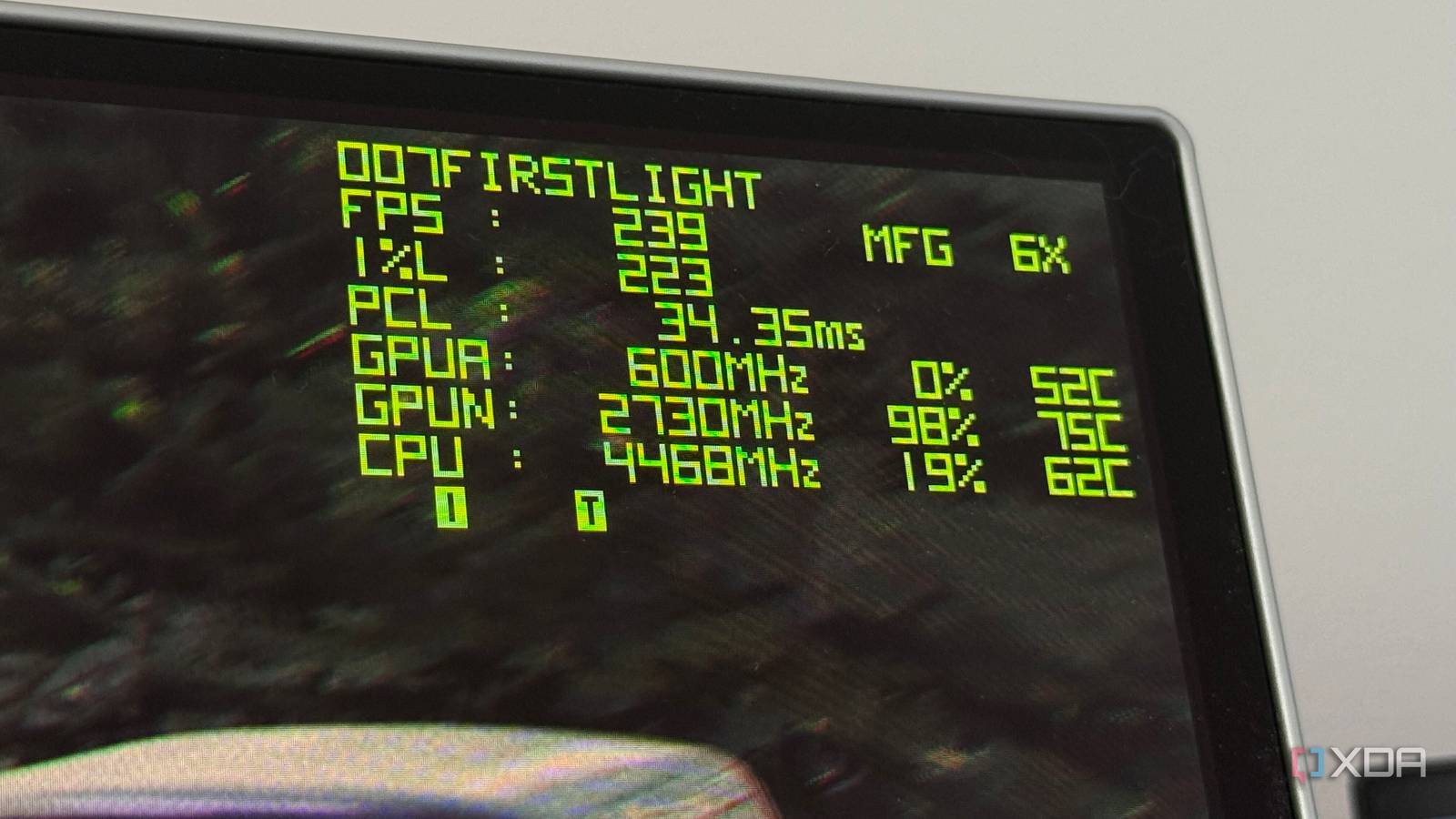
Published Aug 23, 2026, 12:00 PM EDT His love of PCs and their components was born out of trying to squeeze every ounce of performance out of the family computer. Tinkering with his own build at age 10 turned into building PCs for friends and family, fostering a passion that would ultimately take shape as a career path. Besides being the first call for tech support for those close to him, Ty is a computer science student, with his focus being cloud computing and networking. He also competed in semi-pro Counter-Strike for 8 years, making him intimately familiar with everything to do with peripherals. When I'm gaming, I largely try and stay away from frame generation. It adds latency and visual artifacts that are especially distracting when UI elements are present, and two games I've recently been playing a lot of: Cyberpunk 2077 and 007 First Light, have enough of them for me to opt out. At least, that was until I had tried it again, and found something interesting. When I turned on 2x frame generation in 007 First Light, it halved my system latency, but the same setting in Cyberpunk 2077 made it roughly a third worse. This is with the same GPU, same 4K output, and ensuring Reflex was enabled in both cases. The difference was the base framerate, with nearly a 2x difference between them, and that was what made MFG finally make sense. Frame generation works by interpolation Sandwiching new frames between existing ones Credit: Nvidia DLSS Frame Generation works via interpolation, where the GPU renders frames normally, but uses motion vectors and depth data from the game engine to construct one or more intermediate frames inserted between the "normal" frames. This, of course, adds a degree of latency, because adding more frames without sampling the input at a higher framerate means there's naturally going to be more of a delay before you see your input reflected on screen. This is also why Nvidia Reflex is enabled by default when you enable frame generation, because without it, it'd add unplayable amounts of latency. With a healthy base framerate, you don't feel it And some games have better implementations than others 007 First Light runs quite well without resolution scaling or frame generation, but it doesn't quite hit framerates that satisfy my high refresh-rate obsession. Running at 4K Ultra, my base framerate sat at around 56 FPS, with my measured system latency at around 62ms according to FrameView. Switching on 2x frame generation took the displayed FPS to just over 100 FPS, and the base rate dropped to around 50, as expected. This is the cost of doing the generation work, as my GPU has a little bit more to process. Average system latency fell by about half, and render latency also fell a handful of ms. I suspect this is due to Reflex not properly enabling when frame generation is disabled, but all of my results had this same quirk, despite changes in the Nvidia Control Panel and Nvidia App. The Dynamic FG setting allowed the framerate to climb all the way to my refresh rate, and while the latency felt manageable, there was significantly more artifacting. A FG rate of 2x is probably the best case scenario for frame generation with this base framerate, and it shows. The game has a solid implementation, and at 2X, the amount of visual artifacting is genuinely hard to notice. You have to be looking for it to see it, and even then, it's really only noticeable with UI elements. The cases where frame generation is poor When it's bad, it's bad The game I wanted to use frame generation in more was Cyberpunk 2077, as I do enjoy having the ray tracing and path tracing settings enabled, but doing so pushes my 5080 to its limit. The average framerate with Ultra RT and no path tracing is already somewhat low, coming in at just under 30 FPS. Turning on 2x frame generation took the displayed rate to 60, but average latency went up to 73ms from 56ms. This is a very noticeable jump, and you can feel it during gameplay. This is the frame generation experience I was used to, and this is why I was hesitant to use it. This is also why frame generation feels bad to use when you're on an unstable framerate. In both games, I'm pretty consistently maintaining the base framerate, but in a scenario where you're jumping from 60 to 30 because you're entering combat, or vice versa, that massive swing is felt even more considerably with frame generation. Swings in frametime and latency are already quite noticeable, but they're made untenable when the base latency is higher. Frame generation got a bad rap Nvidia may have set expectations too high If you look purely into the technical documentation, DLSS Frame Generation does exactly what it says on the tin. It offers a way to multiply your displayed framerate, often at the cost of latency. Unfortunately, Nvidia's initial marketing for frame generation made it sound like a magic bullet for bad performance, insinuating that a user could turn a 25 FPS experience into 200+ without any strings attached. Additionally, the fact that they often lumped it in with the DLSS upscaling technology muddled the waters further, and that's why frame generation has an unsavory reputation among some PC enthusiasts. Credit: Nvidia GeForce | Youtube These claims are why gamers like me opted to just turn the settings down instead of actually trying it out for ourselves. "4090 performance for $549" still rings in my ears today, but despite that, I do think more gamers should play around with the DLSS suite, because it does unlock some performance doors. Even for a system like mine, which doesn't "need" frame generation or upscaling, if the end result that's displayed to my monitor looks and feels good, I'm going to opt for that experience every day of the week.
Frame generation feels terrible until you stop using it on unstable framerates
Full Article
Original Source
Read the full article at Xda-developers →KhanList aggregates and links to publicly available news content. We do not host full articles from third-party sources. Always verify important information with original sources.