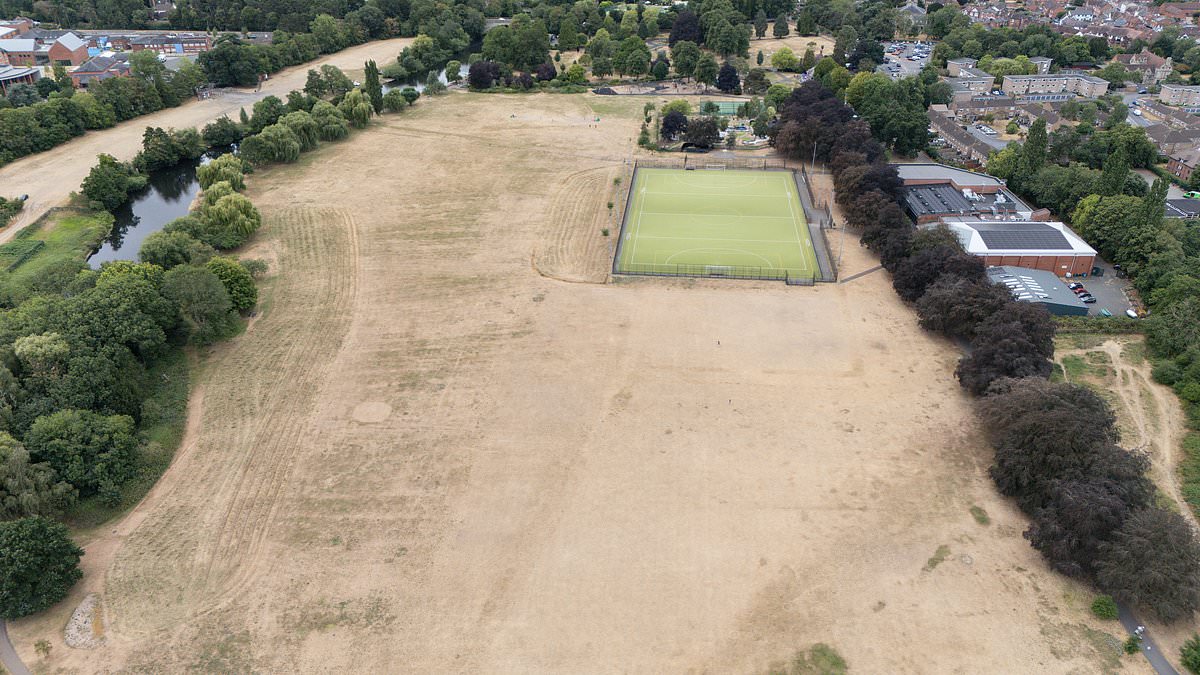
Britain has entered its fourth heatwave of the year, with temperatures predicted to soar up to 35C and fears of wildfires sparking in drought-hit regions.Amber health alerts have been issued to reflect the danger of the short, sharp burst of heat, alongside warnings for Brits to avoid sitting under trees, in case of falling branches.South-east England will see the most extreme temperatures, peaking on Wednesday when the mercury is expected to climb into the mid-30s.Amber health alerts kick in at 9am on Wednesday for the South East, East, and East Midlands, and are set to last for 24 hours.Eight water companies have enforced hosepipe bans to protect the supply, after usage has increased by up to 30 per cent on the hottest days this July.And officials will be looking over the English Channel to France, praying to avoid the devastating wildfires that are currently burning there.But fire chiefs have warned there is a risk of wildfires also sparking in parts of England and Wales in the coming week.A National Fire Chiefs Council (NFCC) spokesperson said: 'Fire and rescue services have already faced significant pressure this summer, responding to wildfire incidents during prolonged spells of warm and dry conditions. The grass around a crazy golf course at St Nicholas' Park in Warwick has been scorched brown by the sun A large playing field also lies severely dried out as the UK enters its fourth heatwave of the year'With the potential for further hot weather ahead, services remain prepared and ready to respond.'They called for Brits to be extra cautious with anything that could start a fire, including disposable barbecues and cigarettes.At the height of the third heatwave in mid-July, firefighters were battling 19 significant wildfires simultaneously in England and Wales. A major fire has burned for two weeks in the Cairngorms, with nine fire engines and 75 firefighters still at the scene near Nethy Bridge on Monday.Several places around the UK have officially declared drought conditions, while a number of water companies have brought in hosepipe bans.Six areas, five of which are in north Wales, have announced they are experiencing droughts - while another eight are at risk. Meanwhile, yellow health alerts will be activated in the South West, West Midlands, and Yorkshire and The Humber from 9am on Wednesday - also to last for 24 hours.But the forecast presents a split picture, with the northerly half of the country - including Northern Ireland, Scotland and northern England - escaping the extreme heat and any health alerts.Temperatures are expected to cool slightly from Friday, though the south will remain slightly warmer than the average for this time of year. Met Office Deputy Chief Forecaster Gregory Wolverson said of this week's weather: 'This is a short-lived spell of heat, but temperatures will climb quickly through the first half of the week, particularly in the southeast. A huge wildfire burns through the Cairngorms national park in northern Scotland The blaze in Scotland was declared a 'major incident' with more than 500 firefighters deployed to battle the flames'By Wednesday, some areas could see temperatures in the mid-30°Cs, and while the heat will not be widespread across the whole of the UK, it will be enough for parts of the southeast to likely meet official heatwave criteria by Thursday.'Elsewhere, the weather will be more changeable, and the change to cooler, more unsettled conditions will arrive sooner from the north and west, with a mix of sunshine and showers.'Across northern areas, it is possible there will be heavier showers with a small risk of isolated thunderstorms through the week.'If heatwave conditions are met, as forecasters expect, it will mark the fourth time this year.This month has been especially hot, with the Met Office recording a mean temperature so far of 17.5C - which is second only to July 2006, when it was 17.8C.The Met Office has also said UK heatwave thresholds will need to be adjusted to account for the consistently high temperatures caused by the warming climate, after records have been broken consistently this year.Met Office meteorologist Marco Petagna said that heatwave thresholds for some counties rose by a degree four or five years ago. French firefighters battle a wildfire spreading in Marcheprime, south-western France, July 26 2026 Smoke from a wildfire spreading on Cap Ferret peninsula is seen over a pine forest in Lege Cap-Ferret, south-western France, July 24 2026'Going forward they'll need to be adjusted to take into account… current climate, otherwise we're going to more frequently go into heatwaves. It's a moveable thing, really, as we go through a warming world,' he added.It comes as blazes have wrought destruction in mainland Europe this week, with 220,000 forced out of their homes in south-west France and 116,000 evacuated in Spain.In Bordeaux, an 'apocalyptic' fire has grown so large that it is generating its own thunderstorms, with 38C (100F) heat threatening to fan the flames of the terrifying blaze.In what represents one of the most devastating events in the country since the Second World War, more than 240 properties have been completely destroyed – many thought to be holiday homes owned by millionaire Parisiennes.The inferno, which started on July 12 in forests on Cap Ferret, has been steadily approaching Bordeaux ever since, because of the strong winds which have been fanning the flames westwards.And the return of searing temperatures this week threatens to complicate firefighting efforts. Emmanuel Macron said on a visit to the wine-making capital: 'The coming weeks will be tough and we have to hold out.'
Fourth heatwave hits sun-scorched Britain with temperatures of 35C expected amid amber heat health alerts and wildfire fears in drought-hit regions
Full Article
Original Source
Read the full article at Dailymail →KhanList aggregates and links to publicly available news content. We do not host full articles from third-party sources. Always verify important information with original sources.