
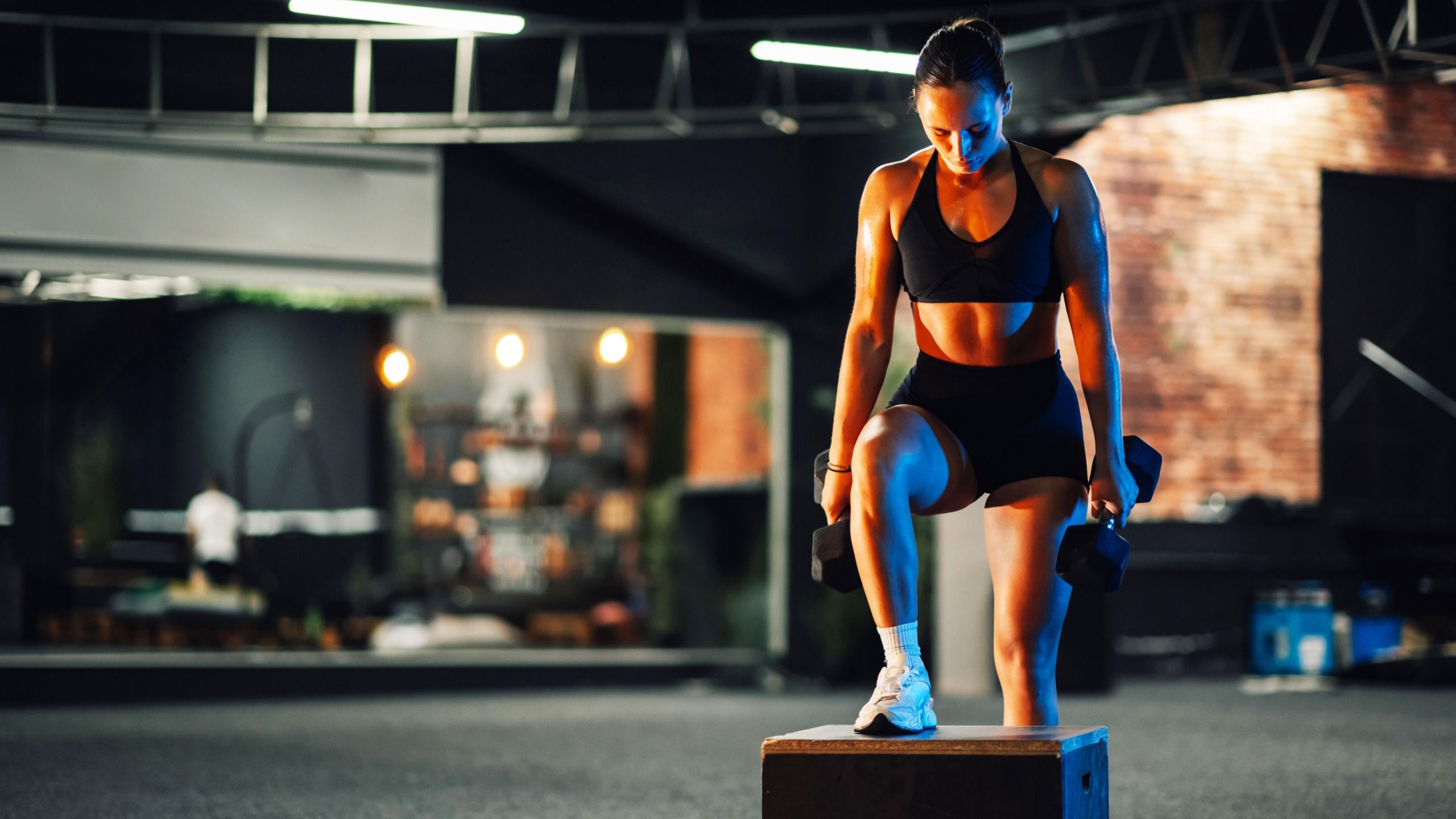
(Image credit: Shutterstock) A personal training client of mine recently asked why squats are a good exercise. It was an easy question to answer: they’re a functional movement that requires effort from multiple muscle groups at once, and doing them regularly can lead to stronger quads, glutes, hamstrings, and even abdominals.Squats are definitely one of my favorite exercises, but what they don’t do is train each of your legs separately from the other. That means your stronger leg will inherently do more of the work in a squat without you even realizing it. In order to address any strength deficits between your left and right legs, you’ll need to do exercises that train them independently.I include the following three exercises in my routine to ensure that both of my legs are getting stronger equally, and it’s led to heavier squats, faster runs, and better balance. If you have similar goals, or if you’re looking to add variety to your lower body workouts, pick up some dumbbells and give them a try.How to do the three exercisesBefore starting any new activity or exercise program, consult with your medical team. They may suggest alternatives or avoidance based on your history.Beginners should consider meeting with a certified personal trainer or physical therapist to learn how to do these exercises properly. Performing them with improper form can lead to injury. A trainer or therapist can provide modifications for exercises when necessary, and progression options when you’re ready to advance.You’ll need a set of moderately heavy dumbbells and a raised platform, like a stair or aerobic stepper. A good dumbbell weight will allow you to get through all reps in a set without needing to rest, but will leave you feeling fatigued. Adjust your dumbbell weight as needed, keeping in mind that you may need different weights for different exercises.Start by doing one set of 10 reps for each exercise. Do the step-ups and the lateral lunges unweighted at first. As you get stronger, increase your reps to 12, add an additional set, and pick up dumbbells for the step-ups and lateral lunges. Work your way up to 3 sets of 12 reps.Get instant access to breaking news, the hottest reviews, great deals and helpful tips.These exercises can be done as their own workout, or you can add them to your current lower body workout. Here’s how to do them:1. Step up to balanceStand in front of a raised platform, like a stair step or aerobic stepper.Engage your core muscles.Place your left foot on the step.Push into your left foot and come to a standing position on the step.Bring your right knee to a 90-degree angle in front of you.Pause briefly.Lower your right foot back down to the floor.Continue for 10-12 reps, then repeat on the other side.After you’ve built up strength, consider holding a dumbbell in one or both hands while performing this exercise.2. Lateral lunge to balanceStand tall with your feet hip-width apart.Engage your core muscles.Step your right foot to the right, keeping your toes pointed forward.Bend your right knee and lower your hips towards the ground, keeping your left leg straight.Push off your right foot and bring your right knee to a 90-degree angle in front of you.Pause briefly.Continue for 10-12 reps, then repeat on the other side.After you’ve built up strength, consider holding a dumbbell in one or both hands while performing this exercise.3. Single-leg Romanian deadlift Dumbbell Single Leg Romanian Deadlift - OPEX Exercise Library - YouTube Watch On Stand tall with your feet hip-width apart.Hold a dumbbell in each hand.Engage your core muscles.Bend your right knee slightly and bring your torso forward, lowering the dumbbells towards the floor and lifting your left leg behind you.Pause briefly.Return to a standing position.Continue for 10-12 reps, then repeat on the other side.Benefits of the three exercisesIt’s common for one side of our bodies to be stronger than the other (it’s usually, but not always, our dominant side). While strength deficits between our left and right sides are common, it can lead to muscle imbalances, pain and stiffness, and ultimately, injury.The three exercises in this workout strengthen your left leg and right leg independently. You may notice these exercises feel easier on one side and much harder on the other, which signifies a strength deficit. The more you do these exercises, the more your “weaker” side will catch up so that both legs have a sufficient amount of strength, stability, and power.These moves work the quads, hamstrings, hip abductors and adductors, and glutes. Additionally, the “balance” element of all exercises forces our deep core muscles to stabilize our bodies as we move. Follow Tom's Guide on Google News and add us as a preferred source to get our up-to-date news, analysis, and reviews in your feeds. Alternatively, you can read our content on the Tom's Guide app available now for iOS and Android. More from Tom's GuideI'm a personal trainer who works with clients over 50 — these are the 3 mobility exercises I never skipAfter 60, this is the 10-minute routine I use with my clients to stay strong, mobile and independent'I’m a Pilates instructor, and I recommend these 5 core exercises to help older clients build strength and improve posture' Jennifer Rizzuto is a freelance writer and certified personal trainer based in Long Island, NY. She covers various fitness-related topics and reviews for Tom's Guide. She also writes sketch comedy and short films, and performs frequently as an actor, singer, and improviser. When she's not writing, working out, or performing, you'll find her trying to convince her husband to get a dog.
Forget squats — these 3 exercises improve single-leg strength, stability, and power
Full Article
Original Source
Read the full article at Tomsguide →KhanList aggregates and links to publicly available news content. We do not host full articles from third-party sources. Always verify important information with original sources.