
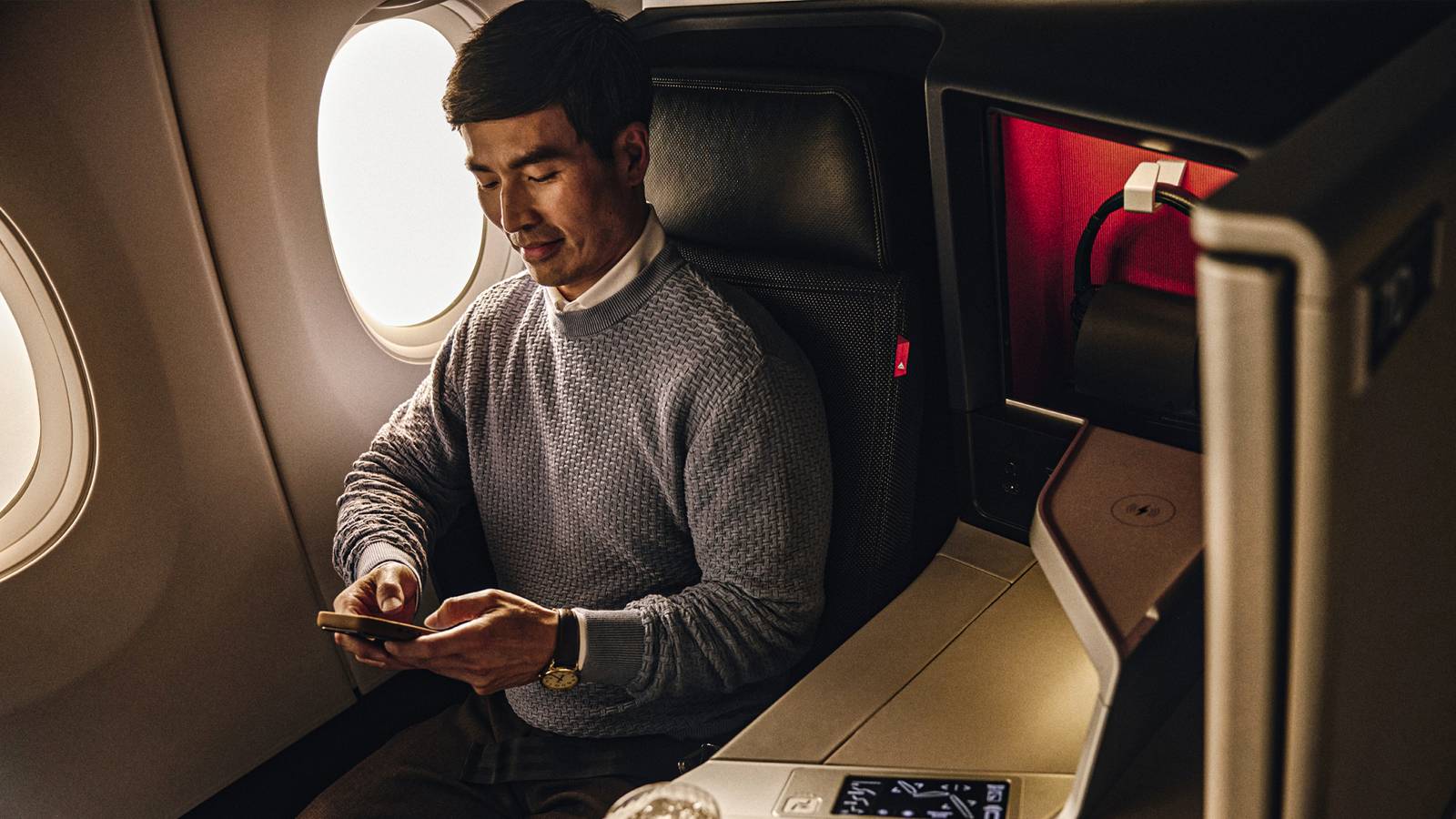
Published Oct 25, 2026, 6:00 AM EDT Jack comes to Simple Flying with a lifelong interest in all things aviation. He holds a degree in Aerospace Engineering from Georgia Tech, and is a certified private and remote pilot. Beyond these experiences, Jack previously worked for a corporate flight department where he gained first-hand experience in the world of business aviation. Currently, Jack works in the professional services industry and continues to build his flight hours outside of work. Delta Air Lines is presenting its latest Delta One redesign as its most comprehensive premium-cabin overhaul in nearly 30 years, but one headline feature leaves room for a rival to claim an advantage. Delta’s next-generation suite on the Airbus A350-1000 will have a 24-inch (60.96 cm) 4K QLED seatback display, the largest in the airline's history. Delta's rival, United Airlines, now offers Polaris Studio suites, introduced on its redesigned Boeing 787-9 Dreamliner, featuring a 27-inch (68.58 cm) 4K OLED display. United’s screen is three inches larger diagonally. Announced on October 14, Delta’s redesign focuses on dining, hospitality, and rest, including a longer meal preselection window, a sleep-first breakfast option, refreshed amenities, and new beverage partnerships. Service changes will begin on select flights departing Los Angeles International Airport (LAX) this fall before expanding across the global network. Delta is also preparing a new suite for A350-1000 aircraft and retrofits for Airbus A330-200 and Airbus A330-300 jets. The rollout combines immediate service changes with a longer hardware transition. A Broad Service Redesign, Not Just A New Suite Credit: Delta Air Lines Delta calls the project its largest and most holistic Delta One redesign in nearly three decades, building on more than $1 billion invested in its fleet. The goal is a more consistent journey from airport to aircraft. The culinary program was developed with chef Simon Hulstone and Master Sommelier Andrea Robinson. It emphasizes familiar dishes with upgraded ingredients, including a Wagyu beef burger and regionally inspired sea bass, alongside refreshed desserts and tableware. Delta says the program reflects customer feedback and aims to improve consistency as well as presentation. The airline produces around eight million Delta One meals annually through international kitchens, making execution across routes a significant operational undertaking. Hospitality changes include a “sip and settle” moment with a preferred beverage, warm nuts, and a hot towel before the meal. Fresh-cracked pepper and sauces served separately give passengers more control over how dishes are finished. Their success depends on consistent delivery by crews and catering teams. The program will first appear on transoceanic Delta One routes departing LAX in fall 2026, with broader expansion planned for early 2027. This is a staged rollout, not a single fleetwide launch. Travelers booking during the transition should check the aircraft and service details for their flight rather than assume every advertised element is already available. The 24-Inch Display Is A Major Upgrade, But Not The Biggest Credit: United Airlines Delta’s upcoming A350-1000 suite will feature a 24-inch 4K QLED screen, Bluetooth headphone connectivity, wireless charging, and additional storage. The suite is also designed around a longer lie-flat bed and privacy doors. These changes should improve entertainment and usability on long-haul journeys. United’s Polaris Studio moves the screen benchmark to 27 inches, with a 4K OLED panel. The suites debuted on United’s elevated interior Boeing 787-9 with privacy doors, wireless charging, Bluetooth connectivity, upgraded bedding, and a companion ottoman in six of the eight Studio suites. United describes the display as the largest among US airlines. United’s screen is three inches larger diagonally, although QLED and OLED differ, and size alone does not determine viewing quality. OLED panels can produce individually lit pixels and deep blacks, while QLED displays use a quantum-dot layer with LED backlighting; actual performance also depends on implementation. The comparison applies to specific next-generation products, not every seat on either airline. Polaris Studio is a premium subset of United’s Polaris cabin, while Delta’s new suite is tied to incoming A350-1000s and planned A330 refurbishments. Existing aircraft can have different seats and entertainment hardware. Viewing angle, glare, responsiveness, content, and comfort also affect the experience. United wins the numerical comparison; Delta’s overall proposition depends on the complete suite and the consistency of its delivery. Meal Preselection And Sleep-First Service Target Practical Needs Credit: The Global Guy | Shutterstock Delta is extending entrée preselection to 18 hours before departure, six hours closer to departure than its previous window. It says this is the latest pre-order cutoff offered by any US carrier. The later cutoff may help travelers with changing plans and improve catering forecasts. The sleep-first option lets passengers skip a full pre-arrival breakfast and receive coffee and a croissant instead. On overnight flights, a conventional meal can interrupt rest even when the food is well-prepared. A lighter alternative recognizes that not every passenger values the same number of courses, particularly before landing. Emirates also offers advance meal selection. Eligible Business Class passengers can pre-order main courses as early as 14 days before departure and up to 24 hours before the flight, although the option is limited to selected routes. Its longer window lets passengers secure a preferred dish earlier, while Delta’s new selling point is its later cutoff. These systems are not identical, and route eligibility matters. Premium Drinks And Amenities Add Distinction, But Execution Matters Credit: Delta Air Lines Delta is refreshing its beverage lineup with a wine program curated by Andrea Robinson. The airline says it has selected 13 wines from 11 wineries for the October 2026 to September 2027 period, moving from four annual rotations to two. Fewer rotations may help crews deliver more consistent service while retaining variety. The lineup also introduces Dassai 45 sake on selected routes to and from Tokyo-Haneda (HND), plus cocktails and mocktails including Hugo Spritz and Paloma variations. Blanton’s Single Barrel Bourbon is scheduled to join the offering on December 1, 2026. Delta says it will be the first and only airline to serve the label, using the partnership to give the cabin a recognizable premium identity. Availability can still depend on route, provisioning, and rollout timing. Amenities are changing too. Delta’s Missoni “Winter Elsewhere” kit is scheduled to launch November 3, with skincare and dental products, alongside a Missoni Mini pillow for transoceanic flights. The pillow is intended to complement the mattress pad, slippers, and eye mask. Delta is also expanding its Porsche tarmac-transfer partnership from 40 to 70 hybrid vehicles across 15 airports by 2028, extending the premium experience beyond the aircraft for eligible customers. These extras add value only when they reinforce reliable hospitality. Delta’s challenge is making the new touches feel natural across a large international operation. Fleet Rollout Will Determine How Quickly Customers See The Difference Credit: Kevin Hackert | Shutterstock The hardware changes will arrive more gradually than the revised service program. Delta expects its first A350-1000 aircraft in early 2027, featuring the next-generation Delta One suite. It also plans to add privacy-door suites to A330-200 and A330-300 aircraft during broader cabin refreshes. Delta says updated interiors will extend to more than 800 aircraft over five years, although that wider program includes changes across cabins and does not mean every aircraft will receive the same business-class seat. United has a separate path for Polaris Studio. Its first aircraft with the Elevated interior is the 787-9, and the airline said it planned to have at least 30 such aircraft operating worldwide by the end of 2027. The eight Studio seats sit within a larger premium cabin; they do not replace all standard Polaris seats. Availability therefore matters when travelers compare routes or choose flights based on the seat. Aircraft substitutions remain possible, so travelers should check the seat map and aircraft type close to departure. Even within the same airline, nearby departures can offer different hardware. This transition creates a competitive timing issue. Delta’s service improvements can reach passengers before its newest screens and suites become widespread. That sequencing may help the airline demonstrate near-term progress while waiting for aircraft deliveries and retrofit capacity to catch up. United’s screen advantage is clear on Polaris Studio-equipped aircraft, but customers must be on a flight offering that product. For both airlines, fleet scale and delivery pace will determine whether the premium promise becomes routine or remains something travelers need to plan around. The Next Battle Will Be About Delivering Premium At Scale Credit: iledIMAGE | Shutterstock As Delta and United expand their next-generation business-class products, the competitive challenge will shift from unveiling impressive features to delivering them consistently across a growing share of departures. Delta’s service redesign gives it a way to improve the passenger experience before its newest suites become widespread, while United’s larger Polaris Studio display establishes a measurable hardware advantage that rivals may eventually feel pressure to match. Neither advantage guarantees lasting differentiation. Once larger screens, privacy doors, and wireless charging become standard expectations, airlines will need to compete through reliability, personalization, and the quality of the entire journey. The next phase will also test how much premium travelers value individual features when choosing flights. A larger display may influence passengers who spend long hours watching entertainment, but dependable sleep, preferred meals, and a well-managed arrival can carry greater weight on overnight routes. Delta’s opportunity is to make its service investments meaningful across more aircraft, rather than concentrating the strongest experience on a limited number of new suites. United faces a parallel challenge as it scales Polaris Studio beyond its initial aircraft. Ultimately, the stronger product may be the one passengers can identify with confidence when booking, not simply the one with the most impressive specifications on paper.
Delta One's 'Biggest Overhaul In 30 Years' Still Has A Smaller Screen Than United's Polaris Studio
Full Article
Original Source
Read the full article at Simpleflying →KhanList aggregates and links to publicly available news content. We do not host full articles from third-party sources. Always verify important information with original sources.