
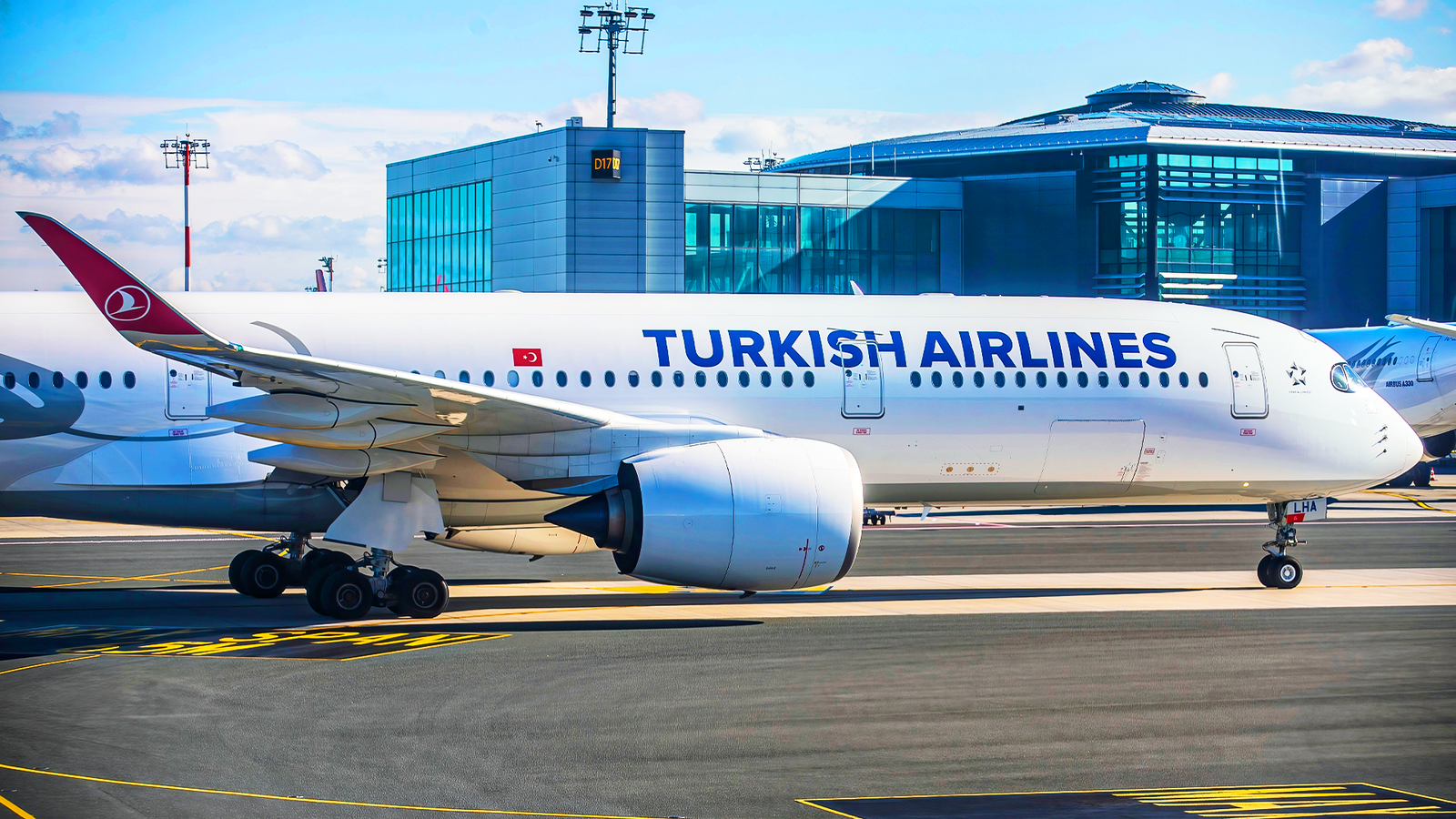
Published Oct 25, 2026, 11:00 AM EDT Brandon's passion for aviation started at a young age. He became involved in the flight simulator and VATSIM communities, which sparked his interest in aviation and eventually led him to earn his private pilot license. Outside of work, he continues to build flight hours, explore new airports, and stay involved in the aviation community. Every Airbus A350 ever built flies with the same engine. Over more than a decade of production and with more than 60 airline customers, no operator has had a choice. Simple Flying noted the contrast directly: while other widebody aircraft such as the Boeing 777 and 787 Dreamliner offer customers a choice between General Electric and Rolls-Royce engines, the A350 family has never had an alternative. Delta Air Lines' SEC filing describes the single engine choice as a departure from previous Airbus aircraft. That outcome was not Airbus' preference. General Electric (GE) was prepared to supply an engine for the A350-900 and refused to build one for the stretched A350-1000, because the larger aircraft competes directly against the GE-powered Boeing 777. With GE unwilling to cover the full family, Rolls-Royce became the only manufacturer willing to develop an engine specifically for the aircraft. What began as a default decision has since been locked in by contract through 2030. Why Did GE Walk Away From The A350? Credit: Tada Images | Shutterstock, Simple Flying General Electric was willing to power part of the A350 family. When Airbus launched the program, GE offered a derivative of its GEnx engine family, already selected for the Boeing 787, for the A350-900. But it would not build the higher-thrust engine the stretched A350-1000 required. That refusal, rather than any technical shortcoming, left Airbus with a single supplier for the entire family. The reason sits on the other side of the Atlantic. GE is the sole engine supplier for the Boeing 777-200LR and 777-300ER through the GE90, and the A350-1000 was designed to compete directly against those aircraft. Developing a 97,000 lb thrust engine for Airbus would have given airlines a GE-powered alternative to the GE-powered 777, cannibalizing a franchise GE already owned outright. The manufacturer has also cited insufficient overlap with its existing GE90 and GEnx programs as justification for staying out of the competition. The commercial arithmetic made the decision straightforward. Developing a clean-sheet large turbofan costs billions, and GE would have spent that money competing for a share of an Airbus program where Rolls-Royce already held the incumbent position on the -900. The investment would have won GE a slice of one aircraft family while risking the engine monopoly it held on another. GE has since suggested it could build a product that outperforms the Trent XWB, but it will not, because such an engine would compete with its own GE90-115B-powered 777 variants. With GE unwilling to commit to the full family, Airbus was left with one manufacturer prepared to build an engine specifically for the aircraft. What Did Rolls-Royce Build Instead? Credit: fifg | Shutterstock Rolls-Royce did not adapt something it already had. Delta's SEC filing states the position plainly: the A350-900 is offered with a single engine choice, a departure from previous Airbus aircraft, and the Trent XWB was designed for the A350, powering both the -900 and -1000 variants at 84,000 lb and 97,000 lb of thrust. That distinguishes it from the GEnx derivative GE had put forward, which would have been an existing engine modified for a new airframe rather than a design built around one. The two thrust ratings are not a single engine with a software change. The Trent XWB-97 was a re-engineered evolution with a larger core, new intermediate-pressure compressor stages, and improved cooling systems to manage higher thermal loads. Rolls-Royce effectively developed a second engine within the same family to cover the A350-1000, which is precisely the work GE declined to undertake, and the cost of doing so only made sense for a manufacturer capturing the whole program. Over time, the commercial logic hardened around that investment. Airbus and Rolls-Royce concluded that continuously improving the Trent XWB platform made far more sense than reopening the airframe to competing engines. Rather than pursuing new engines, the two companies chose to evolve the existing one, which is why the current fleet flies on EP variants of the same design rather than anything structurally new. That decision raises the question of how long the arrangement is formally guaranteed. How Long Does The Exclusivity Actually Run? Rolls-Royce held exclusivity on the A350-1000 from the start. The A350-900 was the only variant where competition remained theoretically possible, and Rolls-Royce settled that question on March 11, 2021. During its FY2020 results presentation, Rolls-Royce announced that Airbus had extended the A350-900 agreement by five years, taking the Trent XWB-84 to 2030 as the sole powerplant on the variant that accounts for the bulk of the fleet. The previous agreement was due to expire in 2025, keeping the possibility of a rival engine alive through the middle of the decade. Then-chief executive Warren East framed the extension around what comes next: “We’re already exclusive on the A350-1000, and extending our position on the A350-900 variant, which accounts for the bulk of the A350 fleet, out to 2030 is in line with the development timeline for our next-generation UltraFan engine program.” East added that Rolls-Royce was delighted to end years of speculation about a rival engine for the remainder of the decade. By the time the agreement expires, he noted, engine technology will have moved to a new stage. Five years on, Rolls-Royce’s priorities have shifted. A Rolls-Royce spokesperson told Simple Flying that the company now focuses on investing in the modern Trent engine series, so customers benefit from increased durability, reliability, and availability. The spokesperson pointed to a changed market and a business transformed under new leadership, along with longer timelines for airframers to bring new designs to market because of geopolitics, supply chain pressures, and certification. The agreement arrived at a useful moment. It came as Rolls-Royce disclosed a record $5.6 billion loss for 2020, and locking in a decade of guaranteed production on its most important widebody program gave the company a revenue floor at its most exposed point. Who Benefits From One Engine Option? Credit: Spech | Shutterstock The partnership pays Rolls-Royce for predictability. More than 2,600 Trent XWB engines are in service or on order across over 60 airline customers, and every A350 built through 2030 adds to that figure with no competitive bid attached. Guaranteed volume on that scale justifies continuous investment that a contested program cannot support, because the manufacturer captures the full return on every efficiency gain rather than splitting it with a rival bidding for the same aircraft. By 2021, the fleet had already accumulated more than seven million flight hours, six years after entry into service. Airlines get something narrower but real. The exclusivity simplifies logistics, maintenance, and customer support. An A350 operator maintains one engine type across its fleet rather than managing the duplicate inventories and training programs a mixed-engine 777 or 787 fleet requires. LATAM's SEC filings show how the relationship works in practice: a general terms agreement covers engines for 27 A350 family aircraft and up to seven spare engines, plus a rate-per-flight-hour shop maintenance agreement with Rolls-Royce TotalCare Services. The arrangement also closed off the market. Rolls-Royce is now the sole supplier of widebody engines for in-production Airbus widebodies, and GE Aerospace is expected to become Boeing's sole supplier as the Trent 1000 goes out of production around 2030. Two manufacturers, two airframers, no overlap, with no realistic opening for a third party on either side. The question that remains is what happens when the agreement expires. What Happens After 2030? The exclusivity agreement runs to 2030, and the A350 could technically be dual-sourced from 2031. Whether that happens depends on whether another manufacturer wants the work. The original reason GE declined has not changed. The A350-1000 still competes against the 777, and GE has said it will not build an engine that would undercut its own 777 programs. Rolls-Royce’s attention is on the engine it already has. The 2021 extension was tied to the UltraFan timeline, but UltraFan remains a technology demonstrator rather than a production engine, and Rolls-Royce has not named it a candidate for any airframe. The company’s stated priority is now making its existing engines perform better and last longer. The Trent XWB-84 EP reflects that approach. It has received EASA certification and delivers improved fuel efficiency and durability through refined turbine materials, higher core temperatures, and advanced digital health monitoring. Airbus could open the A350 to competition in 2031, but after two decades of co-development and a decade of guaranteed volume, it is not clear that anyone would step forward.
Why No Engine Other Than One Can Power Airbus' Most Fuel-Efficient Widebody
Full Article
Original Source
Read the full article at Simpleflying →KhanList aggregates and links to publicly available news content. We do not host full articles from third-party sources. Always verify important information with original sources.