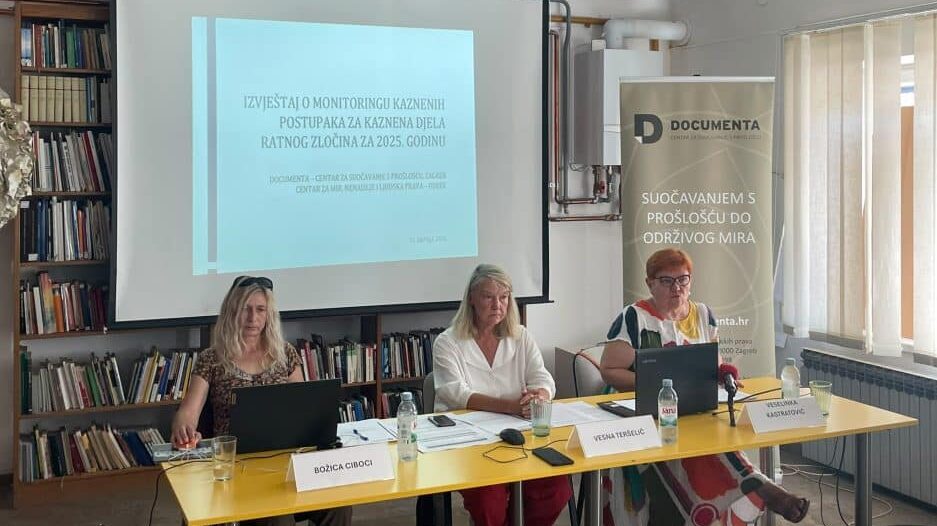
Bozica Ciboci, Vesna Terselic and Veselinka Kastratovic. Photo: Documenta Since Croatia joined the European Union, the effectiveness of its war-crimes prosecutions has stagnated while crimes committed against Serbian civilians and prisoners-of-war are almost never investigated, a report presented on Friday by Documenta – the Centre for Dealing with the Past, says. “The number of proceedings is declining. We have recorded 33 criminal proceedings in the trial phase before county courts, involving a total of 91 defendants,” Documenta head Vesna Terselic said, presenting the 2025 Report on Monitoring Criminal Proceedings for War Crimes. By comparison, there were 54 criminal proceedings in 2024, 64 the year before, and 61 in 2022. Of the 91 defendants in war-crimes proceedings in 2025, 87 were members of Serbian paramilitary and police forces. The remaining defendants included three former members of the Croatian Army and one member of the Croatian Defence Council, HVO. Terselic said many dedicated professionals work in the State Attorney’s Office, the police, the courts and the Ministry of Croatian Veterans, but that county state attorneys’ offices lack the capacity to investigate unresolved war-crimes cases. “Recently, a final verdict brought to an end one of the longest war crimes trials, in which Branimir Glavas was convicted. That trial would not have happened if witness Krunoslav Fehir had not spoken out. It would not have happened if Vladimir Faber had not investigated the case while serving in the police. It was an extremely difficult crime to investigate, and many institutions failed to support the investigation,” Terselic recalled. She said recent legislative amendments had improved the position of civilian victims of the 1990s Homeland War, but that changes to the law on the rights of victims of sexual violence during the armed aggression against Croatia were still needed. “Unfortunately, today, there is not a single active trial for crimes committed during Operations Storm and Operation Flash. No one disputes the right of the Croatian Army and police to liberate occupied parts of Croatia and re-establish state authority there, but no one gave them the right to follow that with criminal acts,” said Veselinka Kastratovic, legal adviser at the Centre for Peace, Nonviolence and Human Rights Osijek. “We cannot say it did not happen. We all know in Croatia that it happened; some people simply choose to look away,” she added. Documenta’s report also criticises public statements by some high state officials, saying they reflect “one-sided and simplified interpretations of recent history”. More positively, the report highlighted the commemoration of the killings in Varivode, where then-President Ivo Josipovic and Prime Minister Andrej Plenkovic delivered messages of remembrance. In Varivode, Croatian soldiers killed nine elderly Serb civilians after Operation Storm, a key Croatian Army operation in 1995, which overwhelmed a self-proclaimed Serbian statelet on Croatian territory. Bozica Ciboci of Documenta called on countries across the region to “sign agreements aimed at improving the prosecution of war-crimes perpetrators and preventing the politicisation of war crimes trials.”
Croatia’s War Crimes Prosecutions are Stagnating, Watchdog Warns
Full Article
Original Source
Read the full article at Balkaninsight →KhanList aggregates and links to publicly available news content. We do not host full articles from third-party sources. Always verify important information with original sources.