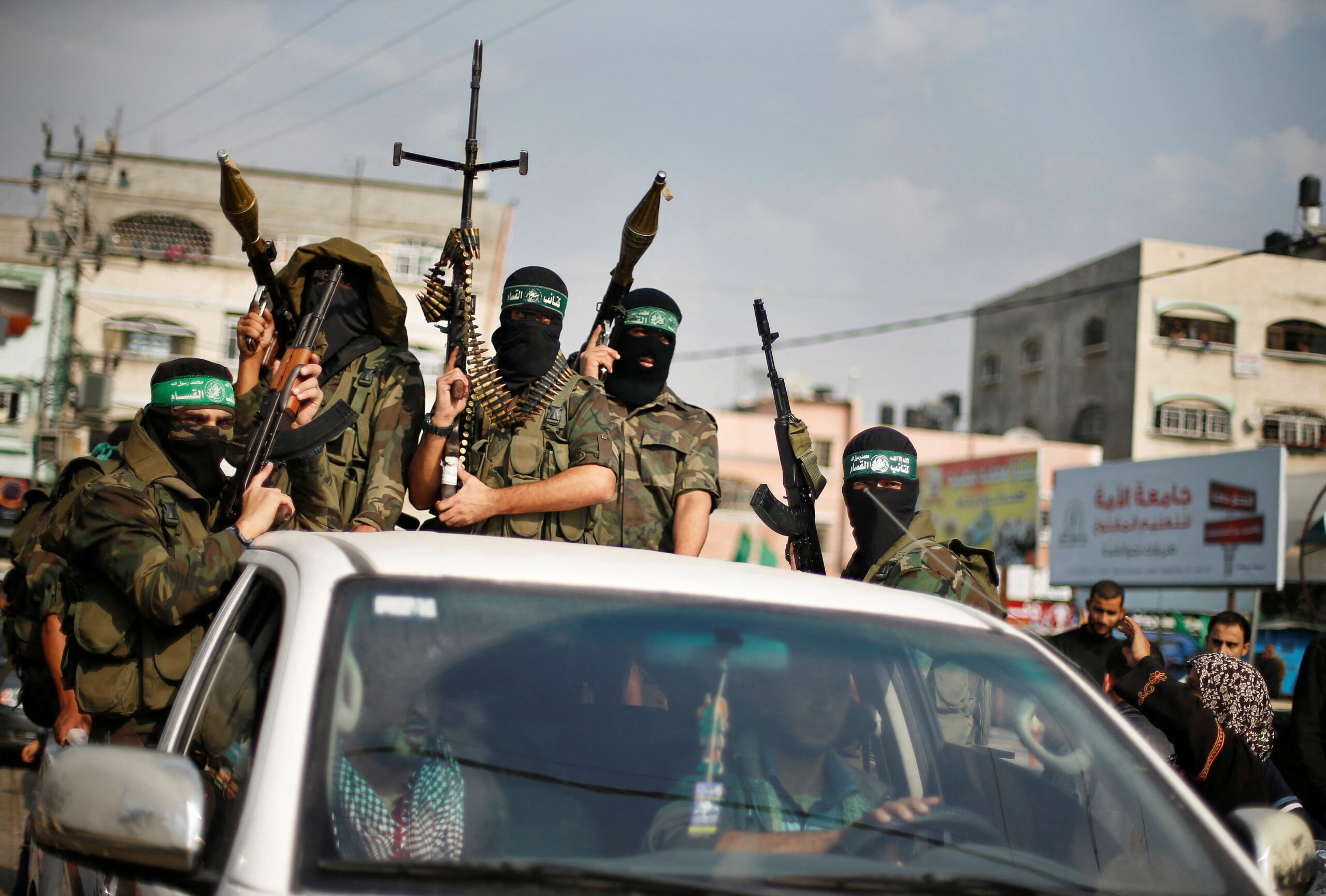
Is it a new day for Gaza? The US-led Board of Peace has announced an agreement that could lead to the disarmament of Hamas and the withdrawal of Israeli forces from Gaza, nearly three years after Hamas’s October 7 terrorist attack on Israel set off a conflict that shook the region and the world. Hamas officials have confirmed their acceptance of the deal, but Israeli Prime Minister Benjamin Netanyahu has yet to weigh in. The details are intricate, and the road ahead complicated. We turned to our experts to answer our burning questions about the agreement and its broader consequences. Click to jump to a question 1. What exactly did Hamas just agree to? 2. Why is this coming together now? 3. What will it take to implement the deal? 4. What does this mean for Trump’s larger twenty-point plan for Gaza? 5. What does this mean for Hamas’s control over Gaza? 6. What does this mean for Gazans? 7. What does this mean for Israel? 8. How are Gulf countries likely to react? 9. How does this fit into wider dynamics in the Middle East? 10. How does the Trump administration view this effort? 1. What exactly did Hamas just agree to? Less than twenty-four hours after formal announcements by US President Donald Trump on Truth Social and High Representative for Gaza Nickolay Mladenov on X, what exactly Hamas is agreeing to still remains a question mark. The biggest question is whether the deal commits Hamas to giving up not just heavy weapons—rockets, for example—but light and personal weapons as well, such as AK-47s and handguns. Another question is how the disarmament process would take place. Clause 6 of Trump’s original twenty-point plan implies that light weapons must be decommissioned, as well. But a Hamas official has said that the agreement requires Israel to halt all military conduct, the deployment of an international force, and “self-determination, establishing an independent Palestinian state.” A cynical read would be that Hamas knows that Israeli officials—especially three months before a national election—are unlikely to agree to a deal, which provides an opportunity for the group to shift the blame for the current impasse over Trump’s twenty-point plan back on to Jerusalem. But two things can be true at once. And such a read also risks underestimating the amount of pressure that Hamas—and its newly formalized leader, Khalil al-Hayya—are currently under by regional mediators, Qatar and Egypt especially. Moreover, Hamas doesn’t know how the Iran war will turn out, or whether it will still have a patron in Tehran willing and able to supply the group with money and capabilities. At the same time, Israel withdrawing to the so-called “Yellow Line” as an initial step in the deal—something Israeli officials have already said they would not do—is only one in the incredibly complex series of reciprocal steps and sequencing challenges the mediators will have to implement. Lost in the conversation over weapons is that the agreement is also slated to ensure the National Committee for the Administration in Gaza (NCAG) is able to come in and assume civilian control of the strip. This would necessarily include the Hamas-dominated police force handing its weapons over to the NCAG, a step that would further demilitarize the group and begin to allow the people of Gaza to escape from the group’s brutality and domination. Ultimately, the ambiguity in what is and is not included might help square the circle to allow for an agreement to be announced. But as the recent US memorandum of understanding with Iran demonstrated, if the parties are not in agreement as to what’s being committed to, no public pronouncement, no matter how strong and hopeful, will be enough to change circumstances on the ground. —Jonathan Panikoff is the director of the Scowcroft Middle East Security Initiative and a former deputy national intelligence officer for the Near East at the US National Intelligence Council. 2. Why is this coming together now? Trump’s announcement of an agreement for the disarmament of Hamas and other armed groups in Gaza provides an important foreign policy win for him and his administration at a time when the US remains bogged down in its conflict with Iran, a war that is unpopular with the American people and has contributed to the president’s low approval ratings. The announcement also serves as a rebuke to critics who have said the president’s focus on Iran has left the plan for peace in Gaza to languish without significant progress since the ceasefire and twenty-point roadmap for Gaza’s future were agreed to this past fall. Trump probably hopes that shining a spotlight on Gaza with an agreement that could pave the way for Israeli withdrawal and eventual rebuilding of the enclave will provide a needed boost to his popularity and his claim that he is the dealmaker who can bring an end to a major source of conflict, a more secure future for Israel, and a brighter future for Palestinians in Gaza. Hamas’s apparent agreement to the disarmament plan is probably the result of intense pressure from Egypt, Turkey, and Qatar, who have played a critical role in brokering the negotiations over the deal, and perhaps promises of political and financial support from the latter two countries if Hamas leaders eventually depart Gaza. Hamas leaders also may have concluded that agreeing to a disarmament plan linked to Israeli withdrawal from Gaza could help reverse the group’s declining political fortunes. The group is losing financial support from Iran, which is financially strapped because of the US naval blockade and sanctions; Israel continues to occupy more Gazan territory in response to ongoing Hamas militancy; and Palestinians in Gaza are blaming Hamas as well as Israel for their suffering. Whether Hamas remains seriously committed to full disarmament remains an open question, however. For its part, Israel has not yet publicly signed onto the deal but will be under enormous pressure from Trump to go along or risk his ire by sabotaging what he is touting as a historic success. Israel has little to lose by okaying the plan, even while it is likely to attach conditions, given that it is a phased agreement that could take as much as a year to complete, with many opportunities for Jerusalem to claim Hamas is not upholding its end. Indeed, Israeli Prime Minister Benjamin Netanyahu will face conflicting pressure from his far-right coalition partners—pressure that will intensify as Israeli elections draw closer—to take a hard line toward the agreement’s implementation and be ready to walk away at the slightest sign that Hamas is exploiting the deal to maintain a military and political presence in Gaza. This latest agreement has the potential to mark a turning point in the Israeli-Palestinian conflict. But it could easily become another in the long list of “end of conflict” deals over the past several decades that have raised hopes, only to see them dashed by the lack of trust and divergent interests of the two sides. —Alan Pino is a nonresident senior fellow with the Scowcroft Middle East Security Initiative. He previously served for thirty-seven years at the Central Intelligence Agency, covering the Middle East and counterterrorism. 3. What will it take to implement the deal? The announced agreement is notable and positive in that it begins to address core governance issues in Gaza. As we’ve seen so often in the past—and continue to see in Lebanon—announcements are easy, and implementation is anything but. This agreement essentially requires several things to happen simultaneously. Key among them is Hamas turning in its weapons and relinquishing military control of the strip in return for Israel ceasing its attacks on and withdrawing from Gaza. Trust between the two parties here is nonexistent, and neither will be expecting the other to follow through—and with good reason. External actors will therefore be indispensable in the success of this proposal. Egypt and Qatar will have to continue to lean heavily on Hamas to fulfill its commitments, even as Iran is almost assuredly whispering in the terror organization’s ear to play for time. On the other side of the equation, Israeli resistance to ending operations in Gaza—let alone fully withdrawing—prior to full disarmament is almost assured. Trump will need to place tremendous pressure on Netanyahu to provide space for the proposal’s success, especially as Netanyahu gears up for October elections and faces certain resistance from the far right. And eventual reconstruction support by the Gulf states remains critical but in question, as their economies have been severely hit by the ongoing Iran war. Finally, the agreement envisions a significant role for the United Nations–authorized International Stabilization Force (ISF) in securing surrendered weapons and preventing a security vacuum. To date, however, the ISF is little more than a paper exercise, with only some two hundred multinational soldiers. Its deployment has been conditioned on the aforementioned steps of a durable ceasefire, disarmament, and phased Israeli withdrawals. This sequencing challenge will be as difficult to overcome as the political resistance, and it will require confidence-building steps by all parties to keep things moving. With good faith in short supply as Gaza’s citizens continuing to endure horrific humanitarian conditions, this only succeeds through the sustained and relentless pressure of the United States and its partners. —Jennifer Gavito is a nonresident senior fellow with the Scowcroft Middle East Security Initiative. She previously served as deputy assistant secretary of state for Iraq and Iran. 4. What does this mean for Trump’s larger twenty-point plan for Gaza? The disarmament deal announced by Trump is several steps forward for his twenty-point plan, but it’s not the finish line. What was announced is far from perfect, but the highly respected high representative for Gaza and his team, along with the mediators from Egypt, Turkey, and Qatar, deserve enormous credit for having gotten this far. The disarmament deal is a series of interlocking commitments, just like the twenty-point plan, and there are obvious ways it could break down. Israel was consulted during the negotiation of the agreement, but it will likely object to certain provisions and the absence of a stipulation that Hamas give up its tens of thousands of AK-47s and similar weapons. Both Hamas and Israel will have numerous opportunities to slow-roll implementation, with the first test coming in about fourteen days, when the high representative and his team are to present an implementation timetable for the parties to accept. The mediators who talked to Hamas may have given them an understanding of the text that is different from the US understanding. There is the cautionary example of what went wrong with the US-Iran Memorandum of Understanding, where the parties had radically different and incompatible interpretations what the single text said about control of the Strait of Hormuz. US President Donald Trump attends the inaugural Board of Peace meeting in Washington, DC, on February 19, 2026. (REUTERS/Kevin Lamarque) But the agreement at least gives the Board of Peace, the Office of the High Representative, and the National Committee for the Administration of Gaza something to work with. There needs to be pressure on all sides—not just Hamas and Israel, but also on the United States, the mediators, Europeans, and others—to make sure that the Trump twenty-point plan can be made to work. The next priority needs to be getting the five thousand troops needed for the ISF and the hundreds of staff needed for the Office of the High Representative to make this plan work. Everyone needs to hold everyone else’s feet to the fire. —Thomas S. Warrick is a nonresident senior fellow in the Scowcroft Middle East Security Initiative and a former deputy assistant secretary for counterterrorism policy in the US Department of Homeland Security. 5. What does this mean for Hamas’s control over Gaza? Any deployment of international stabilization forces or newly trained Palestinian police under the National Committee for the Administration of Gaza umbrella remains many months away due to logistics, financing, and training hurdles. Until then, Hamas will continue exercising full control over Gaza’s population and will have ample time to craft contingency plans to preserve relevance and influence. And just as there is no olive oil without olives, there is no Hamas without weapons and armed resistance. Some members may genuinely want to evolve and enter a political process, and they may. However, they are unlikely to do so sustainably and successfully while still operating under the Hamas banner and identity. Ultimately, the men with guns inside Gaza, not political figures abroad, hold real authority. Hamas is under severe pressure, which may explain why this announcement resembles its claim from a month ago to have “dissolved” its governance apparatus in the strip, even as it maintained full control on the ground. The group’s incoming leader, Khalil al‑Hayya, underscored this reality last week with a fiery speech doubling down on the pursuit of “victory,” liberation, armed resistance, alignment with Iran, and the Islamist Jihadi ethos central to the organization’s identity and political agenda. Without a willingness to accompany disarmament with a narrative, political, and programmatic shift similar to what the Palestine Liberation Organization did in the early 1990s, Hamas’s disarmament in Gaza on its own amounts to little more than a long‑term ceasefire or a “Hudna.” The group has long floated “Hudnas” as a way to coexist beside Israel without recognizing the Jewish state, relinquishing the armed resistance that is central to its identity and ethos, or abandoning force and violence as tools of political strategy. —Ahmed Fouad Alkhatib, who grew up in Gaza City, leads Realign For Palestine, an Atlantic Council project that challenges entrenched narratives in the Israel and Palestine discourse and develops a new policy framework for rejuvenated pro-Palestine advocacy. 6. What does this mean for Gazans? Another announcement from Trump of a historic agreement for peace is likely to fall flat for exhausted and despairing Gazans. This is because they have suffered three years of an Israeli bombardment that has killed over seventy thousand men, women, and children and left tens of thousands more injured and homeless; a bombardment that has destroyed the basic elements needed for daily life, including housing, hospitals, schools, mosques, churches, businesses, and more. This past fall, the president announced a historic peace plan that came with a “ceasefire” that has now lasted nearly a year. During this break in hostilities, five Israeli soldiers were killed early on, but armed Hamas fighters have been useless in the face of continued Israeli strikes and gunfire that have killed over one thousand Palestinians—women and children included—and wounded many others. It’s clear an armed Hamas serves no purpose for Gazans. Hamas cannot defend Palestinians in Gaza. It cannot stop Israel from taking over land and displacing Palestinians. (Israel has increased its control of Palestinian land from about 50 percent a year ago to 70 percent at the prime minister’s instruction in May 2026.) Nor can Hamas’s weapons increase aid, open border crossings, provide healthcare, clear rubble, or bring supplies to rebuild schools, hospitals, and homes. Gazans may hope that Hamas turning over weapons to a Palestinian governing body will stop the daily killing of Palestinians, not only by Israel, but by Hamas and other militias as well. However, Gazans know Netanyahu well. And they know it will take sustained attention and pressure from the United States and others to get and keep the Israeli leader in check. Netanyahu is a leader who famously defies US presidents and bragged that he was able to block a Palestinian state for decades; one who supports increased Israeli control of the Gaza Strip and who is likely to resist full compliance with this deal to protect his political future. Gazans will wait and see. —Gina Abercrombie-Winstanley is a distinguished fellow at the Scowcroft Middle East Security Initiative and at the Atlantic Council’s Scowcroft Center for Strategy and Security. She served as the US ambassador to the Republic of Malta and as special assistant for the Middle East and Africa to the secretary of state. Her Middle East assignments included election monitoring in the Gaza Strip. 7. What does this mean for Israel? The latest announcement thrusts Gaza back into the limelight that has been consumed overwhelmingly by the Iran war. Hopes of progress toward a resolution of the Hamas-Israel conflict should be tempered severely, however. The acute deficit of mutual confidence between the protagonists endures: Israelis have no faith in the perpetrators of the October 7 massacre and Hamas, reciprocally, is mistrustful of the country that wrought devastation upon Gaza in the aftermath. The begrudging parties were brought to the table by a full-court, international press. Hamas leaders, muscled by the mediators into making a deal, reconciled themselves to “reach the best possible formula that was achievable,” as one Hamas negotiator said. Israel’s security cabinet reluctantly approved the entry of the ISF into Gaza to facilitate Trump’s twenty-point plan, but only for the purpose of preserving his support for Israel’s broader objectives in the region. Continued engagement by these external actors, particularly the United States, will be a critical factor in preventing failure of an arduous implementation process. Celebratory declarations of an “HISTORIC” agreement cannot disguise the cracks that are already showing. Trump’s assertion that the Board of Peace has brokered “COMPLETE DISARMAMENT of Hamas and all other armed groups in Gaza” is poised already as a linchpin. The stipulation of the new roadmap that links decommissioning and storage of armaments in Gaza to an Israeli withdrawal “in phases” encapsulates the near-impossibility of this challenge: Hamas refuses to disarm until Israel retreats fully from the territory, while Israel insists that the Israel Defense Forces (IDF) will stay put until Hamas hands over all its weapons. None of this can be divorced from questions of politics. Netanyahu’s treatment of Gaza—including the degree of his personal responsibility for the October 7 debacle—will be on the minds of Israelis when they return to the polls in three months. Having promised “total victory” against Hamas, he can ill-afford an outcome in Gaza that would cast him in the role of capitulator. Equally important to him, however, will be remaining in the good graces of Trump, whose every utterance is dissected by Israeli voters. Netanyahu’s most likely recourse will be a calibrated approach that takes pains to meet Trump’s minimum expectations, while lying in wait for Hamas to scuttle the bargain. —Shalom Lipner is a nonresident senior fellow for Middle East Programs at the Atlantic Council. He previously served seven consecutive Israeli premiers over a quarter-century. 8. How are Gulf countries likely to react? As the shadow of the Iran war spreads farther across the region, Gulf capitals will welcome this announcement as a rare piece of good news, even if they remain skeptical that the deal will actually be implemented. The announcement is a win for Qatar, which continues to leverage its role as a mediator to elevate its influence both in the region and Washington. Other Gulf countries are acutely aware of the difficulties of negotiating with Hamas, but they are also deeply frustrated by Israeli actions in both Gaza and the West Bank. Some Gulf capitals may welcome the fact that this announcement puts the onus on Israel to respond—including to Washington. —Allison Minor is the director of the Project for Middle East Integration with the Atlantic Council’s Rafik Hariri Center and Middle East programs. She previously served as US deputy special envoy for Yemen and as director for Arabian Peninsula affairs at the National Security Council. 9. How does this fit into wider dynamics in the Middle East? Since soon after Hamas’s October 7 attacks on Israel, and as the Israeli response gathered steam in Gaza, the focus of much of the region has been on the suffering of Palestinian civilians. Public opinion in the Arab world has, to a significant degree, overlooked Hamas’s role in those hardships, placing responsibility on Israeli military operations. Arab governments, meanwhile, have been critical of Israel, but also recognized that Hamas’s continued rule in Gaza is incompatible with any resolution. So, if the agreement announced by the Board of Peace is implemented, it will go a long way toward opening space for renewed diplomacy to expand Arab-Israeli integration in tandem with progress toward a Palestinian state. But that is a big if. Spoilers abound. Hamas has a long history of seeming to accept deals that in fact come laden with caveats. It would be in keeping with their history to walk back their apparent agreement to disarm. Israeli skepticism about Hamas’s intentions is deep, and with elections approaching, Netanyahu will resist making, or keeping, commitments to withdraw the IDF while disarmament remains unsettled. Iranian officials reportedly urged Hamas leaders to play for time and not sign the agreement. In Gaza, as in Lebanon, they will continue to try to scuttle US-led diplomatic successes that would weaken their regional partners, hoping to maintain their counter-leverage as their own war with the United States drags on. The civilian population of Gaza desperately needs to be free from Hamas’s brutal misrule and to have the opportunity for responsible Palestinian leadership to work alongside international forces to stabilize the territory, as reconstruction gets underway and Israel completes its withdrawal. And the whole regional atmosphere would be calmed by progress on these fronts. But a stalled implementation would continue to leave Gazans languishing, Israelis determined to hold out for the removal of their terrorist nemesis, and the region stuck in neutral. —Daniel B. Shapiro is a distinguished fellow with the Atlantic Council’s Scowcroft Middle East Security Initiative. He served as US ambassador to Israel from 2011 to 2017 and most recently as US deputy assistant secretary of defense for the Middle East. 10. How does the Trump administration view this effort? It will be a significant win for the Trump administration if Hamas has agreed to disarm as a concrete step in the Board of Peace roadmap. The initial Gaza deal and hostage release was achieved by leveraging the uncertainty and thus deterrence Trump could create into forcing key concessions out of both parties. For Hamas, this was the release of all Israeli hostages without an explicit end to the war. For Israel, it was a robust ceasefire without Hamas disarming. Trump basically promised Hamas he would not let the war restart and Israel that he would implement some form of future non-Hamas government, which they had to take on trust largely for fear of consequences. This is a powerful weapon for the administration. The key moment of the deal was always in the “what next?” The hostages are released and military operations mostly paused, so what is the pressure to move to disarmament (and replacement) of Hamas or full Israeli withdrawal? Apparently, the answer is a desire by both Israel and Hamas to demonstrate to Washington that the other side is the problem. This is the strategy that Russia and Ukraine have pursued in their US-led peace negotiations as well. Hamas officials have reportedly demanded that Israeli forces retreat to the initial deal line, let in civilian goods, and completely halt operations before weapons decommissioning begins. This is a clever request, because both Israeli withdrawal and aid supply are easy to verify. The world, and Trump, can see if Israel has done it. Weapons decommissioning is almost impossible to verify. This agreement with Hamas is thus a meaningful indicator of progress, and a credit to Trump’s efforts on this issue, and also an effort by Hamas to pass the buck to Israel. Such is the stuff of diplomacy. —Andrew L. Peek is the director of the Adrienne Arsht National Security Resilience Initiative of the Scowcroft Center for Strategy and Security. He was previously the senior director for European and Russian affairs at the US National Security Council and the deputy assistant secretary for Iran and Iraq at the US Department of State’s Bureau of Near Eastern Affairs.
10 questions (and expert answers) about the deal to disarm Hamas
Full Article
Original Source
Read the full article at Atlanticcouncil →KhanList aggregates and links to publicly available news content. We do not host full articles from third-party sources. Always verify important information with original sources.