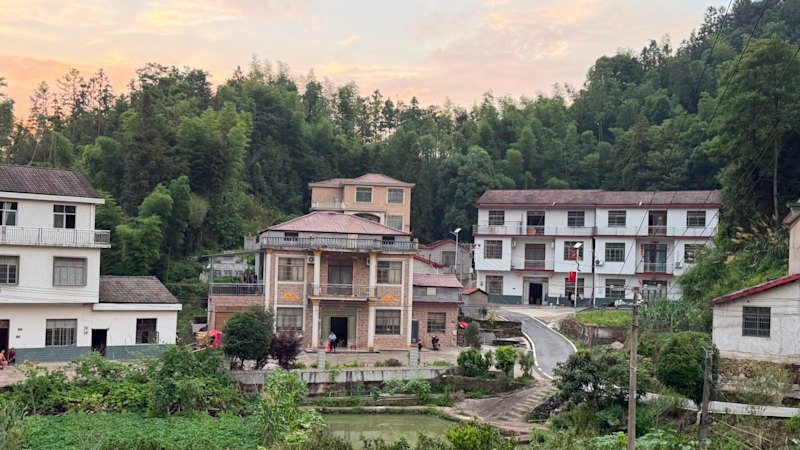
What in the World, a free weekly newsletter from our foreign correspondents, is sent every Thursday. Below is an excerpt. Sign up to get the whole newsletter delivered to your inbox. Xingming village, China: Perched atop a hill in a small village in central China, Li Zhiying’s family guesthouse has a spectacular view.Just beyond the front door is a vista of a pristine reservoir, ringed by pine forests and framed by mountain ranges flossed with low-hanging clouds.Along the cul-de-sac that winds past his house, Li’s neighbours tend crops of beans, chillies, pumpkin and corn in small plots near their homes.Li Zhiying grew up in poverty in Hunan province in central China and later returned to his home town to open a guesthouse.Lisa VisentinVillage dogs bark and scrap in the street and chickens roam freely. By the roadside, an elderly man is picking the Sichuan peppercorns that will spice the tea and tingle the tongues of neighbours who will pop by later that evening for a daily ritual of gossip and card-playing.I’ve come to Li’s home town of Xingming in China’s central Hunan province to spend three days exploring a different side to the modern China story that frequents the headlines. The ordinariness of rural life.A snapshot of the so-called “real China” that’s more representative of everyday life for millions of Chinese people than dancing robots, drone light shows and the breakneck speed of AI development that is reshaping tech hubs in Beijing, Shenzhen and Hangzhou.The evening I arrive we wander down the street to the home of the retired village chief, a local Communist Party official, whose wife is serving slices of watermelon and tea in plastic cups to any neighbour who stops by for a chat.“Hello Australia, welcome, please enjoy our village,” one elder tells me, using a translation app.This is Chairman Mao country, where portraits of China’s former supreme leader hang in the homes of older villagers, his reputation unspoiled by history’s verdict – in the West at least – of the calamity caused by the Great Leap Forward and the Cultural Revolution.“Mao is like a god to us,” a local party cadre from the neighbouring province tells me over lunch at the guesthouse. “He understood the ordinary people.”Xingming village, in Hunan Province, in central China.Lisa VisentinThe nearest market is five kilometres away in a small unremarkable township, where everyone is curious about the visiting foreigner (me). There’s plenty of pointing and waving and lots of smiles.“Never!” an old villager running a pork stall responds when I ask how often foreigners come to the market.Nearby, a man is loading hunks of fresh meat into the boot of his car lined with just a piece of cardboard.Another vendor is selling a freshly killed whole dog, its fur shaved off but skin intact. It’s a confronting sight for the uninitiated, though Li tells me he has never seen dog meat for sale here before.By his own admission, Li forewarns would-be guests that his home is located in a rural village that most Chinese people have never heard of. There’s no tourist infrastructure, and quotidian village life is slow-paced and perhaps even boring.“If you are looking for a comfortable, easy introduction to China, this may not be the place,” he says on the guesthouse website.This is not the side of China that has bedazzled the wave of influencers who have arrived under the government’s soft power masterstroke of visa-free travel, which has now been extended to more than 70 countries, Australia included.They have flooded Instagram and TikTok with effusive videos about China’s smartphone-powered megacities, with a cashless economy, gleaming skyscrapers, robots that deliver food to the hotel door, and futuristic electric vehicles that cruise silently around clean streets.The comparison couldn’t be starker. There’s little tangible wealth in villages such as Xingming but community bonds are strong. People eat what they grow, or fish from the reservoir, and share what they have with their neighbours. Younger people have decamped for the cities looking for work, often leaving behind their children to be raised by their grandparents.“My children have gone to work in the 3D printing industry,” one woman says, as she picks beans from her garden while her granddaughter plays nearby.But the crushing poverty that once afflicted Xingming, and mired families such as Li’s in destitution, has largely been eliminated.To get to Xingming from Beijing, it’s a five-hour journey on high-speed rail to the nearest station in Yueyang – a small, lower-tier city by Chinese standards with only 5 million people (about the size of Sydney). Then it’s an hour-long drive through the countryside from there.I’ve come specifically to meet Li himself, a 36-year architect turned aspiring AI-developer, whose life has skirted the same grooves as China’s own recent trajectory in many ways.Playing cards with neighbours is a routine pastime in rural China.Lisa VisentinHe rose out of poverty off the back of China’s economic juggernaut, which from the 1990s onwards lifted hundreds of millions of people like him with it. Li then crested the wave of the country’s property boom before crashing with its collapse, shuttering his own construction company within six months of opening it in 2022.Since then, he’s looked for ways to reinvent himself, firstly in ecommerce, joining a friend’s large online company selling adult products to consumers all over the world on platforms like Amazon and Taobao — a lucrative pivot that was especially profitable in the US market until Donald Trump’s tariff war upended global supply chains.Now he’s dabbling in the emerging tech economy, splitting his time between Xingming and Shenzhen — the gravitational epicentre of China’s entrepreneurial classes — where he is teaching himself AI and building a small online game.At the same time, he’s running the guesthouse, hoping the injection of foreign travellers into China will bring new faces to rural areas. The 14-bedroom homestay is a relatively new addition to Xingming, one he designed himself, overseeing its construction in 2016 during the runaway years of China’s real estate bubble. To build it, he scrimped, saved and borrowed money from friends in a bid to deliver on his parents’ dream for their son to return home and share his success with the family.Its minimalist open-plan aesthetic – with sharp lines, exposed brick, timber panelling and floor-to-ceiling glass windows – is a strikingly incongruous landmark in the small village.It’s also an unrecognisable improvement on the basic brick flat that once stood in the same spot and where his mother cooked over an open wood stove that doubled as heating. As a child, his family was too poor to afford a bicycle, so he and his brother walked two hours through the mountains to attend school, a journey they made twice a week, sleeping at the school quarters in between.“We could only afford to eat meat a handful of times a year. As for clothes, we often wore the same clothes for five or six years, unless we literally outgrew them,” he tells me.“I think everyone in China has felt the economic growth, and people in rural areas have felt it very noticeably too.Li Zhiying and his friend, Li Mi, paddling on the reservoir that sustains the local village.Lisa Visentin“If you had visited rural China 30 years ago, there was basically not a single paved or asphalt road in most rural areas. All the toilets in the countryside were simple pit latrines. Our waste was used to fertilise the vegetables.”These days the roads are sealed, and the village has reliable power and sewerage systems. Many of his neighbours have rebuilt bigger, multi-storey houses in recent years, and many families have at least one car.Li’s ticket out was that he was academically gifted, won a scholarship to university and was supported by government policies that helped low-income families. He graduated as an architect into a rapacious property market, at one point securing a well-paid job with Country Garden, China’s biggest real estate developer.Laden with billions of dollars of debt, Country Garden has been teetering on the brink of collapse since 2023. Its crisis, along with the implosion of other major developers, has hollowed out China’s middle-class wealth and left an economic wound so deep that even the nation’s breakout AI industries haven’t come close to healing it.When Li’s guesthouse first opened before COVID-19 hit, it was fully booked on weekends, but since then the slow post-pandemic recovery and lagging domestic economy has seen bookings dwindle as Chinese consumers sit on their savings.During my stay last weekend, I was the only guest, although more travellers arrived the day I checked out.As China opens up, Li says he hopes more foreign tourists find their way to villages such as Xingming.“If you travel China, 70 to 80 per cent of the places are like this. It is also very beautiful here. Although the big cities are also a real part of China, this is what China truly is.”Get a note directly from our foreign correspondents on what’s making headlines around the world. Sign up for our weekly What in the World newsletter.Lisa Visentin is the North Asia correspondent for The Sydney Morning Herald and The Age based in Beijing. She was previously a federal political correspondent based in Canberra.Connect via X or email.From our partners
Chickens, Chairman Mao and spiced tea with the neighbours: Welcome to ‘the real China’
Full Article
Original Source
Read the full article at Smh →KhanList aggregates and links to publicly available news content. We do not host full articles from third-party sources. Always verify important information with original sources.