
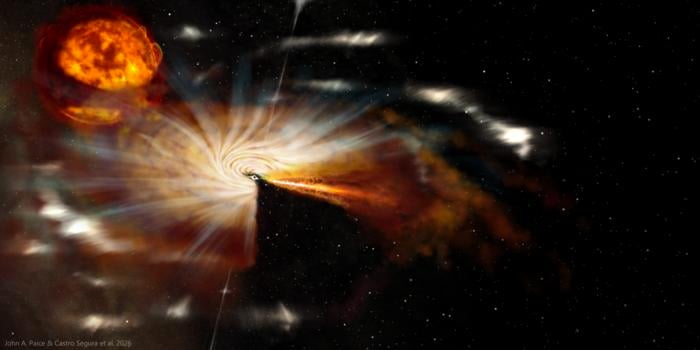
Black holes are some of the most awe-inspiring and mysterious celestial objects in the universe. This is primarily because astronomers still don’t understand the underlying mechanisms that drive black holes, including its formation, evolution, and end. As their name implies, black holes can’t be viewed directly since they blend into the background of the vastness of space. Therefore, astronomers are limited to “seeing” black holes when they consume other celestial objects, most notably stars. When this happens, the astronomers see the light from the star being violently consumed by a nearby black hole in a spectacular display. However, astronomers are still puzzled regarding what happens after the consumption. Now, an international team of scientists led by the University of Warwick might be one step closer to solving this galactic conundrum regarding how a black hole consumes objects. In findings recently published in the Monthly Notices of the Royal Astronomical Society, the researchers present new evidence regarding the binary black hole system, Swift J1727.8−1613, discussing how some materials consumed by Swift J1727.8−1613 are discharged back out where it came from. The reason Swift J1727.8−1613 is a binary black hole system is because it consists of a large black hole with a normal-sized star orbiting it. In this case, the black hole is estimated to be approximately 10 times the mass of our Sun with the black hole consuming pieces of its companion star. This exciting discovery was made using the European Southern Observatory’s Very Large Telescope (VLT), which observed a 2023 eruption from Swift J1727.8−1613 that displayed material being discharged as winds and jets violently being expelled from the black hole. While black holes are typically observed through single images, the astronomers used the VLT to make several observations over time, enabling them to watch the sequence of events from consumption to eruption. Black Holes Not Endless The team notes that Swift J1727.8−1613 is a small and less active black hole than how others have been observed, suggesting black holes act function more on digestion instead of being endless pits where nothing escapes. Essentially, Swift J1727.8−1613’s small size might have been too full to fit all the material and “barfed” up the leftovers, with these eruptions lasting for extended periods of time. A key finding was that even after the black hole was done with its “meal”, the eruption continued. “People often imagine black holes simply swallowing everything around them,” said Dr. Noel Castro Segura, who is a Postdoctoral Fellow at the University of Warwick and lead author of the study. “What we’re seeing is a much more complex process. Matter falls in, the system processes it, and a surprising amount is expelled again. If black holes can continue shedding material even after their largest outbursts, it means they may be much less efficient eaters than we previously assumed. A significant fraction of the meal may never reach the black hole at all, changing our understanding of how binary stars in galaxies evolve.” New Insights One possible explanation for how this study could help gain insights into the evolution of binary stars is because Swift J1727.8−1613 likely started off as a two-star system consisting of a large star and a smaller star. Over time, that larger star exhausted its fuel, resulting in a supernova event and it becomes the black hole we see today. Now, the second and smaller star could be large enough, or its orbiting close enough, so the black hole has started stripping its material and consuming it. What new insight into black holes and their unique eating habits will researchers make in the coming years and decades? Only time will tell, and this is why we science! As always, keep doing science & keep looking up!
Astronomers Catch Black Hole Spewing Matter After Feeding
Full Article
Original Source
Read the full article at Universetoday →KhanList aggregates and links to publicly available news content. We do not host full articles from third-party sources. Always verify important information with original sources.