
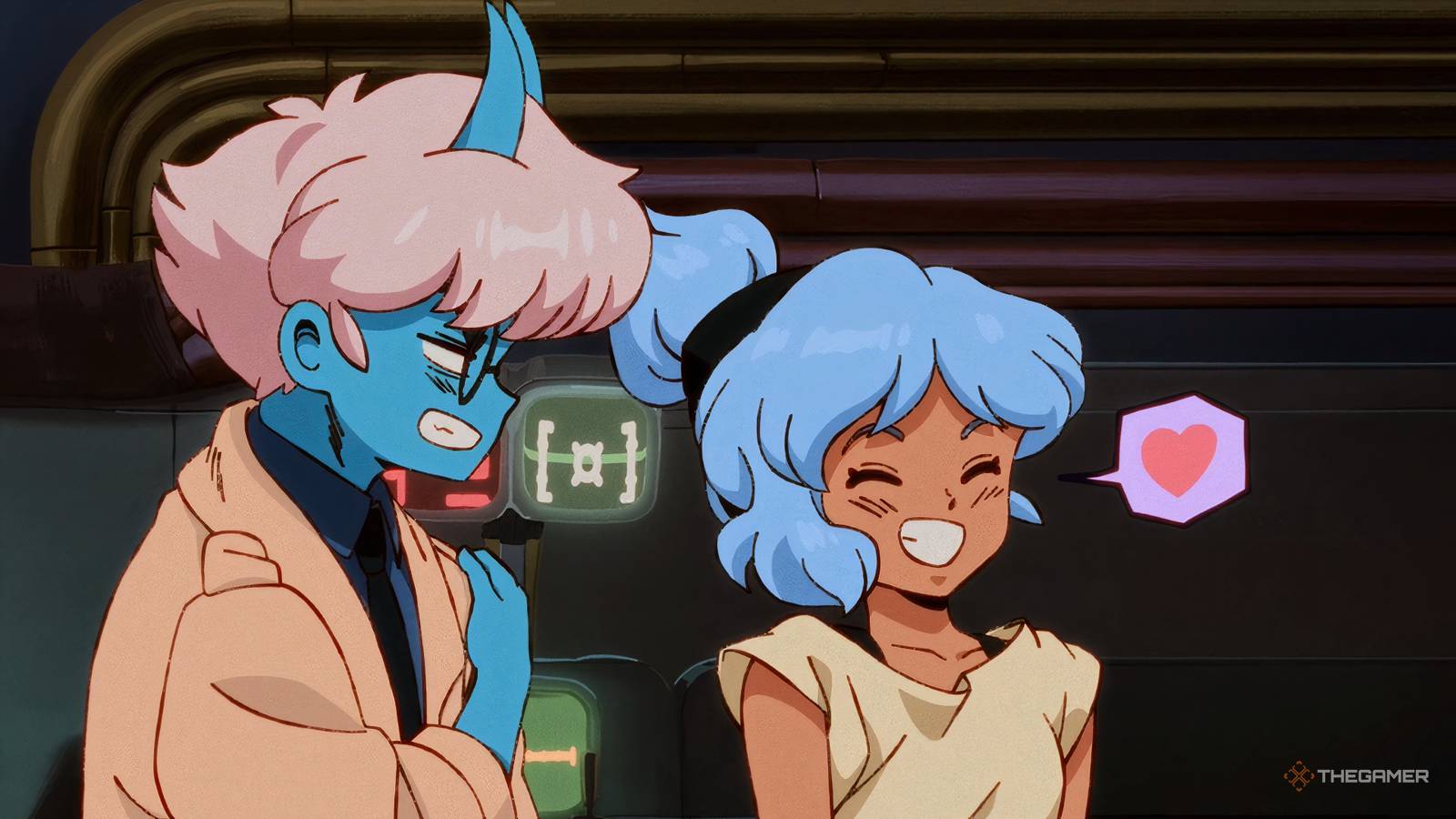
Nostalgia is a powerful tool, but it’s also one of the easiest things to misuse. From the moment I laid eyes on Orbitals’ retro anime aesthetic, I, like most of you, was hooked. That said, it’s not enough to throw out a couple of clever references and capture a beloved art style. There also needs to be a deeper understanding of why these resonate in the first place. For that reason, I initially remained cautious that Orbitals might rely too heavily on nostalgia without fully delivering an experience comparable to the classics it was pulling from. Now, I’m pleased to say my worries were for nothing. From the moment you boot up the game, it’s abundantly clear that there's passion and intention in every aspect of Orbitals' design. There are clear references, yes, but the feel of comfortable familiarity in the world-building and character design is something you can’t fake. Shapefarm has managed to find a balance between tugging at the heartstrings of the past and creating something with its own identity. Player 2, I Choose You! Shapefarm Being sold on the visuals before I even picked up the game, the main thing I was seeking from the gameplay was a good use of teamwork mechanics that made Orbitals feel like more than two players having individual experiences in the same game. For a game centered around a feature like this, the co-op gameplay needs to feel less like a feature and more like a mandatory requirement for cooperative problem-solving and story development. Thankfully, Orbitals delivered on this even beyond my initial expectations. Maki and Omura each have their own roles for the mission, but nearly every aspect of the game, from exploring the world to defeating bosses, requires both players to work together, as they should. Nobody is ever just sitting on the sidelines. Orbitals even gives you the freedom to figure out the team dynamics yourself, so the choice you make at the start of the game doesn’t end up defining your entire experience. In games like It Takes Two or Split Fiction, the character you select at the beginning unknowingly locks in the abilities you’ll have access to for the rest of the game, and that is not the case with Orbitals. While you do choose who will play as Maki and Omura at the start of the game, and any time you pick it back up, these choices have no impact on your gameplay beyond just assigning the character model that will represent you. Rather than tying abilities to the characters, Orbitals puts focus on the tools instead. On your ship, you’ll have a small space where you can find all the tools you’ll use throughout the game, such as grappling hooks or laser guns. At the start of each mission, the required tools will be highlighted, and Maki and Omura are free to grab the one they’d like to use. This lets both players discuss which tool to take while also giving them the freedom to choose a different one on a later mission. On top of this, several missions and all boss fights will take place while operating the ship, which requires one player to pilot and the other to be the gunner. Normally, you’d expect the game to pre-determine this based on the characters and their personalities, but it doesn’t. These roles are decided by sitting in the corresponding seat on the ship, and you can exit your seat and swap them at any point during a mission. Everything about Orbitals’ gameplay is designed to let players take control of their co-op experience, which is everything I could’ve asked for. Since Orbitals lacks solo content, a Global Friend Pass is available for download in the Nintendo eShop. This friend pass is free and allows a player without the game to join a game hosted by someone who has it, meaning two friends could split the cost of a single copy and enjoy it together. This Isn’t Even My Final Form As for the actual missions, I had a great time exploring space with Maki and Omura, but there were a few shortcomings I couldn’t get past. The different areas and objectives were unique, and the puzzles were creative, but I constantly found myself wishing for more of a challenge. I didn’t expect Orbitals to be a difficult game, but I did anticipate that my partner and I would be forced to communicate and problem-solve together more often. We were required to work together simply because both characters were part of each puzzle, but rarely needed to establish anything about our individual tasks or solve something beforehand. Instead, it was pretty clear what each player needed to do on their end, and we were able to progress without issue, which did hurt some of the initial excitement I had about seeing how collaborative the puzzles were. That said, because my partner and I weren’t frustrated by the game, we were able to let our guard down and enjoy more hilarious moments where we intentionally sabotaged each other, so there is something to be said for the lack of struggle. Bosses were probably the main element that made the lack of difficulty feel that much more detrimental to the experience, in that there almost weren’t any. Over the course of this roughly twelve-hour game, you’ll face two major bosses. I understand that cooperative puzzles are the core of Orbitals, not fighting bosses. However, with so many interesting areas across the different missions, it felt like a missed opportunity not to have even a few significant mini-boss fights to conclude missions. Of the bosses that were present, the different phases do manage to include a surprising amount of gameplay variety, but this only further solidified my thinking that the game might have benefited more from breaking off some of these phases into individual fights over the course of the game. This was especially true of the final boss, who seemed to introduce a new phase with different gameplay each time I thought the fight was over. Though the lack of difficulty was definitely a concern, it’s also important to acknowledge what Orbitals does right on missions, by allowing players to enjoy the journey. Modern games are often so focused on moving things along that they forget to let players breathe and actually enjoy the game at their own pace. Outside of open-world RPGs, when it’s time to move on to the next area of a game, players are often teleported there with no time wasted on travel. In Orbitals, however, whether it’s time for Omura and Maki to board the ship, hop into the pilot and gunner seats, or enter a new area, you’ll do it all yourself every step of the way. This could be tedious for some players, but I adored it. It slowed things down and gave my partner and me a chance to appreciate the smaller details without being rushed. Just Who The Hell Do You Think We Are? In an opening sequence that immediately reminded me of The Pillar of Autumn sequence in Halo, Orbitals’ story wastes no time getting you up to speed on the challenges Maki and Omura will face. Following several tragedies, their tiny community is now facing a great threat that might wipe out what’s left of them for good. Everyone on board is fortunate enough to have an I.M., a machine that holds their soul and allows them to respawn should they meet an unfortunate end. The I.M.s doubly serve as an explanation for why Maki and Omura respawn when they die, which I appreciated, while also stressing the urgency of the current situation. If the I.M.s on board were to be destroyed, nobody would come back. The stakes were high from the start, and I was fully invested in all the characters that were being introduced, some of whom even looked and felt straight out of Studio Ghibli. Unfortunately, as the story progressed, it made a few choices that were a bit predictable, which lowered the impact of the final act. I won’t get into spoilers, but the conclusion felt as though some of the game’s conflict could have been easily avoided, and that even seemed to be the point it was trying to make, which isn’t a great feeling when you just spent the past twelve hours getting here. The beautiful moments shared between characters and the incredible voice work throughout did save some of the moments where the story itself came up short, but it still felt like a weaker point in the game. Communication is also a core theme throughout and fitting for a co-op game, but it would’ve been nice to see it hammered in more by creating more conflict between the main characters. For the most part, Maki and Omura get along perfectly. While this is a refreshing change from other co-op games where the characters practically hate each other, by not giving these two any sort of conflict, Orbitals misses an opportunity for more character development and creating an interesting dynamic for players. You’re Gonna Carry That Weight Though I did have some qualms with the gameplay and story here and there, a game like Orbitals is more than just the sum of its parts. Overall, it was a phenomenal experience to share with my partner, and I’d gladly enjoy it all over again. The creativity and visuals are stunning, the characters have a ton of heart, the soundtrack is an absolute banger, and the atmosphere immediately transported me to the cozy feel of an ’80s–’90s anime. If this is only the beginning for Shapefarm, the future of co-op games is bright. Orbitals Systems 4.0/5 Released September 3, 2026 ESRB Everyone 10+ / Animated Blood, Fantasy Violence, Mild Language Developer(s) Shapefarm KK Publisher(s) Kepler Interactive Multiplayer Online Co-Op, Local Co-Op Number of Players 1-2 players Pros & Cons Beautiful visuals Charming characters with great voice acting Co-op Gameplay that lets the players decide how to play Incredible music that enhances the experience Compelling story that begins to fall off a bit in the third act Lacks elements that pose a real challenge for players
Enjoy A Space Adventure Full Of Nostalgia And Charm In Orbitals
Full Article
Original Source
Read the full article at Thegamer →KhanList aggregates and links to publicly available news content. We do not host full articles from third-party sources. Always verify important information with original sources.