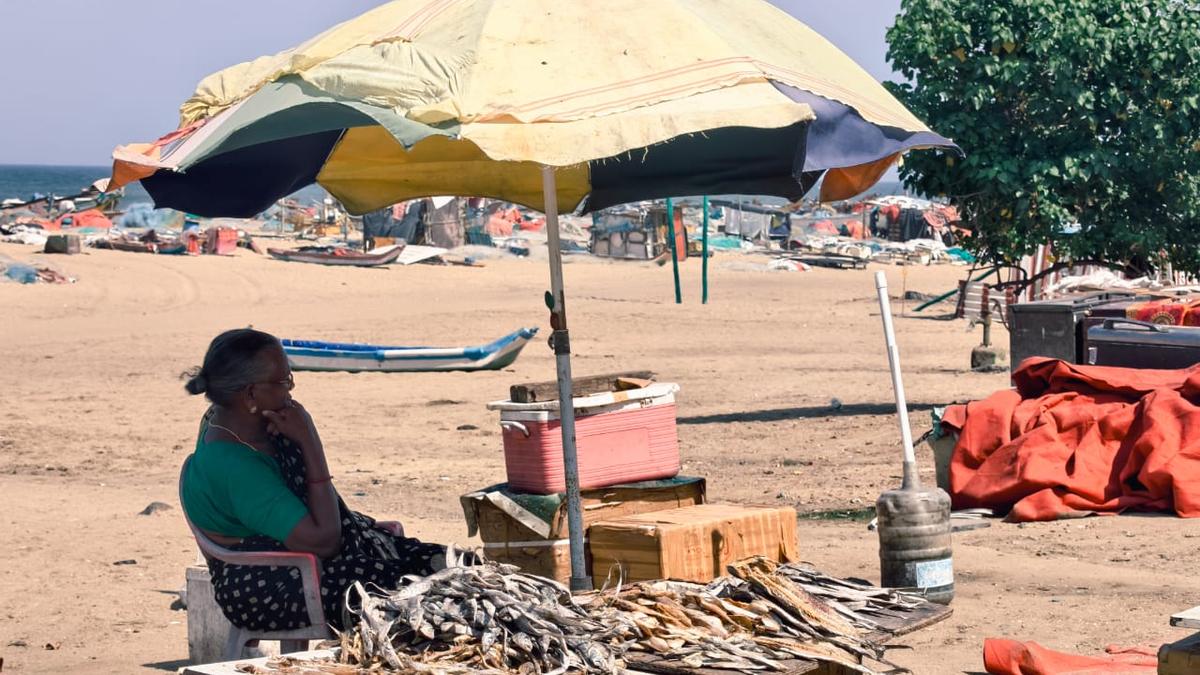
A minute is always 60 seconds. But it rarely feels that way for Kavitha, 40, selling fish under an unforgiving sun.By seven each morning, she has to arrange the day’s catch neatly on a small table at Chennai’s bustling Nochikuppam fish market, one of the city’s fishing hamlets tucked between the Marina Loop Road and the Bay of Bengal. Buyers drift in, bargain, leave, and return.“Between each sale, I keep an eye on the fish. As the mornings are getting hotter, I worry about selling everything before the sun spoils their freshness,” she says.Rising temperatures are not the only challenge fisherwomen face. Changes in the sea itself have made earning a livelihood far more difficult. Kavitha’s husband is among the artisanal fishermen who plan their work around the predictable rhythms of two fishing seasons: vaadai, characterised by northerly winds and currents, and kachan, marked by southerly winds and calmer seas. But those rhythms are no longer as dependable.Changing sea, shrinking catchAccording to S. Palayam, veteran fisherman from Urur Kuppam, Chennai, the traditionally calmer kachan season has become, on average, 33 days shorter than it once was, while the vaadai season now lingers well beyond its usual withdrawal.His study, ‘Sea Changed; Seasons Changed: A Fisher Science View of Climate Change’, which draws on daily observations recorded over 1,179 days between September 2018 and October 2023, also found an increase in rough sea days during kachan, disruptions in the productive transition between the two seasons, and the disappearance in recent years of vanda thanni — a nutrient-rich phenomenon that traditionally brought abundant fish closer to shore.Fisherwomen sense these changes not through measurements of wind speeds or currents, but through the uncertainty they bring to daily work. Disruptions at sea, whether rough weather, poor catches or fewer fishing days, reduces the fish available for sale, thereby shrinking women’s daily earnings and, with it, the financial agency they exercise within their families.“My husband manages the bigger expenses and repays our loans. But the money I earn gives me some independence. I can buy groceries, pay for my son’s school needs, or spend on small things without having to ask anyone,” says Kavitha.Fishers say the waters close to the shore no longer yield the catch they once did. Forced to travel farther into the sea, they incur higher fuel costs and spend longer hours fishing, even as their returns continue to shrink. “We’re spending ₹5,000 to ₹7,000 more per month, but the catch is much less,” says Kavitha.Although overfishing by mechanised trawlers remains the biggest reason for declining catches, many fisherwomen say changing weather and sea conditions have made their work increasingly uncertain. The seasonal cues they once relied on are no longer dependable. Erratic winds, rougher seas, and unpredictable ocean currents have made it increasingly difficult to anticipate fish availability and plan fishing trips as they did in the past.Pollution deepens woesS. Velvizhi, marine biologist at the M.S. Swaminathan Research Foundation (MSSRF), says climate change is only one of several pressures bearing down on marine fisheries. Marine pollution, overfishing and the degradation of critical habitats such as coral reefs, seagrass beds and river estuaries have all contributed to the depletion of fish stocks, she says.In Pulicat, India’s second-largest brackish water lagoon that straddles Andhra Pradesh and Tamil Nadu, fishers say declining catches are also linked to the periodic closure of the lagoon’s sea mouths, which regulate the exchange of water with the Bay of Bengal. When these remain closed, water flow into the lagoon is restricted, salinity rises during the summer months, and fish populations decline.Standing knee-deep in the waters of the Pulicat lake in Tiruvallur district, Sarala, 50, spends hours hand-picking prawns to earn a living. But the returns have dwindled sharply over the years. Decades of industrial pollution have degraded the lagoon’s ecosystem, while invasive species believed to have been introduced through ballast water have further disrupted native fish populations.Sarala recalls earning ₹200 to ₹300 after two hours of prawn picking; today, she says, four hours in the lagoon fetches her only about ₹150.The shrinking income has consequences beyond the day’s meals, Sarala says. “I use it to look after my elderly parents, pay my monthly seetu [chit] contribution, and save whatever little I can for my daughter. Earlier, I could manage all that. Now, after meeting everyday expenses, there’s hardly anything left to save.”Making ends meetLike many fisherwomen in Tamil Nadu, Selvi, 50, a resident of Pattipulam in Chengalpattu, says she survives by borrowing. As declining fish catches have reduced her daily earnings, she has found it increasingly difficult to meet household expenses, let alone repay old debts. She currently juggles five or six loans at a time, borrowing from one lender to repay another and to keep her fish vending business going. “I keep rotating the loans,” she says. “If the catch is poor, there isn’t enough money to repay them. So I take another loan. That’s how we’ve been managing.”‘Meenava’ Shanthi, a fisherwoman based in Kasimedu, says the welfare system continues to view fisheries through a largely male lens. Although the Tamil Nadu Fishers and Fishworkers Welfare Board is intended to cover those engaged across the fisheries sector, she argues that there are few welfare measures tailored to the realities of women’s work.“Most of the welfare schemes are meant for those who go out to sea. Even when benefits reach a family, they usually come through the male fisher. Women like us, who sell, process and dry fish, don't have any support meant specifically for us,” she says.With little by way of targeted government support, many fisherwomen are finding their own ways to stay afloat. As fish vending has become less reliable, some are taking up tailoring, catering, daily wage labour, or work under the Mahatma Gandhi National Rural Employment Guarantee Scheme (now VB-G RAM G) during lean periods.Coping with changeIn the hours between returning from the market and preparing for the next day’s work, Kavitha has begun stitching clothes. At first, she learnt simply to sew for herself, her mother, and her sister. Encouraged by her younger sister, she now hopes to turn it into an additional source of income.“My younger sister keeps telling me, 'Why don’t you take orders from others? You stitch well.’” She has not yet begun taking customers but sees tailoring as a way to cushion her family’s income on days when there is little fish to sell. “If I can get more orders, I’ll continue doing it. At least there will be some income even when business at the fish market is poor,” she says.Others are turning to value-added products such as dried fish and pickles or small self-help group enterprises. These supplementary incomes help soften the blow, but women say they rarely compensate for the steady earnings that fish once brought. “A few of us get together to make small batches of fish pickle, which we sell through a neighbourhood grocery shop,” says Sarala.Velvizhi says many fishing villages have already demonstrated that alternative livelihood models can work when women receive the right support. “There’s much more of an entrepreneurial mindset among fisherwomen today. Earlier, when we suggested making value-added products like fish pickles or marketing them through WhatsApp, many were hesitant. Now, they’re far more open to trying new ideas,” she says.But adapting to a changing fisheries sector, she says, requires more than encouraging women to diversify. The State must invest in building new skills that match today’s markets. “The old approaches won’t be enough anymore. Women need digital literacy, digital marketing skills, quality control, and training in value addition so they can access better markets and earn more from their products,” she suggests.(This story is part of the Asian College of Journalism’s Climate Change Media Hub Mentorship Programme.)
As the sea changes, fisherwomen in Tamil Nadu struggle to stay afloat
Full Article
Original Source
Read the full article at Thehindu →KhanList aggregates and links to publicly available news content. We do not host full articles from third-party sources. Always verify important information with original sources.