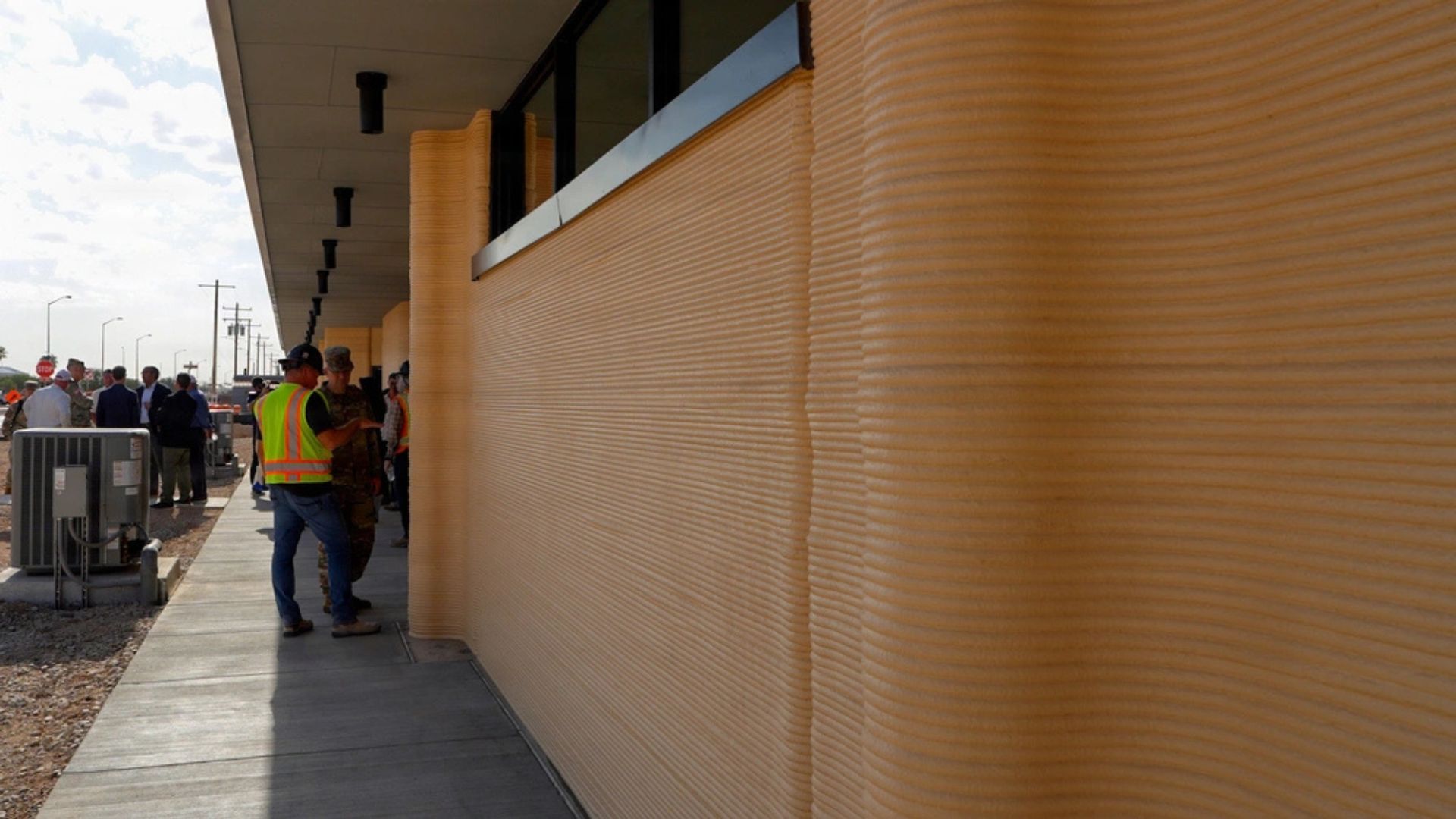
Massive robotic nozzles squirted layer upon layer of concrete under the high desert sun. Fifty-eight days later, the walls of ten new military barracks stood finished. The Department of Defense has officially entered the era of 3D-printed military housing. On July 28, 2026, installation leaders at Fort Bliss cut the ribbon on the first two of 10 giant, 3D-printed barracks. The milestone marks the military’s largest deployment of automated construction technology to date. 3D printing delivers high-quality, energy-efficient barracks faster and at lower costs, directly boosting soldier well-being and operational readiness. “[T]his project is about much more than statistics, 3D printing or cost savings,” said Maj. Gen. Curtis Taylor, the commanding general of Fort Bliss. “It is about combat readiness, and most importantly, it is about taking care of our people…This facility sends a clear and undeniable message to every Soldier who walks through its doors: We value you. We value your mission. And we value your sacrifice.” Building military housing in record time For troops returning from shifts along the U.S. southern border, standard accommodations often meant long commutes to temporary housing. The new facilities rewrite that routine entirely. Members of Task Force Bastogne, currently serving under Operation Ardent Vanguard, will be the first service members to move in. Instead of driving an hour out into the desert after a taxing shift, soldiers will walk straight into climate-controlled, energy-efficient housing located steps away from dining halls, gyms, and recreational facilities. The speed of additive construction changes the blueprint for military logistics. What once took years of framing and masonry now happens in a matter of months. The project encompasses ten 3D-printed structures spanning a combined total of 78,000 square feet, with each individual building offering 5,772 square feet to comfortably house up to 560 service members. Built at an unprecedented pace, all ten structural shells were printed in just 58 days, keeping the entire project on a rapid nine-month timeline from initial contract award to final delivery. The U.S. Army’s adoption of 3D construction technology delivered a rare dual win of financial efficiency and unprecedented speed. By opting for additive manufacturing over conventional methods, the project reportedly achieved a 9.3% cost reduction against standard construction benchmarks set by the U.S. Army Corps of Engineers. Even more impressive was the delivery timeline: crews erected the structures at four times the velocity of traditional construction, proving that rapid military deployment doesn’t have to come at a premium price tag. “The project represents the largest deployment of robotic construction capabilities for the Department of War to date, highlighting how emerging technologies are reshaping Army infrastructure,” the US Army stated. 3D-printed structures comply with official standards The current project expands on a successful 2024 pilot program at Fort Bliss that proved 3D-printed structures could withstand Texas heat and heavy military use. All 10 buildings comply fully with Unified Facilities Criteria standards. They feature thick, resilient walls designed to lower life-cycle maintenance costs and drastically reduce energy consumption. Once Task Force Bastogne completes its border mission, the campus will remain a permanent fixture of Fort Bliss, accommodating rotating units for decades to come.The full 10-building complex is scheduled for total completion by September 2026.Recommended ArticlesGet the latest in engineering, tech, space & science - delivered daily to your inbox.Mrigakshi is a science journalist who enjoys writing about space exploration, biology, and technological innovations. Her work has been featured in well-known publications including Nature India, Supercluster, The Weather Channel and Astronomy magazine. If you have pitches in mind, please do not hesitate to email her.
78,000 sq ft of US military barracks shells 3D printed by Army in 58 days for troops
Full Article
Original Source
Read the full article at Interestingengineering →KhanList aggregates and links to publicly available news content. We do not host full articles from third-party sources. Always verify important information with original sources.