
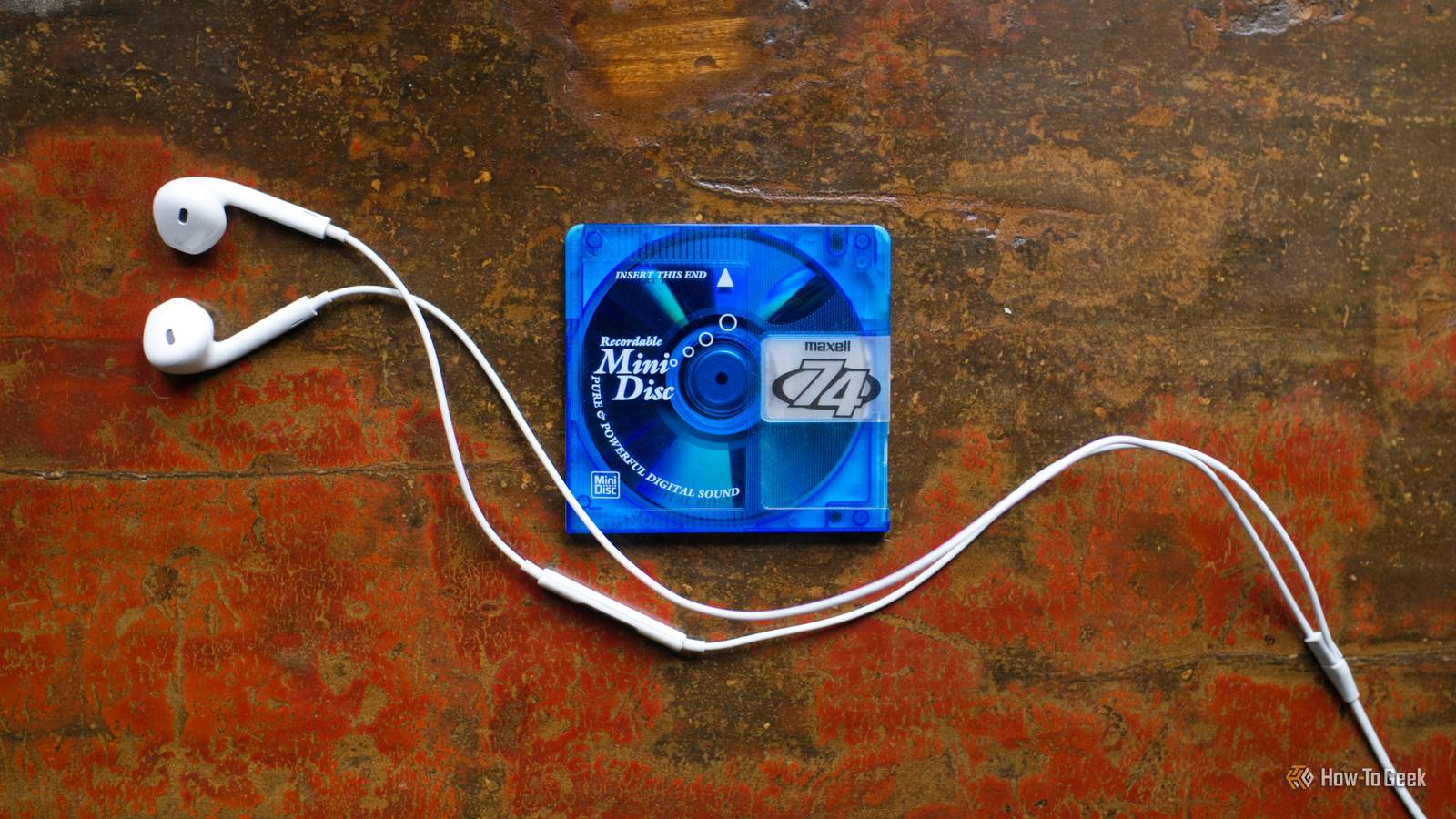
Published Oct 10, 2026, 12:01 PM EDT Adam has a degree in Engineering and has a life-long interest in technology. He has been writing for over a decade for various print and online publications, with a focus on consumer tech. He joined How-To Geek in 2024 while working at Pocket-lint. As well as being a long-term fan of Apple products, he also has a strong interest in smart home tech, running a Home Assistant server at home to automate all his smart home devices. He believes that the ideal smart home should work with minimal interaction from the user, with automations running as if by magic rather than requiring you to push buttons on a control panel. You can find more of his work on Muck Rack. It feels like we never reminisce like we used to, but the past was clearly better in many ways. There are some 1990s gadgets that were so awesome or ahead of their time that they still put current tech to shame. Sony MiniDisc Walkman (1992) The perfect combination of cassette and CD Cassettes helped make the personal audio revolution possible. You couldn't carry around a record player and headphones, but with the development of the Walkman, bringing your music with you became a reality. CDs followed, but both CDs and cassettes had their own problems. MiniDiscs attempted to solve those problems by combining the two formats. The problem with CDs was that they were easy to scratch, but by placing optical discs within a protective plastic cartridge, MiniDiscs made them far more durable. Recordable MiniDiscs could also be erased, re-recorded, and edited, enabling you to create your own compilations, rearrange track orders, or even split tracks without using a computer. Despite this, MiniDiscs never reached the dominance of CDs or cassettes. The technology is still popular among enthusiasts, however, despite being more than 30 years old. PalmPilot (1996) A pocket computer that didn't rot your brain Long before the smartphone was ever a thing, the PalmPilot allowed you to carry a small computer in your pocket. These devices were personal digital assistants (PDAs) designed to replace paper calendars, to-do lists, notes, and more. The touchscreen could be operated with a stylus, and there was even a handwriting-recognition system that worked using simplified letter shapes. A PalmPilot offered many of the useful features of a smartphone without any of the annoying distractions. You could even sync your calendars and contacts with your computer. With a PalmPilot, you could get things done, instead of just wasting hours doomscrolling. Nintendo Game Boy Color (1998) Portable gaming without downloads Credit: Domenico Fornas/Shutterstock.com The first gaming device I ever bought with my own money was a Nintendo Game & Watch, and I played it to death. Nintendo continued to hone the concept of a handheld gaming device, releasing the original Game Boy in 1989, but the format arguably reached its peak with the Game Boy Color in 1998. This version had a full-color display, more memory, and a faster processor, but was still compatible with most of the original Game Boy cartridges. You could get about 10 hours of battery life from two AA batteries, and there was even an infrared port that could share data between devices. The subsequent Game Boy Advance is often considered the superior handheld, but it lost the iconic design of the earlier Game Boy models, which is still found today in handheld devices such as the R36S. Nokia 3210 (1999) The perfect phone for a simpler time Credit: My Electronics Collection / YouTube A lot of the time, I hate my phone. I waste so much of my life scrolling mindlessly through apps, and it really annoys me that I can't seem to stop. I wish we could go back to the days of the Nokia 3210. This was about as good as a phone could get, selling in the millions. It looked great, thanks to the internal antenna that removed the external aerial common on earlier phones. The interface was simple and easy to use, with T9 predictive text, customizable ringtones, and some iconic built-in games. You could change up the look of your 3210 with interchangeable covers, and you didn't need to worry about buying a phone case because you could drop it from space, and it would probably still work. The phone was so popular that Nokia revived it for the 25th anniversary in 2024. Sega Dreamcast (1998) A console that was ahead of its time Credit: Interneteable/Shutterstock.com The 1990s saw some of the greatest consoles of all time being released. I still remember getting a train to the nearest Toys R Us with five friends to go buy a brand-new first-generation PlayStation. I lost hundreds of hours of my life to the Nintendo 64, and I don't regret it for a second. The Dreamcast was arguably the best of them all; despite its relatively short lifespan, it had a library comparable to the N64's, and was worth owning for Crazy Taxi alone. What it did best, however, was to innovate. It was the first sixth-gen console, before the PS2, GameCube, or Xbox, and included a built-in modem that made online gaming a core part of its design. The Visual Memory Unit (VMU) was also crazy, having its own screen and even working as a tiny handheld gaming device. Bandai Tamagotchi (1996) Proof that graphics aren't everything Tamagotchis have been around for 30 years, but they've lost none of their appeal. My kids got Tamagotchis from a relative last Christmas, and they were obsessed with them. In the 1990s, consoles were tripping over each other to try to have the best graphics possible, but the Tamagotchi took the opposite approach. The graphics were so basic that it was often hard to tell exactly what was on the screen, but it didn't stop these virtual pets from being incredibly addictive. Sony Mavica MVC-FD5 (1997) A digital camera that used floppy disks This last entry wasn't hugely popular, and the concept soon died a death, but the sheer audacity of the design has to be applauded. At the time, transferring images from digital cameras usually involved special cables and software, but the Mavica MVC-FD5 threw all of that out. Instead, it saved your photos to a 3.5-inch floppy disk that you inserted directly into the camera. You could then eject the disk and stick it straight into your computer, or just leave the images on the disk and insert another. The idea seems obvious now in an era of cameras that save images to SD cards, but it was revolutionary at the time, as it used floppy disks that were cheap, easy to get hold of, and compatible with almost any PC. 90s tech is still popular for a reason My dad owned a Mavica camera that took floppy disks, and I thought it was total genius at the time. I kind of still do. While technology has moved on insanely far since the 1990s, some iconic 1990s gadgets are still popular to this day, three decades on.
7 old gadgets that prove the 1990s were peak tech
Full Article
Original Source
Read the full article at Howtogeek →KhanList aggregates and links to publicly available news content. We do not host full articles from third-party sources. Always verify important information with original sources.