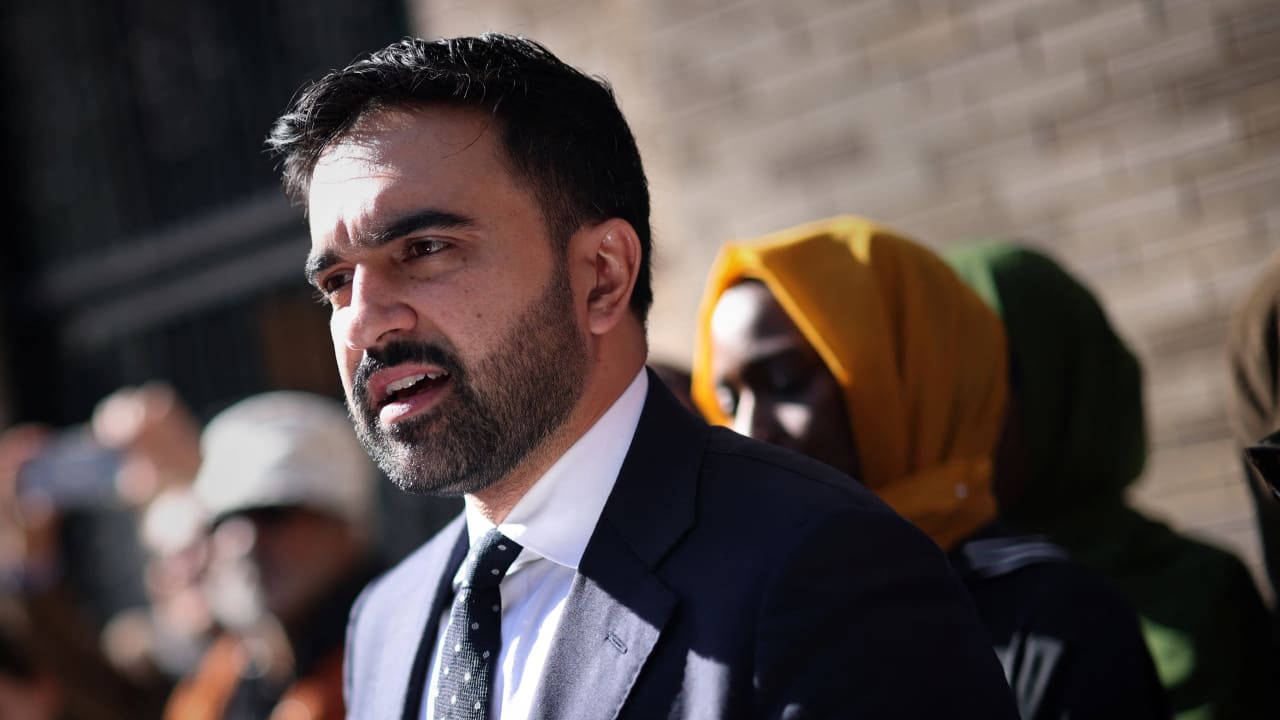
ByMICHA DANZIGJULY 30, 2026 18:00Few words carry the weight of “genocide.” Raphael Lemkin coined it in the shadow of the Holocaust to describe one thing: the intentional effort to destroy a people because of who they are. Because the accusation is so grave, when an elected official invokes it, he lends the authority of his office to the gravest charge one nation can level against another.That is what makes New York City Mayor Zohran Mamdani’s description of Israeli Prime Minister Benjamin Netanyahu as “the architect of genocide” so dangerous. This is not a dispute over Middle East policy. It comes as Jews, roughly 10% of New York City’s population, account for some 60% of its reported hate crimes.A mayor who brands the world’s only Jewish state uniquely genocidal is not merely commenting on foreign affairs. He is shaping the civic climate in which his own Jewish constituents live. The problem is not only what Mamdani believes about Israel, but how those beliefs shape his posture toward the Jews who live in his own city.Nobody disputes that the war in Gaza has caused terrible suffering. At issue is whether “genocide” accurately describes this war, and whether the mayor of a city with the largest Jewish population outside Israel should present that characterization as settled fact when it remains one of the most contested questions in international law. Even among Israel’s harshest critics, the charge remains disputed. Words this heavy derive their authority from precision, not repetition.There is one fact that separates this war from every recognized genocide in history: Israel repeatedly and publicly stated the conditions under which the fighting would end. Release the hostages. Hamas surrenders or it’s removed from power as a fighting force.New York City Mayor Zohran Mamdani pictured during his first day in office, January 1, 2026. (credit: Dave Sanders/Pool via REUTERS)Those demands may be accepted or rejected, but their existence reveals the war’s stated purpose. A campaign fought to force an enemy’s surrender, as the Allies fought Germany and Japan in 1945, is fundamentally different from a campaign whose purpose is the destruction of a people.No historical genocide had an off-switch. The Holocaust would not have ended had Europe’s Jews surrendered. Rwanda’s killers did not pause for concessions from the Tutsi. The Ottoman authorities did not offer Armenians terms under which the deportations and mass killings would cease.In each case, extermination was the point. The killing was not a means to an end; it was the end itself. By contrast, from the outset of the war, Israel publicly identified military and political conditions that would bring the war to a close. Equating a war fought for surrender with campaigns fought for annihilation drains the word “genocide” of the very meaning that gives it moral force.Israel’s conduct is also difficult to reconcile with the claim of exterminatory intent. Throughout the war, it facilitated the entry of humanitarian aid into Gaza, supported polio vaccination campaigns that reached more than 500,000 Gazan children, and issued evacuation warnings by leaflet, text, phone call, and other means before military operations.Military lawyers were embedded in the targeting process, giving them the authority to reduce the size of a munition, delay a strike, or cancel one altogether when anticipated civilian harm was deemed disproportionate under international humanitarian law. Israel’s critics count the strikes that occurred. Almost no one counts the strikes that never happened because military lawyers stopped them.Israel tries to reduce civilian casualtiesNone of this settles every question about proportionality. Armies often fight well and badly within the same campaign. But a military that warns civilians, facilitates massive aid, vaccinates children in enemy-controlled territory, and routinely aborts strikes to reduce civilian casualties is simply not behaving like a military engaged in the extermination of a people. Whatever else one calls it, it’s not “genocide.”The deeper problem is moral and historical, not legal. For centuries, Jews have been cast not merely as wrong or even dangerous, but as uniquely malevolent – poisoners of wells during the Black Death, ritual murderers in the blood libel, a secret corrupting hand behind governments and markets in modern antisemitism.Ordinary events or conflicts become evidence of extraordinary Jewish evil. Many Jews hear “uniquely genocidal” applied to the only Jewish state through that lens – not because Israel should be immune from criticism, no democracy is, but because it is judged by a vocabulary applied to no other nation at war. That is not criticism. It is hyperbolic exceptionalism masquerading as principle.The selectivity gives it away. Mamdani built a public identity around condemning Israel long before he held office, and this pattern has continued in City Hall.When an anti-Israel mob tried to storm a New York synagogue hosting an event for Jews exploring immigration to Israel – his office’s response was to accuse the synagogue of violating international law.This was followed by him libelously describing a Hamas terrorist killed by Israel as a “journalist” and by repeatedly making genocide accusations culminating in his viral video calling Netanyahu an “architect of genocide.”Against this backdrop, an identifiably Jewish man was stabbed on the Upper West Side, steps from the Barney Greengrass restaurant. And the day after that, Mamdani named 18 lawyers to the panel that screens judges, including those who hear hate crime cases, in a city with more Jewish lawyers than any other in America, yet not one of them was Jewish.Taken together, these episodes reveal a pattern. Mamdani has not built a comparable campaign (or any campaign) against Iran, whose regime executes dissidents, crushes protests by the thousands, and exports terror across the region – nor against any other government genuinely responsible for mass atrocities. “Genocide” is the word he reaches for once, against one country. That is not a legal judgment. It is a target.His defenders will say officials must be free to condemn what they believe violates international law. Fair enough. But authority carries a corresponding duty, and it scales with the accusation.The more inflammatory the charge, the greater the obligation to get it right. “Genocide” is not a synonym for a brutal war; it describes something categorically different, and every time it is stretched to fit a war that doesn’t meet its definition, the word has less left for the next atrocity that does.That is the real charge against Mamdani. Not that he is wrong about Israel and Gaza, though he certainly is. It is that he has taken a word forged to describe the mass-extermination of millions of Armenians and Jews and applied it to a war whose legal characterization remains deeply contested.A war whose approximately 72,000-person death toll – according to Hamas-run authorities – combines civilians and combatants and is compiled by institutions that attribute virtually every death in Gaza to Israel. It is the casual invocation of history’s gravest accusation."A mayor willing to spend that word so cheaply – and who has repeatedly minimized or sidelined Jewish concerns at home – has told New York’s Jews how lightly he regards the fears of a community confronting a historic surge in antisemitic hostility.The writer is an attorney, former IDF soldier, and former NYPD officer. He writes widely on Israel, Zionism, antisemitism, and Jewish history. He serves on the board of Herut North America.Follow us on Google
Zohran Mamdani's genocide accusation matters far beyond Israel - opinion
Full Article
Original Source
Read the full article at Jpost →KhanList aggregates and links to publicly available news content. We do not host full articles from third-party sources. Always verify important information with original sources.