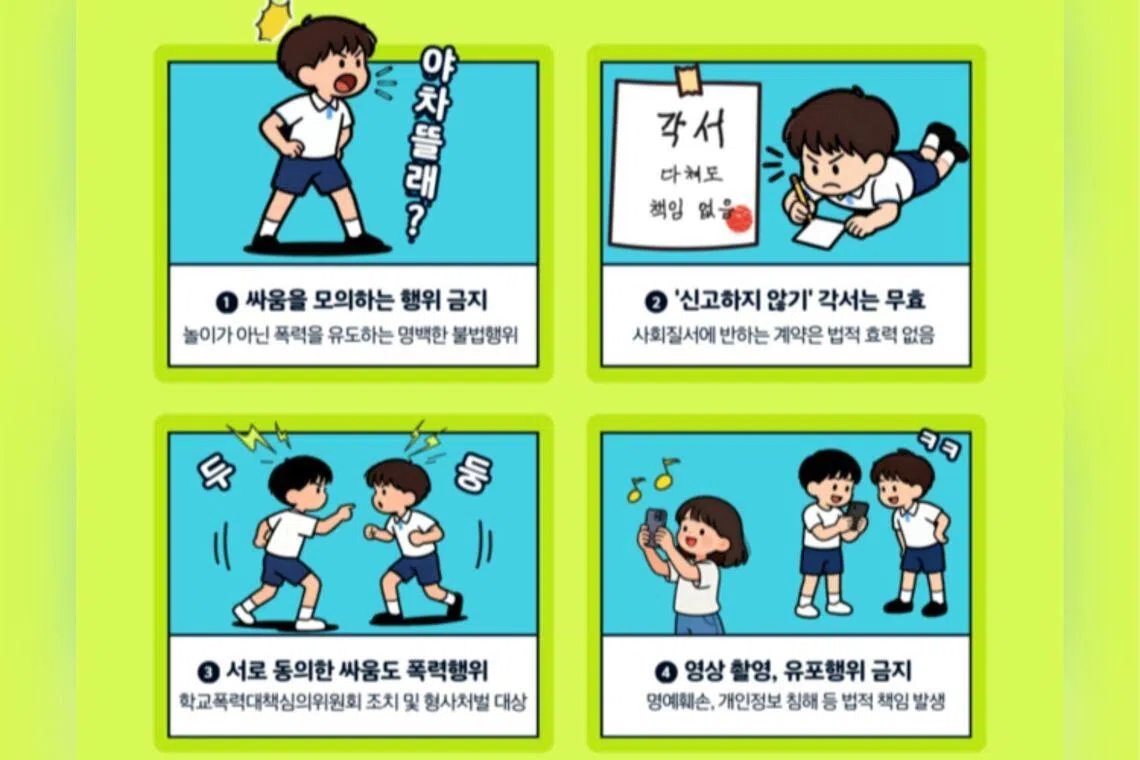
SEOUL – A form of school violence inspired by a popular YouTube martial arts series is spreading among South Korean students, prompting the education authorities and experts to warn that the so-called consensual fights are still acts of violence and may constitute criminal offences.The practice, known as “Yatcha Rule”, imitates the format of a popular YouTube fighting channel called Yatcha_Club in which participants agree to fight under a set of rules. As concerns grow over students being coerced into such fights and videos of the incidents being shared online, experts are calling for stronger measures to curb the trend.Earlier in July, the Seoul Metropolitan Office of Education issued a notice to schools and parents urging closer supervision of students and warning against disguised forms of school violence such as “Yatcha Rule”.“Yatcha Rule” stems from the misconception that mutual consent exempts students from punishment under school violence regulations,” the office said. “It is a new form of school violence that requires close attention both at school and at home.”While fights among students are nothing new, teachers say “Yatcha Rule” reflects a growing belief that mutual consent justifies not only fighting itself but also the methods used, regardless of the level of violence involved.“Many students treat it more as a meme than something they would actually do, but the underlying perception is still concerning,” a middle school teacher in Seoul told The Korea Herald.“Some believe that once both sides agree to fight, anything goes, regardless of whether weapons are involved. That mindset could lead to more serious violence both within and between schools.”Online meme used to disguise bullyingThe practice has also expanded beyond so-called consensual fights.Earlier in July, local media reported that a second-grade elementary school student in the city of Paju, Gyeonggi Province, was assaulted after four fellow students allegedly forced the child to take part in a “Yatcha Rule” fight.The assault was filmed in a manner resembling the YouTube martial arts content.Education workers say cases have also been reported in which students are pressured into agreeing to fights despite significant differences in physical size, with the supposed consent being used to justify one-sided assaults while bystanders simply watch.Bae Sang-hoon, a professor of police administration at Woosuk University, told local media that repeated cases in which violence is resolved through mutual agreements may have reinforced the misconception that people are not punished if both parties consent.He added that the widespread availability of violent content on online platforms, along with real-time audience interaction, may have encouraged students to view such violence as a participatory game.Experts stressed that violence cannot be justified simply because the participants agreed to fight, adding that not only those directly involved but also those who aid the assaults or distribute videos of the incidents should be held accountable.“‘Yatcha Rule’ is a means of legitimising violence regardless of whether the participants consent, and assaults resulting from such acts may constitute criminal offences,” said Lee Hyo-min, a professor of police administration at Youngsan University.“Comprehensive preventive measures are needed, including school-based education, protection against secondary victimisation and coordinated action by relevant government agencies.” THE KOREA HERALD/ASIA NEWS NETWORK
YouTube-inspired ‘Yatcha’ fights spread in South Korean schools, spark concerns
Full Article
Original Source
Read the full article at Straitstimes →KhanList aggregates and links to publicly available news content. We do not host full articles from third-party sources. Always verify important information with original sources.