
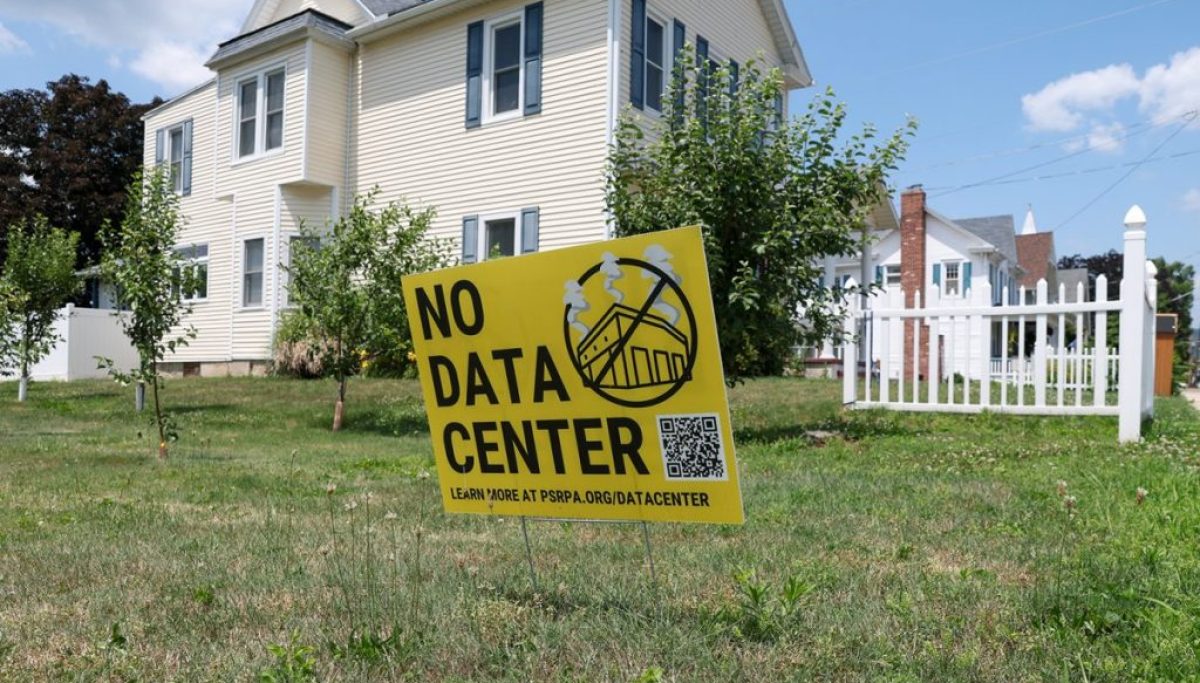
As expected, artificial intelligence played a central role in the recent summit with President Donald Trump and China’s Xi Jinping. Both leaders made clear that AI and the technologies powering it will shape the next era of U.S.-China competition.But for all the ceremony and discussion, no major bilateral agreement on AI emerged. That’s probably for the better, as the United States and China are pursuing fundamentally different strategies in a high-stakes race for technological leadership.We served in Congress as chairman of the Energy and Commerce Committee and vice chairwoman of the Homeland Security Committee, respectively. We saw firsthand that America’s economic strength and national security depend on the infrastructure underpinning our ambitions. In the AI race, that means maximizing U.S. computing power. In simple terms, computing power is the combination of energy, advanced chips, servers, and data centers that turns AI breakthroughs into real-world capability. If we don’t have that infrastructure in place and at scale, we have no chance of competing with China. While China moves with state-backed programs to build the data centers and domestic AI chips needed to win the race, America continues to hamstring our ambitions with more restrictions on data center construction. Over the last few months, China’s state-backed Envision built a new 2-gigawatt supercomputing campus, while Alibaba grew its AI cloud and computing services by 45%.By contrast, local governments in the United States have added more than 300 active data center restrictions across 44 states.Data centers are the heart of America’s AI infrastructure, and computing power remains one of our most important advantages over China in the AI race. China already leads in areas such as energy generation, AI adoption, and scientific talent, which makes protecting and expanding America’s computing advantage even more critical.By building the energy, chips, servers, and data centers needed for American AI leadership, the United States can strengthen its geopolitical, economic, and military position while helping set global digital standards and ensuring American AI models are used around the world.That is because computing power is no longer just a technology issue; it is becoming the foundation for economic growth, military readiness, and advances that improve Americans’ lives. For example:AI is becoming the driving force of private enterprise. For business, AI adoption is increasingly tied to efficiency gains. Forty-four percent of enterprise firms use AI to scale their companies, and a McKinsey report found that AI will enable economic productivity growth of up to 3.4%.Our military readiness also hinges on our AI capabilities. The War Department is using AI to detect incoming missile attacks, and recently, a NATO AI-assisted drone successfully countered a potential Russian attack. The Pentagon is also deploying large language models to streamline supply chain and budgeting data.In healthcare, AI is saving lives by elevating medical care. Advanced algorithms enable doctors to detect polyps and interpret mammograms more accurately, while predictive analytics are actively relieving hospital strain. A Nebraska hospital used AI to reduce the average length of stay. In Arkansas, predictive analytics lowered emergency room congestion by more than 500 patients per month. All of these applications demonstrate that modern national strength relies on our physical computing capacity.To be sure, building more AI infrastructure does not mean ignoring legitimate local concerns around energy and water use, electricity costs, siting, and community input.BILL GATES WANTS A GOVERNMENT LIST OF WHO GETS TO KEEP THEIR JOB. DON’T LET HIMA smart community compact can protect residents while allowing America to keep building data centers. This compact can shield existing ratepayers, require responsible resource use, give communities a voice early, and guarantee lasting local benefits. Done right, communities win, companies gain a predictable path to build, and America strengthens the infrastructure it needs to compete in the global AI race.The country that builds the computing capacity to power the AI revolution will shape the economic, military, and technological future. America must make sure that country is us.Former Reps. Loretta Sanchez of California and Greg Walden of Oregon are advisory board members for the American Edge Project.
Xi isn’t stopping Trump’s AI ambitions. Local zoning boards are
Full Article
Original Source
Read the full article at Washingtonexaminer →KhanList aggregates and links to publicly available news content. We do not host full articles from third-party sources. Always verify important information with original sources.