
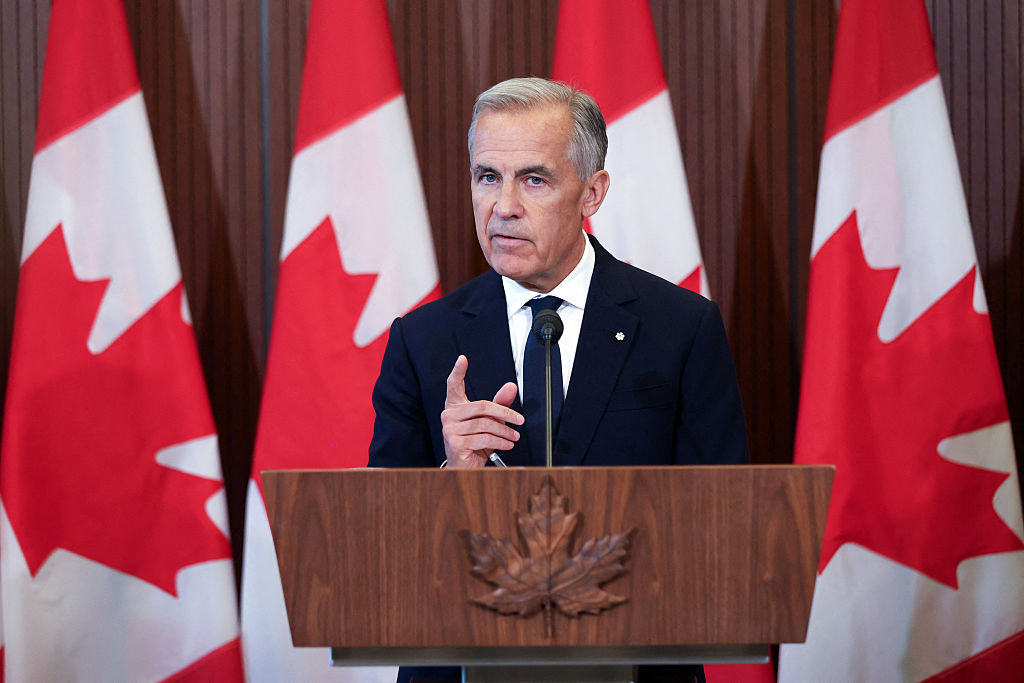
The headlines say it all: “Meet the New Leader of the Free World. No, It’s Not Donald Trump.” “Canada’s Carney Claims Mantle of ‘Leader of the Free World.’” “How Mark Carney Became Leader of the Free World by Standing Up to Trump.” Canadian Prime Minister Mark Carney is not just incredibly popular at home but, increasingly, around the world. Now there is even talk of him winning the Nobel Peace Prize.It is a comforting fiction for those terrified by Donald Trump. But if any leader deserves such a title, it is not Canada’s ex-banker prime minister but Brazil’s president, Luiz Inácio Lula da Silva.The reason is simple: Lula has done more to protect democracy and promote a fair global system than Carney has. And the point is more than academic. Lula will face off with Flávio Bolsonaro, son of the former president who attempted to overturn Brazil’s last election, on October 25 in the second round of the presidential election. The contest will determine whether Latin America’s biggest democracy maintains its resistance to the global far right or rejoins its ranks.The contrasts between Carney and Lula are clearest in their respective paths to power. While Carney did not come from an elite family, his path in life took him to Harvard, Oxford, and then Goldman Sachs. He led the central banks of two of the world’s largest economies. And as his recent investment summit has shown, he has the global economic elite in his Rolodex.Lula came from an impoverished family and was largely raised by his single mother. He became a trade union leader in the ABC Region of Greater São Paulo, was jailed for his union activism, and lost part of a finger in a workplace accident as a metalworker. Carney has spent his career at home among elites; Lula helped to restore democracy to Brazil after a military dictatorship that lasted more than twenty years.Any conversation about Lula’s role in defending democracy must begin with Brazil’s response to those who tried to overthrow it. After pro–Jair Bolsonaro mobs stormed government buildings in Brasília on January 8, 2023, mere days after Lula took office, his government treated the attack as a serious threat to the constitutional order. Brazil’s justice system ultimately convicted and jailed Bolsonaro for plotting a coup that also targeted Lula for assassination.But the response was not limited to the courts. In September of that year, Lula issued a presidential decree that created the Observatório da Democracia (Democracy Observatory), which monitors threats to Brazilian democracy. Lula’s conception of democracy is also worth noting: it extends beyond voting and elections. At the launch of the Global Alliance against Hunger and Poverty in July 2024, he stated, “Hunger and poverty inhibit the full exercise of citizenship and weaken democracy itself.”On the third anniversary of the January 8 events, Lula gave a speech where he said of democracy:It’s more than the desire and the right to vote on Election Day — and then keep your voter registration card for the next four years. Democracy requires the effective participation of society in government decisions.He also noted that given the levels of inequality in Brazil, strong and effective democracy requires a country “with more rights and fewer privileges.”Lula’s partnership with Spanish Prime Minister Pedro Sánchez in the “In Defence of Democracy” initiative further demonstrates his effort to make democracy a central part of Brazil’s international role. By linking free elections and constitutional institutions with social inclusion, reduced inequality, pluralism, and resistance to right-wing extremism and disinformation, Lula has helped advance a broader conception of democracy in international affairs. This is what support for democracy looks like in a world where the United States has dropped the pretense of even caring about it. More countries ought to step up on that front, but so far under Carney, Canada has not.Lula has been criticized in the past for not doing enough to address the collapse of democracy in Venezuela. However, after the flagrantly stolen 2024 elections, Brazil refused to recognize the results and blocked Venezuela’s bid for BRICS partner status. The Brazilian government has also criticized Nicaraguan President Daniel Ortega’s laws that have essentially ended competitive elections in the country.While Nicaragua and Brazil no longer have ambassadors in each other’s capitals, full diplomatic relations have not been ruptured. Nor has that happened with Venezuela. Lula has never shut the door to diplomacy. After Russia’s invasion of Ukraine, he condemned the invasion but also offered Brazil as a mediator.Some will criticize this approach as being too conciliatory. But diplomacy as a tool of statecraft has come under great strain since 9/11 and America’s war on terror. Talking to the other side gets smeared as being naive at best and legitimizing evil at worst. Lula has been unusually consistent in championing diplomacy when other leaders have not.Compare this to Carney. When Trump launched the war on Iran, Canadian government officials provided contradictory statements condemning military action without United Nations approval while insisting that Iran must not obtain a nuclear weapon. Between March 5 and 10, Carney left the door open to Canadian participation in the war before ruling it out after five days when it became clear that it was unpopular. Minister of National Defence David McGuinty’s comment, “The prime minister and the government decided from the beginning of this that we would support this incursion, but we’re also calling for a diplomatic end to it,” sums up the contradiction.In recent days during the opening of the UN General Assembly, when Carney was asked about Trump’s threat to annihilate Iran, he responded with: “Well, there is a war underway, and he’s speaking the language of war.” He also made sure to remind everyone that Iran is one of the biggest threats in the world — and a threat to Israel.Israel provides one of the biggest contrasts between Carney and Lula. Less than three weeks after October 7, Lula called what Israel was doing to Gaza genocide. The Canadian government has yet to take such a position. And it has only done the bare minimum in the face of the genocide. While the government restricted some arms-related exports that could be used in Gaza, it continues to allow exports for use in the Iron Dome.The Carney government’s cavalier attitude toward these modest restrictions was on display when it demoted Sean Casey, the parliamentary secretary to the minister of veterans affairs. Casey was removed from his position after voting for a New Democratic Party bill that would have closed shipping loopholes, which currently allow military goods exported to the United States to be sent onward to active conflict zones. While Canada also sanctioned violent West Bank settlers and joined the ban of imports from illegal settlements in the West Bank, it has never shown any actual leadership on the issue — it has merely followed the meager steps of European countries. The government has also quietly defined anti-Zionism to be antisemitism on the Public Safety Canada website. The difference on this issue could not be starker between the two leaders.With Trump’s national security policy declaring that the Western Hemisphere essentially belongs to the United States, Carney has decided to pretend that Canada is part of Europe, abandoning the Americas. Lula on the other hand has been rallying other Latin American and Caribbean countries to reject the Donroe Doctrine. There is also a very telling difference in how Brazil and Canada have responded to Trump’s blockade of Cuba. Brazil has called it “illegal and illegitimate,” while Canada has announced that it is “monitoring the situation.” Canada has reliably voted at the UN for an end to the decades-long US embargo. But when Brazil denounced the blockade at the UN, Canada abstained on the procedural vote to open debate on it.Lula has articulated a grand democratic vision, while Carney seems to be trying to somehow salvage the Western-led global order without the United States. That is a quixotic project: it is impossible to do without Washington, and it totally ignores the shift in global economic power now underway.As Lula once again fights for his political life against a Bolsonaro, while also contending with American meddling in the election, it is important to remember how fragile democracy can be and who actually fights for it. But the defense of democratic institutions is not, by itself, sufficient. Democracies also require political orders capable of eliciting the allegiance of their populations. Carney’s famous Davos speech was an exercise in political mythmaking with little substance. It put on offer little more than a revamped technocratic neoliberalism — the very model whose failures helped create the political disillusionment exploited by Trump.The point isn’t that Lula is infallible. The Workers’ Party and Brazilian left have not produced someone credible to succeed him. There is also ample reason to criticize the way legitimate concerns about disinformation on social media have bled into state-backed erosion of free speech — a development that factions of the Left have themselves attacked.Lula’s approach to the economy also deserves scrutiny. Shortly after his return to power in 2023, economist Matías Vernengo argued that his government should abandon overly restrictive fiscal frameworks in order to “expand public investment and promote higher wages and consumer credit.” On the eve of the presidential election, Vernengo acknowledged that Brazil’s economy had indeed grown under Lula and that unemployment was low. But he also noted how the fiscal framework he criticized in 2023 had held growth below what was possible, adding, “People eat GDP. What they don’t eat is democracy.” The first-round results of the Brazilian presidential election offer a warning about the potential political cost of that failure.This gets at one of the main contradictions of Lulismo: the president acknowledges the need for inclusivity and development to protect democracy but can be overly cautious on the economic front. This is the inverse of Carney in many ways. The Canadian prime minister does not pontificate about democracy and, while there is every reason to be skeptical of the kind of growth Carney’s economic policies will promote, has put economic growth at the center of an effort to reorient Canada’s economic relationships. For now, he has largely set aside concerns about the deficit.He remains wildly popular in Canada well over a year after his election. That should be a major signal to the Left. Economic growth matters if the Left is to achieve its goals, create political legitimacy, and protect democracy.Ultimately, whatever Lula’s domestic limitations, the values he espouses on the global stage should guide democracies in these uncertain times, not Carney’s technocratic and status quo sensibilities. Realizing that global vision will require both economic equality and growth at home.
Mark Carney Isn’t the “Leader of the Free World.” Lula Is.
Full Article
Original Source
Read the full article at Jacobin →KhanList aggregates and links to publicly available news content. We do not host full articles from third-party sources. Always verify important information with original sources.