
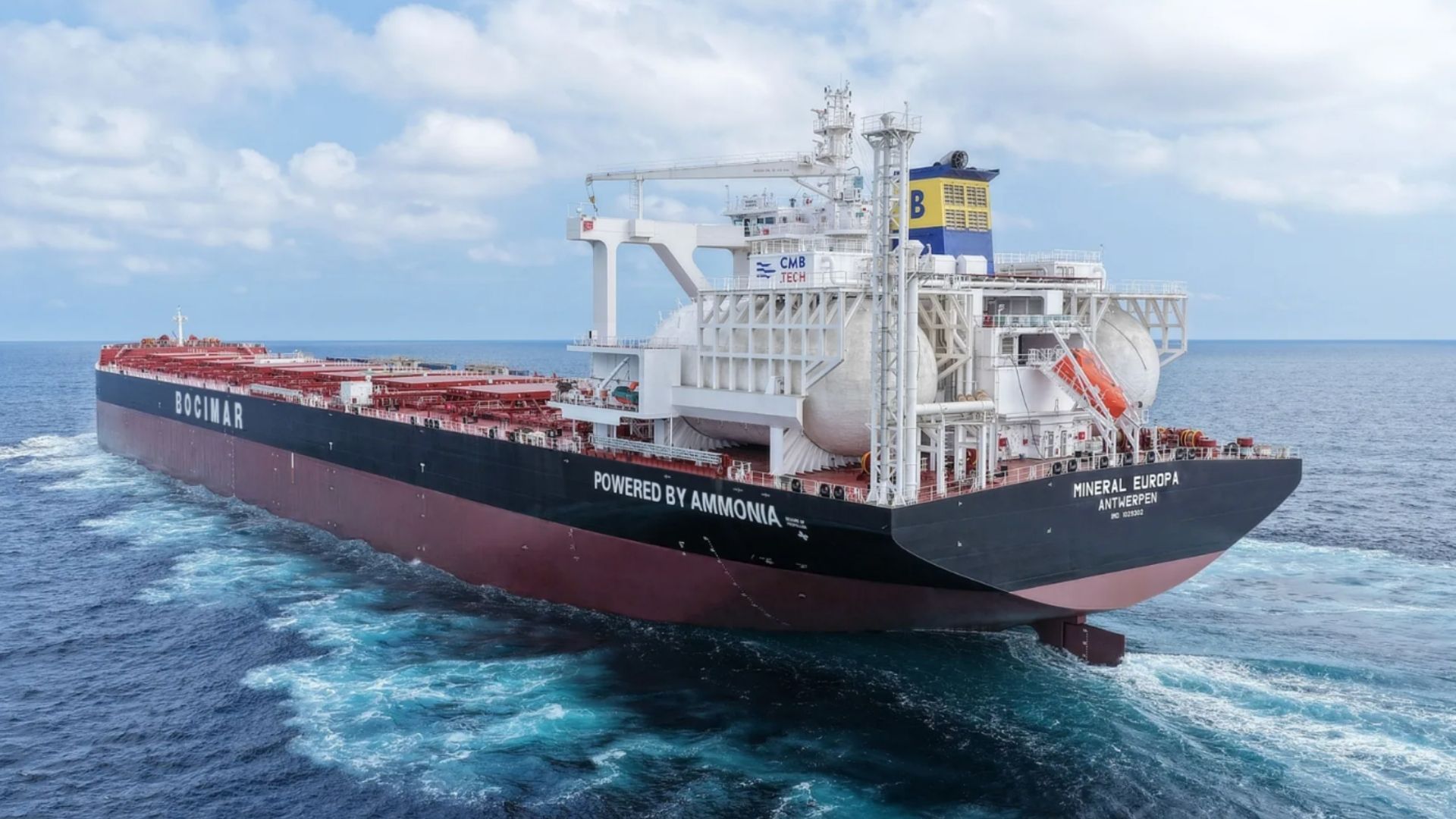
A 300-meter bulk carrier capable of running on ammonia is entering service to transport Australian iron ore. It marks a milestone for Belgium-based CMB. TECH’s nearly decade-long effort to develop large ships that run on the alternative marine fuel. The 210,000-dwt Mineral Europa is embarking on its maiden voyage to Australia. Chartered to Fortescue, it is set to carry iron ore from Western Australia’s Pilbara region to China and other international markets. The vessel forms part of CMB. TECH’s broader push to decarbonize shipping, with a fleet of 21 ammonia-powered vessels targeted by the end of 2029. CEO Alexander Saverys described the ships as the beginning of the “propulsion revolution” and said Mineral Europa “proves that large ocean-going ships can be powered by ammonia.” Dual-fuel engine and deck-mounted tanks Built by CSSC Qingdao Beihai Shipbuilding Co., Mineral Europa uses a dual-fuel engine that can run on ammonia or conventional marine fuel. The engine was developed through a partnership with WinGD. The ship has a reported speed of 14 knots. It is owned by Bocimar, CMB.TECH’s dry bulk shipping business, and is managed by Anglo-Eastern. According to CMB.TECH, liquid ammonia is stored in independent tanks positioned on deck, at a safe distance from the vessel’s sides. The company has established safety protocols, and every crew member must complete training before boarding. CMB.TECH said the vessel would operate on “green ammonia,” produced using renewable power, water, and air. However, it did not address the fuel’s current availability for its vessels. The company also said it is developing the fuel ecosystem needed to support the transition to cleaner shipping. Fortescue charter covers 12 bulk carriers Mineral Europa joins Mineral Latvia, with both vessels registered in Belgium. In June 2026, CMB.TECH announced that Fortescue would charter 12 Newcastlemax bulk carriers. Up to three were scheduled to enter service in 2026 with dual-fuel ammonia engines. The remaining nine were designated ammonia-ready, meaning they could be converted to operate on the fuel. A separate agreement announced in March 2025 involves Japan’s Mitsui O.S.K. Lines and MOL Chemical Tankers. Under that arrangement, MOL and CMB.TECH jointly own three 210,000-dwt Newcastlemax vessels being built at Qingdao Beihai Shipyard. Deliveries are scheduled for 2026 and 2027, with the ships operating under 12-year charters to MOL. CMB.TECH is also building two ammonia-fitted and four ammonia-ready chemical tankers at China Merchants Jinling Shipyard in Yangzhou. These vessels are scheduled to join the fleet in 2028 and 2029 under seven- to 10-year charters with MOL Chemical Tankers. Ammonia fleet remains small By the end of 2029, CMB.TECH plans to have 18 dry bulk vessels, one containership, and two chemical tankers powered by ammonia. The expansion comes as ammonia propulsion remains in its early stages. DNV’s cited data listed five ammonia-fueled vessels in service: two gas carriers, two tugboats, and Fortescue’s demonstration offshore support vessel. Four dry bulk carriers, including CMB.TECH vessels, were undergoing testing. Another 41 ammonia-fueled ships were on order for delivery by 2030, indicating a growing pipeline for a fuel still represented by only a handful of operating vessels.Get the latest in engineering, tech, space & science - delivered daily to your inbox.Atharva is a full-time content writer with a post-graduate degree in media & amp; entertainment and a graduate degree in electronics & telecommunications. He has written in the sports and technology domains respectively. In his leisure time, Atharva loves learning about digital marketing and watching soccer matches. His main goal behind joining Interesting Engineering is to learn more about how the recent technological advancements are helping human beings on both societal and individual levels in their daily lives.
World’s first major ammonia-powered bulk carrier enters service for Australian iron ore
Full Article
Original Source
Read the full article at Interestingengineering →KhanList aggregates and links to publicly available news content. We do not host full articles from third-party sources. Always verify important information with original sources.