
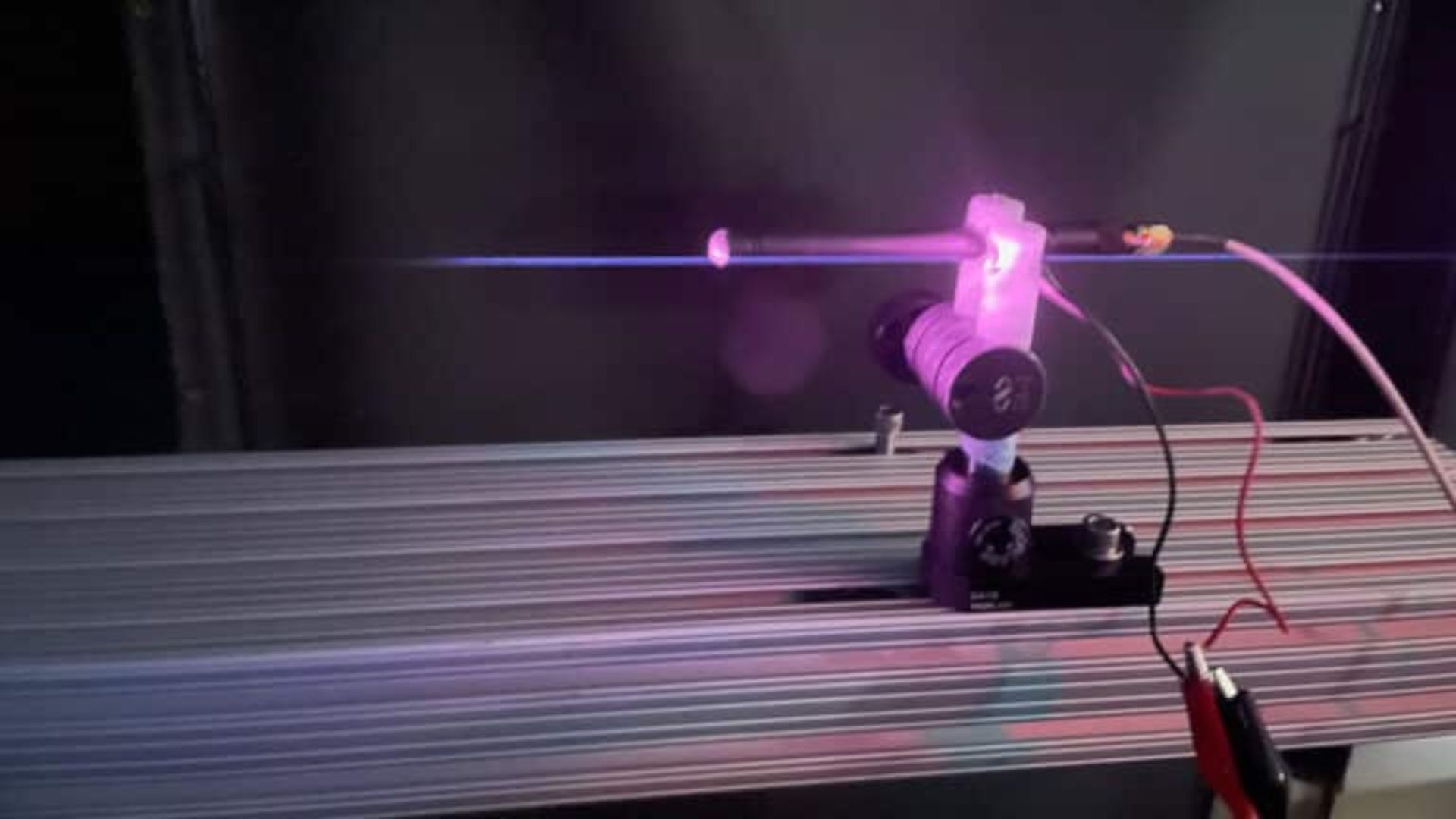
Researchers at a U.S. university have developed a technique to create plasma antennas that look like a ‘lightsaber’ and could send and receive radio signals in space or aircraft without the need for complex mechanical installation. According to the scientists, these laser-generated plasma-filament antennas have never been shown to work before, claiming it as a world-first demonstration of the technique. ”This is the first step, but it is a big step – it is the first time anyone has ever demonstrated that plasma-filament antennas can work,” said Prya Darshni, corresponding author of the study and a Ph.D. student at North Carolina State University. Traditional metal antennas used for radio wave communication are prone to installation setbacks, particularly in space. They can either bend or break when unfolding in space, she highlighted. Drawbacks of physical antennas Moreover, due to the big and bulky nature of physical antennas, they need a lot more room and inflate mission costs, while requiring expertise for effective use. One can argue to cut the budget and payload weights for antennas; one may simply reduce their length. But it is easier said than done. Researchers noted that antenna length is a key factor in determining which signals radio antennas can transmit or receive. ”The length of an antenna […] controls the frequencies at which radio waves can be transmitted and received,” said Darshini. “But manipulating the length of antennas to sweep a desired range of frequencies can be challenging in some applications — such as space exploration technologies,” she added. To overcome these bottlenecks, the team turned to lasers to generate plasma beam antennas that can be tuned to any length or angle without requiring extra space or tricky, tedious adjustment to get a glitch-free signal. Building plasma antenna During their experiments, the researchers fired a laser beam of a specific power and diameter that ionized a thin strip of air, forming a glowing beam or “filament” of plasma that looked like a “lightsaber.” But to give these laser-induced beams the mysterious powers, an extra nudge was needed to establish a radio connection. This was needed to make the plasma antenna work. To make that possible, the researchers developed a contact-free way to send radio signals to it. They placed a metal ring around the laser beam, allowing the beam to pass through the center. The ring acts as a capacitor, generating an electromagnetic field that transfers radio signals to the plasma without touching it. Following this, the electromagnetic wave can transport electrons in the air that are pushed to the edge of the plasma and show that a laser-induced plasma filament could radiate EM waves much like a typical antenna, the study reported. ”Now that we’ve shown it is possible, we can begin improving its performance,” said Darshni. Noting the research is still in its early stages, she confirmed the work is ongoing. ”We have not demonstrated its ability to serve as an antenna that can receive radio signals; there’s no reason to believe it wouldn’t also work as a receiver,” she added. Going forward, the team plans to turn the new “lightsaber” antenna from a potential into a real solution for space exploration by boosting its radiation properties for radar applications. Get the latest in engineering, tech, space & science - delivered daily to your inbox.
World’s first laser-generated plasma antenna could enable space communications
Full Article
Original Source
Read the full article at Interestingengineering →KhanList aggregates and links to publicly available news content. We do not host full articles from third-party sources. Always verify important information with original sources.