
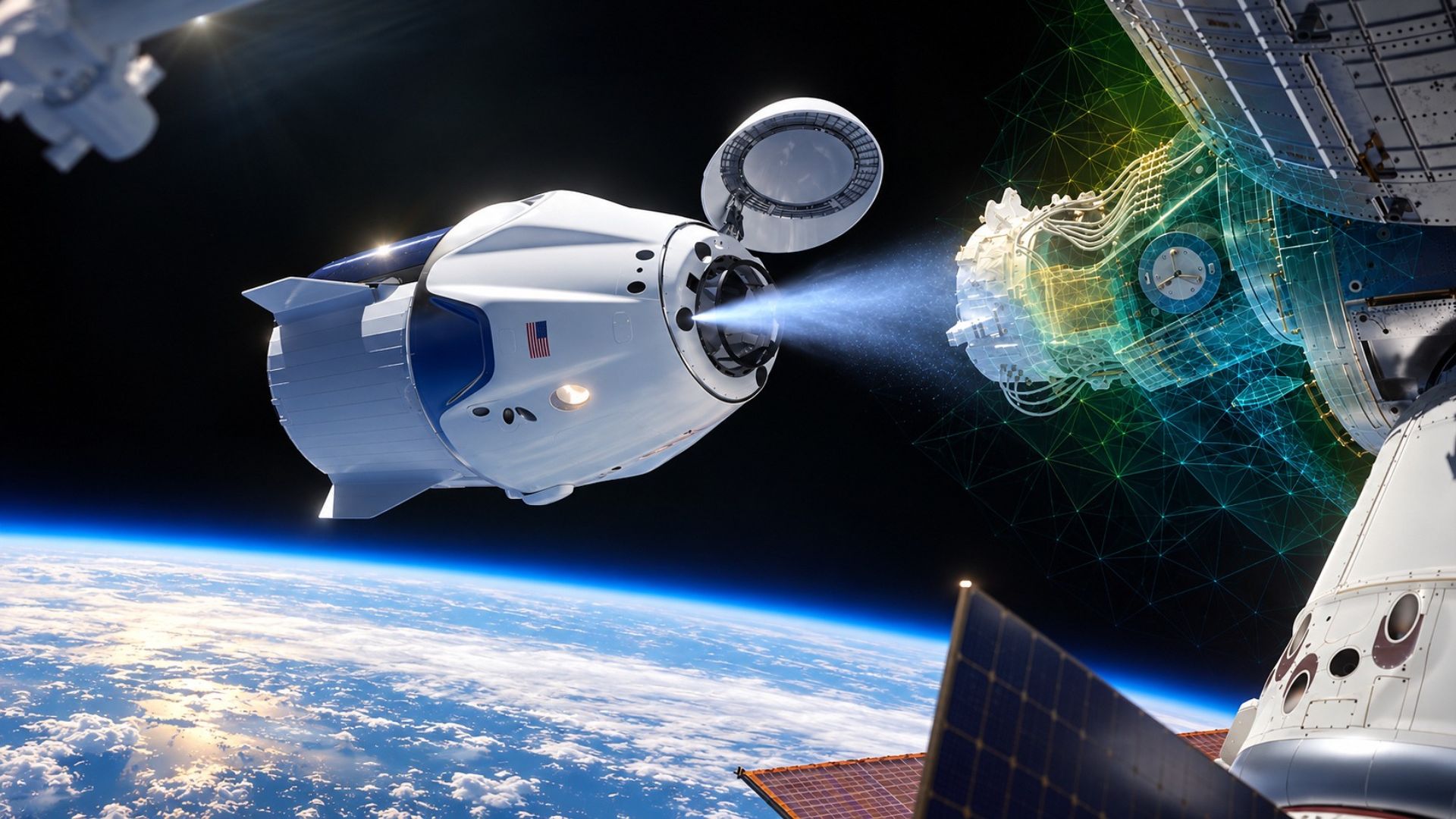
Flexcompute has developed a faster way to simulate how rocket thruster exhaust impacts nearby spacecraft in orbit. The firm has introduced its new Physics Twin for Space Plume Impingement, powered by a Physics World Model. According to the company, the tool is designed to help mission teams with complex rendezvous and proximity operations (RPO), such as autonomous docking, satellite servicing, and refueling. It evaluates thruster exhaust risks (forces, heating, erosion, and contamination) on nearby spacecraft. Existing simulation methods take days to calculate these complex particle interactions; hence, this new development is beneficial. Safer space docking Commercial space operations like autonomous docking, satellite servicing, and in-orbit refueling face severe risks from plume impingement. Exhaust from a thruster can destabilize nearby vehicles, damage outer surfaces, or obscure navigation sensors. Previously, Direct Simulation Monte Carlo (DSMC) predicted these high-velocity particle collisions. DSMC requires massive computational resources, restricting mission teams to testing only a limited number of flight paths. Flexcompute offers a new solution to overcome these computational limitations. This tool reduces long computational delays. It could help engineers and autonomous AI flight agents to simulate hundreds of close-range maneuvers in a fraction of the time. The technique is Tokenized Physics. The system combines neural networks with a novel Boltzmann solver within a unified framework to deliver DSMC-grade precision at groundbreaking speeds. Flexcompute bases its architecture directly on physical laws, avoiding the fragility of typical AI surrogate models when encountering unfamiliar scenarios. The software adapts instantly to new craft geometries and firing sequences without requiring retraining. “Flexcompute’s Tokenized Physics approach has the potential to speed up analysis ~200X compared with Direct Simulation Monte Carlo, allowing us to explore a much larger range of plume interaction scenarios to support mission demands,” said Han Park, Vice President of AI Integration, Space Systems, Northrop Grumman. “For close-proximity maneuvers like docking and refueling, where Northrop Grumman is leading the way and performing unprecedented dynamic space operations, that means we can analyze far more approach paths and firing sequences and see how each one will affect the vehicles involved,” Park added. ~200X speedup The 200-fold leap turns rare, expensive computational tests into routine flight prep. The software reduces computational demands, cutting processing time to just 0.4 GPU-hours per case (under three minutes on a single GPU) compared to 78 CPU-hours for hybrid DSMC setups. This high speed does not compromise accuracy. When compared to established simulation standards, the tool’s calculations for total forces differ by less than 3.5 percent. Specifically, its measurements of the physical push on the spacecraft (axial force) stay within 2.84 percent of standard models, while its estimates of temperature impact (heat flow) remain within 3.35 percent. According to Flexcompute President and Co-founder Vera Yang, the space plume tool is only the beginning. The company is actively deploying its suite of Physics Twins across other industries, mapping everything from orbital particle dynamics to micro-scale warpage in advanced semiconductor packaging.Confidence is vital during space missions. Flexcompute lets teams stress-test every maneuver before launch, saving compute cycles and building the digital foundation for future orbital infrastructure.Get the latest in engineering, tech, space & science - delivered daily to your inbox.Mrigakshi is a science journalist who enjoys writing about space exploration, biology, and technological innovations. Her work has been featured in well-known publications including Nature India, Supercluster, The Weather Channel and Astronomy magazine. If you have pitches in mind, please do not hesitate to email her.
‘Physics Twin’ tool enables faster safety checks for close-range space maneuvers
Full Article
Original Source
Read the full article at Interestingengineering →KhanList aggregates and links to publicly available news content. We do not host full articles from third-party sources. Always verify important information with original sources.