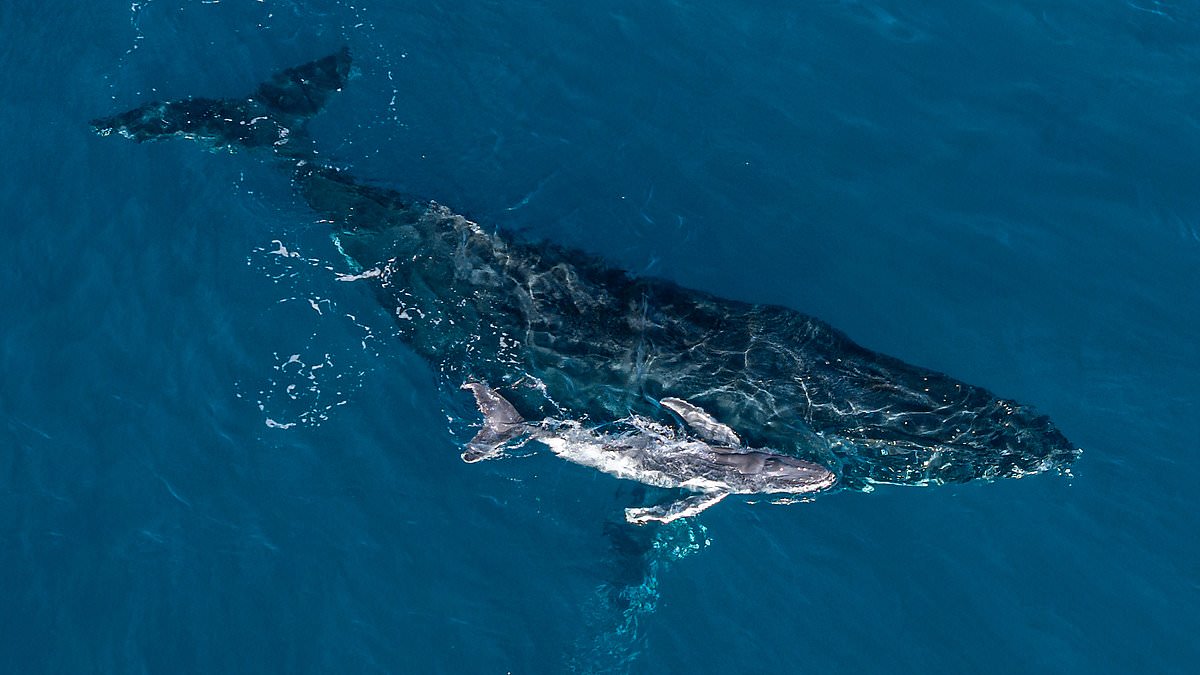
READ MORE: Humpback whale sets record swimming from Australia to BrazilSee more Daily Mail on Google - save us as a Preferred Source Published: 10:42 EDT, 29 July 2026 | Updated: 10:55 EDT, 29 July 2026 A drone operator has revealed his amazement after capturing rare vision of a humpback giving birth off Australia's coastline.Researchers were observing it and dozens of other migrating whales from NSW's northern coastline on Tuesday afternoon. Drone operator Alexander Forrest noticed the humpback swimming abnormally slowly near the ocean's surface while filming for the Organisation for the Rescue and Research of Cetaceans in Australia (ORRCA).'At first, I thought she was simply resting because I'd never seen a whale travelling so slowly and consistently,' he said. 'Within moments, everything changed ... a plume of blood appeared beneath her and a tiny calf rose to the surface for its very first breath.'I realised I was witnessing something incredibly rare.'The drone team said the mother nurtured the calf as it began taking its first exploratory dives.The organisation's head of research, Annie Post, said humpback births were rarely caught on film and incredibly important scientific observations. A drone operator captured a humpback whale giving birth off NSW's northern coast on Tuesday afternoon Drone operator Alexander Forrest described the filmed birth (above) as 'incredibly rare''There are three other published observations of humpback whale births worldwide, with a preliminary review identifying this birth as the first to be captured from the air,' she said.The organisation's research team will analyse the footage and field observations before publishing its findings.About 40,000 humpbacks will pass the nation's eastern seaboard during the winter months, the NSW Department of Environment and Heritage estimates.The whales leave krill-rich Antarctic feeding grounds and head to tropical waters off NSW and Queensland to breed. The 10,000km round trip was one of the longest migrations of any mammal, the department said.
World-first stunning drone footage is recorded of a humpback whale giving birth in the ocean
Full Article
Original Source
Read the full article at Dailymail →KhanList aggregates and links to publicly available news content. We do not host full articles from third-party sources. Always verify important information with original sources.