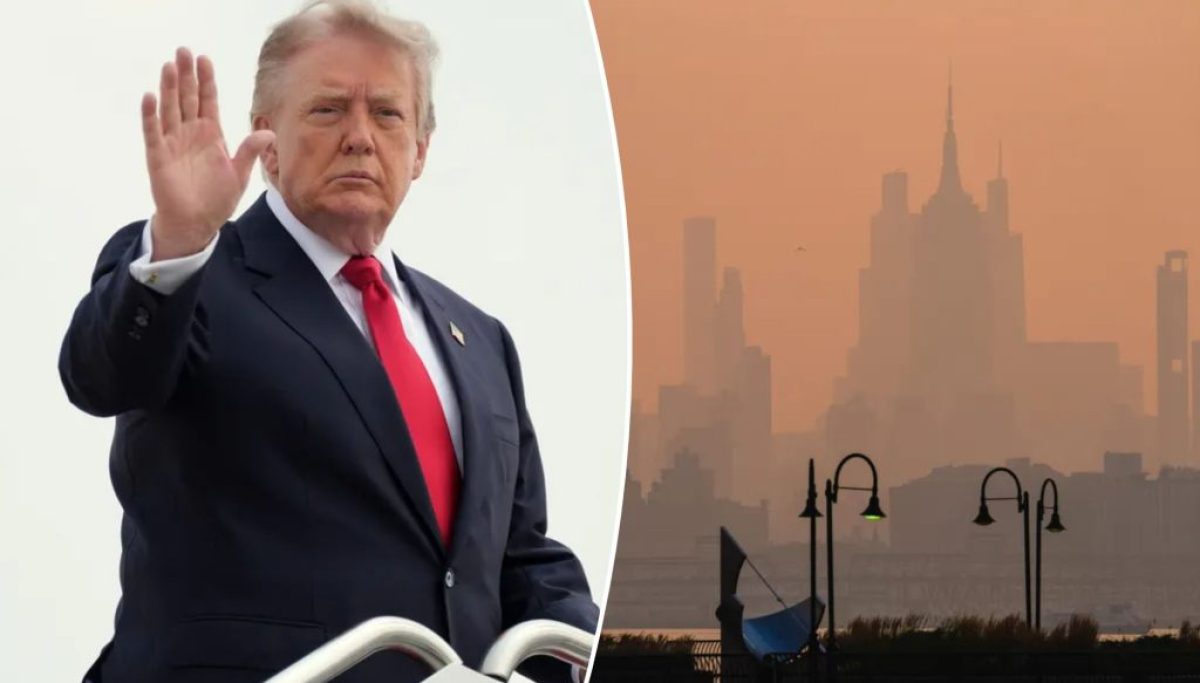
President Donald Trump has recently boosted tariffs against some Canadian exports to the U.S. to the 50% level, something unprecedented, even for him. He has done so, in part, as a reaction to smoke inundating the United States from Canadian forest fires.The New York Times, and who would know better on this matter, indeed, on all matters, rises to the defense of the Great White (pardon me for using this word, and, worse, capitalizing it) North. The Gray Lady states as follows: “Most Forest Fires in Canada Are Simply Impossible to Put Out. Half of Canada’s wildfires are in remote areas with no road access. Impossible to fight, they are often left to burn.”This is a not unreasonable excuse. After all, if it is not the fault of Canadians, it is unreasonable to blame them. Even Trump would not hold the country to the north of him responsible for the cold winds sweeping southward and freezing his citizenry during the winter. Upon one occasion, it was colder in Alberta than on Mars (January 14-15, 2020). But this defense will not hold water. Even the publisher of “all the news that’s fit to print” concedes that Ottawa is in effect responsible for the other half of Canadian forest fires that are not in remote areas. There are thus roads leading to them, and this excuse cannot suffice.But these journalists miss the point on all of the timber stands in Canada, not just half of them. The real reason for these outbreaks is only partially related to geography. A great deal of the blame lies with the socialism endemic to this country, in this case, applied to trees. Their government owns virtually all of that nation’s timberland.By the way, the U.S. does not get off scot-free on this matter, either. It, too, engages in these socialist practices. Let not the southern kettle entirely call the northern pot black (I apologize for not capitalizing this latter word).What are the specifics here? In Canada, 96% of the forests are in government hands and 4% private. The U.S. is a bit less socialistic, but nothing to write home about. Governments, here, control 38% of the woodlands, and private concerns 62%.What does free enterprise have to do with forest fires? Plenty. Assume that instead of Crown Corporations (that’s what they call their government entities up there), several dozen private forestry companies owned virtually all the timberland. Then, they would compete with one another on how to safeguard their property and profit from it. No roads in remote areas? Some would build roads there. Others would invest in planes capable of dumping massive amounts of water on such conflagrations. Some would bulldoze paths a quarter-mile wide to ensure that fires, when started, do not leap from one of their holdings to another. Lightning strikes cause combustion. Perhaps cloud seeding would reduce their incidence. Very severe penalties could be imposed upon those who build campfires during the dry season. These are only guesses. It is impossible to determine before the fact how entrepreneurs would maximize profits by protecting their property.Free market competition is responsible for why we have relatively good and inexpensive cars, clothes, charts, copper, cleansers, capital goods, and carpentry. It is why we are relatively wealthy compared to socialist countries. There are even almost perfectly controlled experiments with East and West Germany and North and South Korea, attesting to the fact that capitalism delivers the goods while central planning does not. It is difficult in the extreme to predict exactly how forest owners would protect their property. But it would be amazing, a veritable economic miracle, if this system worked for every other good and service under the sun except for the lumber industry.Would laissez-faire capitalism have to work perfectly to justify privatization? Not a bit of it. All that is required is that it function better than tree socialism, a very low bar indeed.According to Michael Flannigan, a professor at Thompson Rivers University in British Columbia, and a supposed expert on fire management, “To be blunt, even if we spend a lot more money, I don’t think we could stop these fires.”Well, he cannot see a way. But he is only a pencil-pushing, briefcase-carrying professor who has never met a forestry payroll. Pinko professors are not in the same league in this regard as entrepreneurs with their own money invested in stopping these fiery menaces.Is there any Canadian evidence as to which system works better, private or public? No. Government agencies fight fires on private lands in that country.The U.S. is different. One study of the matter offers this conclusion: “Private non‑industrial lands (small private owners) burned less than expected given their share of the landscape, for both forest and grass/shrub fires. In other words, fires systematically avoided these lands relative to their availability.”It is difficult to extrapolate from this finding since ceteris paribus conditions do not prevail. Other relevant things are not equal. For example, logging takes place to a greater proportional degree in the U.S. on private rather than public holdings.However, this study is evocative: if Canada privatized all forests, the suggestion emanating from this research and the pure logic of economics is that the country would undergo fewer and less severe infernos. Perhaps, then, Trump would lighten up (don’t count on it) in terms of raising tariffs on the basis of smoke inundations emanating from the north.There are, however, two complications that must be addressed if we are to shift from socialist to capitalist forest ownership and management.One, liability. Canada is truly vast. There is not much market value to land way off in the middle of nowhere. Private agents would certainly buy acreage put up for auction at very low prices. With no immediate plans to develop it, they might not care much if it all burned down. But suppose that owners of neighboring tracts sued on the grounds that carelessness had caused their trees to burn down, too. Only if the court would rule that their loss was pretty much zero, too, then this would not be a problem.WALTER E. BLOCK: CANADIANS SHOULD KISS TRUMP’S RING. HE JUST SHOCKED THEIR ECONOMY BACK TO LIFESecond, marginalism. This is a concept discovered in the 19th century by Carl Menger, William Stanley Jevons, and Leon Walras.What is going on here? Trump wants to raise tariffs on Canada for sending smoke southwards. But so much of Canada is so far away from the U.S., and there is so much of Canada, period, that there will undoubtedly be forest fires, and therefore smoke, no matter what. Yes, there would at least be marginally less if we stopped woke forest management. But here “marginally” is a synonym for “slightly.” Thus, moving to free enterprise in this dimension will likely not fully solve this problem. But it might help somewhat. And, it will be a move in the right direction for the Canadian economy.Walter E. Block is the Harold E. Wirth eminent scholar endowed chairman and professor of economics at Loyola University New Orleans.
Why Trump’s smoke tariffs miss the real Canadian culprit
Full Article
Original Source
Read the full article at Washingtonexaminer →KhanList aggregates and links to publicly available news content. We do not host full articles from third-party sources. Always verify important information with original sources.