
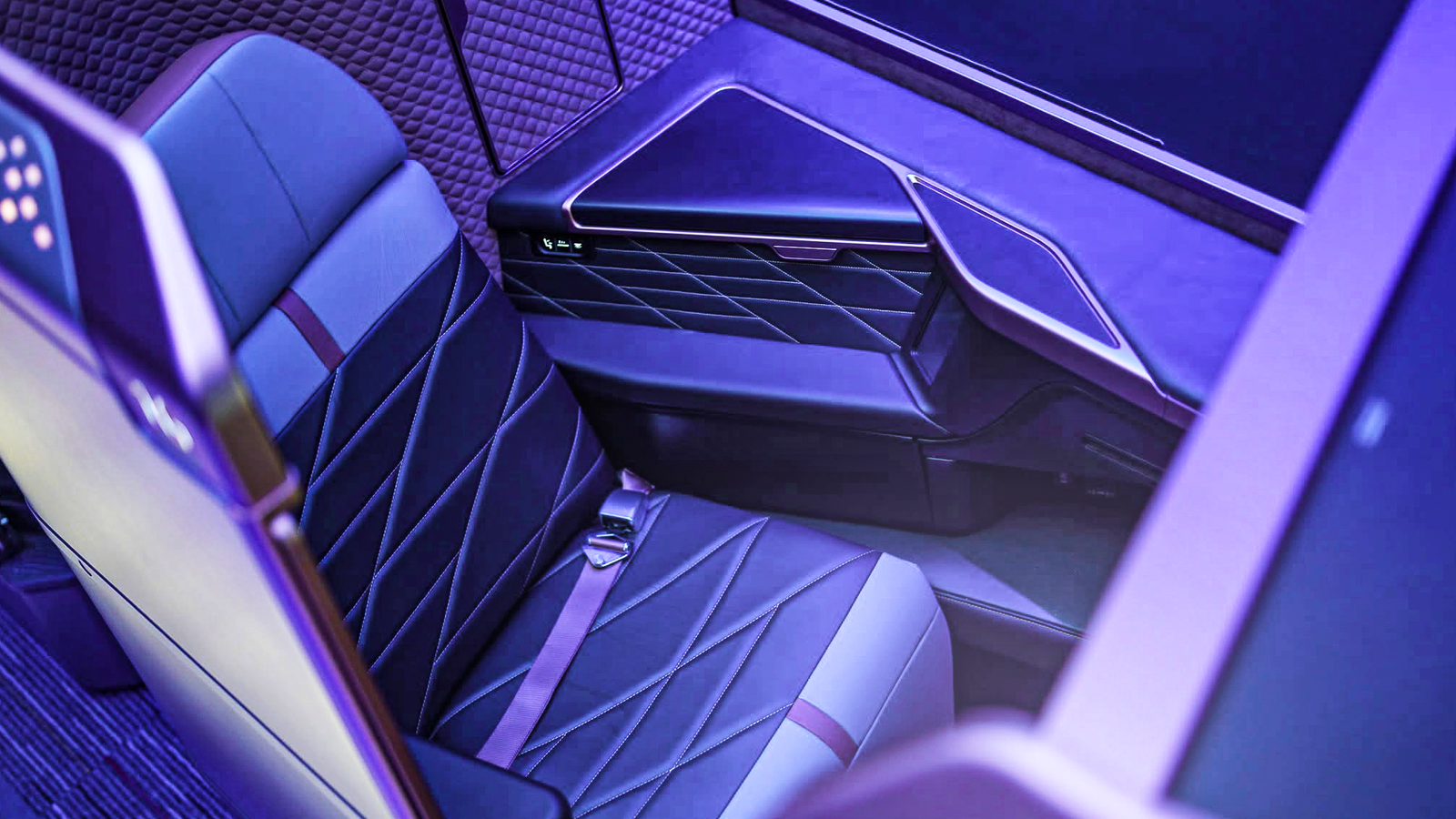
Published Sep 19, 2026, 7:00 PM EDT Aaron is an aviation enthusiast and world traveler with a deep interest in aerospace history and technology. He has traveled around the world numerous times, often incorporating visits to aviation museums and historic aircraft collections into his journeys. A native of New Zealand, he is an expert in aviation and maintains a broad interest in a variety of other subjects. While Taiwan’s luxury-branded STARLUX has not yet announced any long-haul routes to East Coast destinations in the United States, it is laying the groundwork to do so as it receives more of its premium-heavy ultra-long-haul Airbus A350-1000s. This will put it in increased competition with the premium-branded EVA Air on these routes. It also plans to grow its routes to Europe, with the first route to Prague commencing a week ago (as of the time of writing). European routes compete with both EVA Air and China Airlines (both mainline Taiwan-based airlines). Having only commenced operations in 2020, STARLUX plans to have a total fleet of 76 aircraft by 2033, which would make it a peer or near-peer rival of EVA Air and China Airlines, which currently have fleets of 89 and 85 airliners, respectively. Here is what to know about why STARLUX is configuring its new A350-1000s with 40 business class seats while retaining a token first-class fare. STARLUX Taking Delivery Of A350-1000s Credit: Aribus In January 2026, Airbus reported it had delivered the first of 18 planned flagship Airbus A350-1000s to Taiwan's STARLUX Airlines. The A350-1000 complements its existing fleet of ten standard A350-900s. The Taiwanese carrier became the 11th global operator of the stretched A350 and will be deployed on premier long-haul services from Taipei to Europe and North America, as well as some select destinations in the Asia-Pacific region. STARLUX is notable for exclusively operating Airbus aircraft, including a fleet of 13 A321neos (with more on order) and nine Airbus A330-900neos (with more on order). It has one of the youngest fleets, with its 36-strong fleet averaging 3.2 years old. As of August 2026, STARLUX has four A350-1000s in service, with one listed as delivered in December 2025, and the other three in March, July, and August 2026. Six will be delivered by the end of 2026. This brings its total A350 fleet to 14 (ten -900s and four -100s). STARLUX has also ordered ten A350F freighters based on the A350-1000. Airbus claims the A350 offers a 25% advantage in fuel burn compared to the aircraft it replaced. As the first A350-1000 was delivered, STARLUX CEO Glenn Chai said, "The delivery of our first A350-1000 marks the beginning of a new era in STARLUX’s long-haul capabilities." The High-Ratio Premium Seating Credit: STARLUX STARLUX Airlines is positioned as a luxury mainline Taiwanese carrier and is the first carrier on the island to operate the A350-1000. Taiwan is planning to use the new fleet to extend its "signature service from Taipei to even more destinations across North America and Europe." The A350-1000's maiden commercial flight with STARLUX took place on February 10th, flying from Taipei to Tokyo Narita. To commemorate the flight, the airline held an event in Taipei's Terminal 2, A8 lounge, where "Three lucky passengers took home 30 large cups of specialty coffee, unlocking a special inaugural flight surprise!" But what is particularly notable about the aircraft is the unusually high ratio of premium seating it is configured with. These A350-1000s are configured with 350 seats: four first-class seats, 40 business-class seats, 36 premium economy seats, and 270 economy class seats. The configuration is deliberate as STARLUX expands its fleet and network and competes with the rival Taiwanese airlines, China Airlines and EVA Air. STARLUX's Premium Brand Credit: STARLUX The A350-1000s are intended to fill the premium long-haul market in Taiwan, with one of the highest premium-seat ratios among Asian airlines. Around 23% of the A350-1000 fleet's seats are premium (first, business, premium economy). For comparison, STARLUX's A350-900 fleet has 306 seats: four first-class, 26 business class, 36 premium economy, and 240 economy class. While the number of first-class and premium economy seats remains constant, the A350-1000 adds 54% more business-class seats. It's worth noting that the decision to retain a token number of first-class seats is less about volume and more about branding. These four suites are considered a strategic brand product, allowing the airline to differentiate itself as a luxury carrier. The decision to include first-class is significant as the world is largely moving away from it, with many airlines eliminating the class or downsizing. The notable exception is Emirates, which has between a third and half of all the first-class seats, depending on how they are counted. STARLUX is the only Taiwanese carrier to offer first-class fares. Instead, the larger A350-1000 lets STARLUX add 30 more economy class seats, reflecting its longer fuselage, and, importantly, 14 more high-revenue business-class seats. STARLUX is a young carrier still in the growth stage. It was established in 2018 and conducted its first revenue flights in 2020. Competing For Taiwan's Luxury Long-Haul Market Credit: STARLUX With the airline just six years old and still building out its fleet, it is not replacing older generations of aircraft as legacy carriers generally do. Instead, the A350-1000 lets it create a two-tier long-haul fleet with the A350-900, or a three-tier fleet if you count the A330neo. The A330neo is mostly used on medium-haul Asian routes. The massive advertised 8,400 nautical mile range of the A350-1000 allows it to fly nonstop from Taipei to destinations like New York, Boston, and other East Coast North American markets. STARLUX says, "With a range of up to 9,700 miles (15,600 kilometers or 8,400 nautical miles), the aircraft will play a key role in the airline’s expansion into North American and European markets." STARLUX Airlines (per Planespotters.net, 2025 Annual Report) Current fleet size (August 2026) Planned fleet size (2033) Airbus A321neo 13 27 Airbus A330-900neo 9 11 Airbus A350-900 10 10 Airbus A350-1000 4 18 Airbus A350F None 10 Total 36 76 This will give STARLUX a temporary but significant advantage, as EVA Air and China Airlines are still waiting for their A350-1000 deliveries. EVA Air's current flagship is the Boeing 777-300ER with Royal Laurel business class, and China Airlines' flagship is the A350-900. China Airlines is positioned more as a premium network carrier, rather than the luxury boutique carrier STARLUX is positioning itself as. Taiwan's Incoming Widebody Airliners & Business Class Seats Credit: STARLUX Of these two carriers, EVA Air with its Royal Laurel product on the Boeing 777-300ER is considered the main rival in the premium long-haul segment. EVA Air's Boeing 777-300ERs are configured with 38-39 Royal Laurel business-class seats, while its Boeing 787-9s come with 26 and its Boeing 787-10s have 34. Deliveries of the A350-1000s are expected to start in 2027 and replace older Boeing 777-300ERs, although it's unclear what their configuration will be. China Airlines' A350-900s are configured with between 28 and 40 business-class seats, while its Boeing 777-300ERs have 40 business-class seats. Besides the 15 A350-1000s on order, it has 15 Boeing 777-9s, 18 Boeing 787-9s, and six Boeing 787-10s on order. The A350-1000 deliveries are expected to start in 2027, while the 777-9s will start in 2030. The configurations for these aircraft are still unclear. In December 2024, China Airlines announced it would upgrade the cabins of 15 of its A350-900s starting in 2027 and to be completed in 2028. These aircraft will have 306 seats, including 32 business-class, 31 premium economy, and 243 economy-class seats. The airline says that the upgraded cabins "will feature the same Oriental aesthetic of the current cabins, creating an emotional connection with travelers while strengthening the China Airlines brand. The new cabin design will deliver an unparalleled flying experience." STARLUX's Growing Long-Haul Routes Credit: STARLUX On East Coast routes, EVA Air currently flies to New York JFK, Washington Dulles, Toronto, and Chicago, while China Airlines flies to New York-JFK. On European routes, China Airlines flies to London, Amsterdam, Rome, Prague, and Frankfurt. Eva Air flies to Paris, Munich, and Milan. As of the time of writing, STARLUX operates only one European route: Prague, with its new Airbus A350-1000s. The first flight took place in August 2026. This will be its only European route in 2026, while its existing North American routes are Los Angeles, San Francisco, Seattle, Ontario (California), and a new route to Phoenix. In 2027, STARLUX plans to add routes to Barcelona, Zurich, Sydney, and Auckland (via Sydney initially). While its press release highlights the A350-1000's ability to reach the North American East Coast, it has not yet announced specific East Coast destinations for 2026 or 2027. New York is considered an obvious candidate. Currently, Planespotters.net lists the airline as having a fleet of 36 mainline aircraft in service, of which around two-thirds are widebody aircraft. In its 2025 annual report, the company said, "The Company plans to expand its fleet size to 76 aircraft by 2033, including eighteen A350-1000s, ten A350-900s, eleven A330-900s, twenty-seven A321neo passenger aircraft, and ten A350F freighters. As the fleet reaches economies of scale, it will help enhance overall operational efficiency and reduce unit operating costs."
Why This Airline Built A 40-Seat Business Cabin To Attack Its Transpacific Competitor
Full Article
Original Source
Read the full article at Simpleflying →KhanList aggregates and links to publicly available news content. We do not host full articles from third-party sources. Always verify important information with original sources.