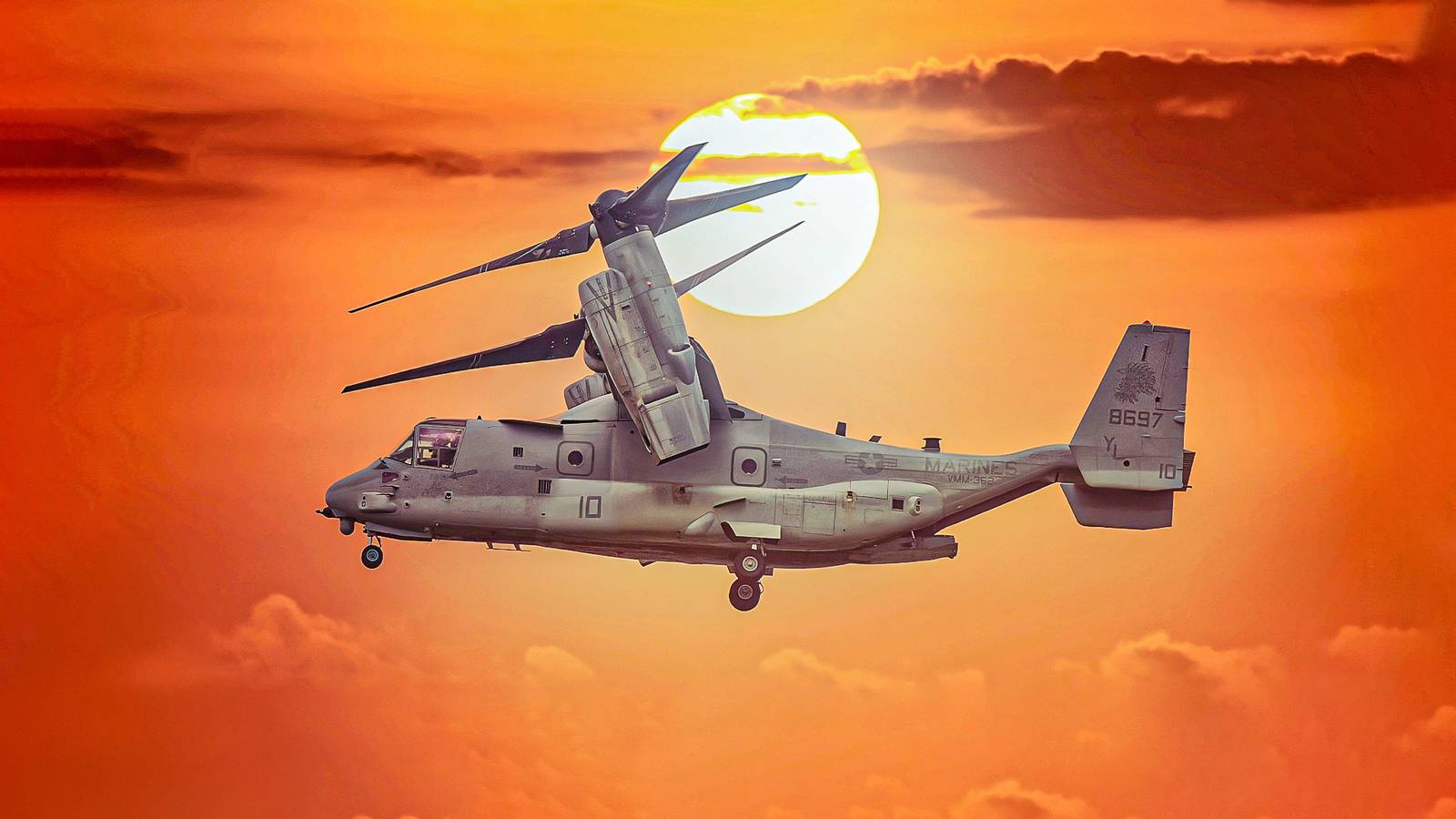
Published Jul 25, 2026, 1:00 AM EDT Luke Diaz is a freelance military writer with experience with active duty experience in the US Navy as well as defense and industrial engineering. He is a former Naval Flight Officer who performed tactical air control on the carrier-based E-2 Hawkeye. When the Bell V-22 Osprey entered service in 2007, it became the first operational tiltrotor aircraft in the history of aviation. The revolutionary plane introduced a new form of rotary wing flying that combined the best of helicopter vertical flight flexibility with the performance and endurance of fixed wing aircraft. To achieve the incredible feat of aerospace engineering of transitioning from vertical flight to horizontal flight, the V-22 must move its proprotors in a very specific speed range. What is dubbed the 'conversion corridor' from helicopter mode to airplane mode, or a 0° nacelle angle, is a graduated speed curve. According to Global Security, that range is between 40 and 120 knots. In airplane mode, the V-22 relies entirely on its fixed wings to generate lift. When converting from helicopter mode, the engine housings rotate forward, transferring the lift from the vertical thrust of the rotors to the surface of the wings. The entire engine assembly rotates when the pilot selects the desired angle, and they can choose 30° increments between 0° and 90°. There is a graduated scale of recommended speeds for transition depending on the exact angle of the proprotor. This speed is dictated by aerodynamic stall. As the nacelles tilt forward, they produce less vertical lift. The wings must pick up the slack. Flying The Osprey By The Numbers Credit: Department of Defense The pilot of a V-22 Osprey must be conscious of their airspeed at all times to ensure that the aircraft is operating at the correct range for its configuration. The low nacelle angles are considered to be between 30 and 60°. The wings need a steady airflow of at least 60 to 80 knots to begin generating partial lift. Flying below this speed while tilting forward will cause the aircraft to sink rapidly. Alternatively, as the aircraft speeds up, the housings must be tilted forward to align the rotors with the oncoming air. If a pilot attempts to fly at 140 knots while the nacelles are still stuck at a 60° angle, the immense aerodynamic drag pushing against the tilted proprotors would twist and tear. In full airplane mode, or 0° angle, the V-22 becomes a heavy, clean-wing aircraft. It requires a minimum speed of roughly 130 to 140 knots just to stay airborne. Transitioning to 0° below this speed results in an immediate wing stall. Nacelle Angle Min Speed (Knots) Max Speed (Knots) 90° (Vertical) 100 60° (Mid-Tilt) 60 (111 kmh) 120 (222 kmh) 30° (Mid-Tilt) 90 (167 kmh) 140 (259 kmh) 0° (Horizontal) 140 (259 kmh) 280+ (519+ kmh) The conversion corridor is defined by a dynamic boundary of minimum and maximum speeds that shift depending on the exact angle of the engines. As the tolerable speed range is constantly shifting, a pilot cannot simply throw the nacelles forward. Only when the airspeed safely clears 140 knots will the flight computer allow the housings to lock all the way down to 0° for high-speed airplane cruise. Vertical Takeoff Or Landing In The V-22 Credit: Department of Defense Slowing down in an Osprey to achieve a vertical landing in the same manner that a helicopter can is the opposite procedure but carries more risk of an aerodynamic stall and other hazards. The pilot cannot simply pull the engines up at cruise speed. Doing so would tear the wings off due to structural overloading. To safely shift backward, the pilot must reverse the logic of the conversion corridor, trading forward airspeed for tilt angle to generate more lift from the prop rotors. The Osprey can cruise at over 250 knots, so to begin the process of making a vertical landing, airspeed must be bled off until the V-22 comes into the tolerable transition range to increase its nacelle angle. As the pilot rotates the proprotors up to roughly 60 degrees, the 38-foot proprotors begin inducing a massive amount of drag. The wind resistance against the face of the tilted rotors acts as a severe speed brake, aggressively decelerating the aircraft. Passengers can feel a distinct sensation of being thrown forward into their seat harnesses. As the forward airspeed drops below 100 knots, the fixed wings rapidly lose their ability to generate lift. At this stage, the pilot relies on the thrust control lever to control lift through engine power. With airspeed dropping below 40 knots, the nacelles are brought fully vertical to 90° or even 95° with the reverse thrust feature. At this stage in the V-22 flight profile, pilots must be aware of one of the greatest aerodynamic risks to their aircraft: vortex ring state. If the aircrew descends too quickly while transitioning, the aircraft can sink into the downward rotor wash as air recirculates upward outside of the blades. This forms a destructive airflow that robs lift from the prop rotors. If VRS occurs to one wingtip before the other, it can induce a sudden uncommanded roll that flips the Osprey upside down during vertical landings. This exact mishap led to a number of tragically fatal crashes during the development of the V-22. Defeating The Tyranny Of Time And Distance Credit: Department of Defense While an amazing feat of aerospace technology, the V-22 Osprey has long been a controversial aircraft due to safety issues during development that cost the lives of aircrew and Marines. Still, the US Marine Corps championed the revolutionary tilt rotor as it solved a fundamental vulnerability for the Marine air ground task force. Before the Osprey, the Marines relied on traditional helicopters with limited speed and range. The V-22 fundamentally revolutionized amphibious warfare by combining the vertical agility of a helicopter with the speed and range of a turboprop airplane. In the 21st century, emerging threats are growing more sophisticated, requiring standoff range at greater distances for the Navy ships that carry the Marines to and from their missions. With the advancement of anti-ship munitions and hypersonic cruise missiles by near-peer adversaries like the People's Republic of China, Navy ships most often loiter 50 to 100 miles (80 to 161 km) over the horizon from the target area during amphibious operations. A legacy helicopter traveling at 120 knots takes nearly an hour to make a single round trip to the beach. This slow speed leaves troops exposed inside a flying target for far too long and prevents rapid reinforcement. The V-22 can fly at 240 to 280 knots. It cuts transit times by more than half, allowing forces to attack from extreme distances, strike deep inland, and return for reinforcements. This capability is crucial to the Marines as they re-embrace a 'Raider Doctrine' as a part of the 'Pivot to the Pacific' by the US Armed Forces as a whole. First Of Its Kind: The Tiltrotor Advantage Credit: Department of Defense The performance gap between the V-22 and the helicopters it replaced highlights why the military refused to cancel the program despite its troubled development history and ongoing mechanical issues. One of the strongest cases for the Osprey is its ability to save lives by delivering a wounded soldier from the frontline to medical aid within the 60-minute 'golden hour.' The odds of survival exponentially improve if a severely wounded Marine is on the surgical table within this time frame, a task that was often impossible with conventional helicopters. The V-22 transformed medical evacuation, or MEDEVAC, allowing the military to pick up wounded troops hundreds of miles away and fly them at airplane speeds directly to medical care, saving thousands of lives in Iraq and Afghanistan. Of course, the other reason the military continued to work toward making tilt rotor airlift a reality was the tactical advantage it delivers to battlefield commanders. Aside from its dramatically higher speed compared to a helicopter, the vastly longer range of the Osprey makes it a much more unpredictable adversary when enemies attempt to counter air assault raids. Ships can launch the V-22 from further away, and it has the flexibility to touch down across a much faster stretch of coastline or even penetrate inland far deeper than any helicopter can. Trailblazing A New Era: Lessons Written In Blood Credit: Department of Defense There was no mistake that the strategic value of the Osprey came at an undeniably high price. The development of the V-22 cost the lives of 30 service members between 1991 and 2000. The most catastrophic of them all was the mishap in 2000 when 19 Marines were killed in a VRS-induced crash. Even after becoming fully operational in 2007, the V-22 has struggled with severe mechanical issues within its complex proprotor gearbox. In June 2022, 5 Marines were killed in a crash caused by drivetrain malfunction. Then in 2023, 8 US Air Force crew were killed in a CV-22 crash due to metal contamination in the main gearbox. The global fleet was grounded after the 2023 mishap until a mechanical fix could be rolled out to prevent future tragedies. The sacrifices of these service members paid for the hard-won lessons that laid the foundation for an entirely new branch of aviation in the history of flight. Now the US Army is officially beginning its own transition to the age of tilt rotor flying. The Bell V-280 Valor was officially designated as the MV-75 Cheyenne II to become the future backbone of the US Army's combat aviation brigades. Today, Army pilots are training with US Marines who have accumulated two decades of operational experience with the world's first tiltrotor. The MV-75 will eliminate many of the mechanical complexities that have plagued the Osprey to improve safety of flight and reliability. Instead of rotating its entire engine nacelle, only the prop rotors and the shaft that turns them will move as it transitions between phases of flight. As the Cheyenne II paves the way toward the next evolution of tilt rotor aviation, it does so in the towering shadow of the legacy of the V-22 Osprey.
Why The V-22 Osprey Can Only Transition Between Helicopter & Airplane Flight Within A Carefully Controlled Speed Range
Full Article
Original Source
Read the full article at Simpleflying →KhanList aggregates and links to publicly available news content. We do not host full articles from third-party sources. Always verify important information with original sources.