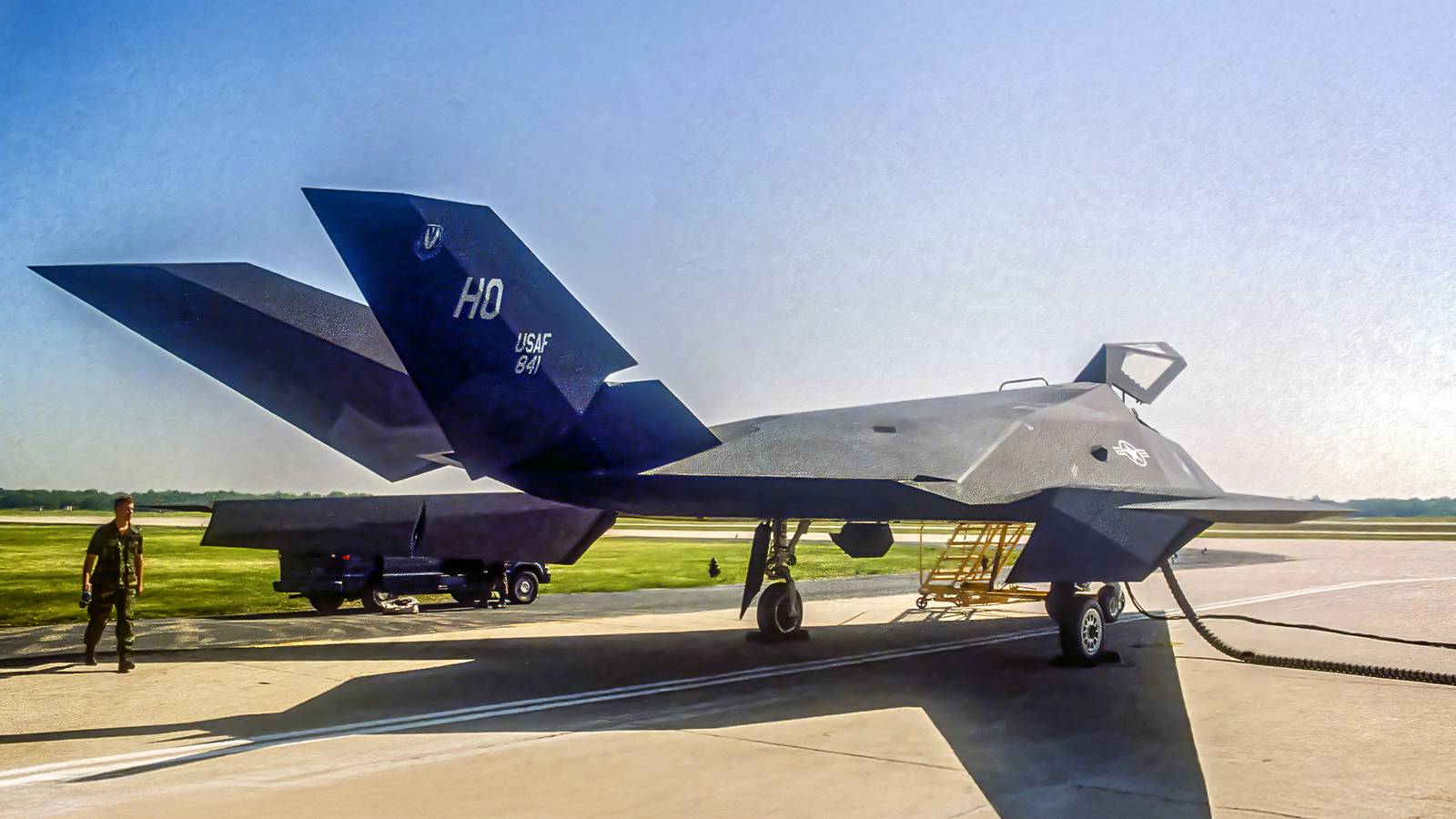
Published Jul 19, 2026, 9:00 PM EDT Luke Diaz is a freelance military writer with experience with active duty experience in the US Navy as well as defense and industrial engineering. He is a former Naval Flight Officer who performed tactical air control on the carrier-based E-2 Hawkeye. Despite its official retirement in 2008, the Lockheed F-117 Nighthawk has continued to fly for the US Air Force and is expected to keep serving until 2034. The iconic stealth fighter-bomber that was a pioneer of one of the most revolutionary advances in air warfare has become a valuable training platform. Instead of rusting out in the Boneyard, the Nighthawks are now helping to improve the tactics and technology on the latest and greatest fifth-generation stealth fighters. Although the technology in the Nighthawk is old by comparison, the aircraft are cheaper to fly and relatively reliable compared to their more exquisite successors. This makes them a highly valuable red air asset and provides realistic combat scenarios to simulate near-peer adversary tactics. The jets also provide a useful test bed thanks to their exceptionally low radar cross-section, which still makes them a very stealthy airframe even by current standards. Now seen primarily flying over the Tonopah test range in Nevada, the jets serve as both a low-risk test bed for emerging weapon systems and a stable target in anti-stealth tactics thanks to their well-documented properties. Whether it's flying as a stand-in for a Russian Su-57 or a Chinese J-20, the F-117 is still an excellent aggressor and flying laboratory. So the Air Force decided that despite retirement from frontline duty, it won't be going anywhere for almost another decade. Skunk Works' F-117 By The Numbers Credit: US Air Force Flying the retired Lockheed F-117 Nighthawk is exceptionally cost-effective because it shields highly valuable frontline fighters from wear and tear while operating on a mature platform that is already bought and paid for. Maintaining a small portion of the fleet airworthy is highly beneficial to the Air Force's readiness levels and budget. The aircraft are fully paid for, and using them for specialized testing prevents unnecessary flight-hour wear and tear on frontline assets like the Lockheed Martin F-22 Raptor or F-35 Lightning II. In addition to the chronically problematic introduction of the F-35 Joint Strike Fighter, which continues to go up in cost while failing to deliver combat capability, simply turning it on costs a lot more money than an F-117. By substituting the F-117 as a test target or aggressor, the Air Force saves millions of dollars per exercise while keeping active-duty fighters available for real-world deployments. A rough estimate puts the Nighthawk around $25,000, with an F-35 around $45,000 and up to $80,000 to fly an F-22. Looking at stealth bombers, the numbers get even more staggering, with the Northrop Grumman B-2 Spirit burning over $130,000 per flight hour, and while the B-21 Raider is still in operational testing, it is likely to cost over $80,000 per hour to fly. It seems counterintuitive that a 1980s airframe with obsolete combat capabilities is relevant. However, its value lies precisely in its now obsolete technology. Don't Fix It If It Ain't Broke Credit: Shutterstock By stripping away the pressure of combat readiness, the Nighthawk operates much like the Fairchild Republic A-10 Thunderbolt II, also known as the Warthog. When Lockheed designed the F-117 in the late 1970s, they kept costs down by raiding the parts bins of existing production aircraft. Since it uses proven components, it completely avoids the experimental hardware bottlenecks that plague modern jets. The F-117 relies on a mature, simplified design that completely avoids the astronomical software and engine costs of fifth-generation jets. The Nighthawk uses two General Electric F404 non-afterburning turbofans, which were mass-produced for the McDonnell Douglas F/A-18 Hornet and are actually going to be installed in the new Boeing-Saab T-7A Red Hawk trainer jet. The landing gear is actually a combination of parts bolted on that came off of both the A-10 and the McDonnell Douglas F-15 Eagle. The Nighthawk's controls were even pulled out of a General Dynamics F-16 Fighting Falcon and plugged straight in. At one time, its radar-absorbent material was a major maintenance cost sink, but that has changed. Today, it only needs to look stealthy enough to calibrate radar systems or play an adversary in a war game. The fact that the Nighthawk will not need to defend itself from actual threats that could endanger the pilot reduces the maintenance burden significantly. Unlike other stealth aircraft, which need to be combat-ready, the Air Force can utilize simplified, easier-to-maintain modern coatings to keep them flying cheaply. To an advanced Western radar system, an F-117 looks distinctly similar to low-observable threats being developed by foreign defense aerospace builders due to the technological disparity between the US and its adversaries. The exact RCS of the F-117’s flat, faceted shape is thoroughly documented; it serves as a perfect control variable. When testing new radar upgrades or anti-stealth sensors, engineers know exactly what the F-117 should look like on screen. Any deviation directly proves the effectiveness of the new sensor. The Burden Of An Exquisite Fighter Jet Credit: US Air Force The F-35’s Pratt & Whitney F135 engine is a miracle of engineering, but it is a financial nightmare. It runs incredibly hot to provide massive thrust, requires exotic thermal coatings, suffers from severe rotor blade cracking, and features highly complex variable-cycle technology. A single F135 engine overhaul can cost millions of dollars. Even still, the highest hidden cost of modern aviation is software sustainment. The F-35 runs on millions of lines of code, controlling sensor suites, electronic warfare systems, helmet-mounted displays, and more. By contrast, the F-117’s F404 engines are simple, analog, and run much cooler because they lack an afterburner. They can be serviced by standard technicians without needing hyper-specialized, proprietary contractor equipment. Its mission systems are also frozen in time and do not require any major updates beyond basic debugging. Again, drawing parallels to the Warthog, by shedding its complex wartime maintenance routine and relying on cheap, mass-produced legacy parts, the F-117 achieves a very similar, highly predictable operating cost. When the F-117 was an active combat weapon, it required a massive logistics tail to maintain its complex weapon-delivery systems, laser designators, and classified encryption suites. Now all of that is unnecessary, and most of the classified internal components have been stripped away to achieve a simple, low-cost price per flight hour, which is actually very similar to what the enduring A-10 costs as well. Putting The Nighthawk Through Its Paces Credit: The National Archives Catalog It seems that an essentially obsolete airframe with inferior performance would not make a very good adversary for the latest and greatest stealth fighters in the US inventory. However, modern air warfare is moving away from dogfighting to beyond-visual-range engagements that rely on sensor management and battlespace awareness. The US Air Force and other military powers are increasingly relying on technology and standoff weapons rather than performance or pilot skill to decide victory in the air. To that end, the F-117 makes a worthy foe in a simulated aerial battle. In fact, near-peer adversaries like the Russian Air Force and Chinese Air Force aircraft are less maneuverable and less stealthy than their American counterparts, which forces their tactics to follow a more restricted doctrine. Simulating low-flying tactics that leverage ground clutter to conceal the aircraft's radar signature means the Nighthawk's aerodynamic limitations do not affect its ability to realistically mimic threat aircraft behavior. It is also much more useful to aircrews in stealth aircraft like the F-35 or F-22 because their systems would simply immediately detect a non-stealthy legacy plane like an F-16 or F-15 and provide no challenge or training value. During massive war games like Red Flag at Nellis Air Force Base in Nevada, the F-117 acts as a consistent benchmark. Because the Air Force entirely controls the F-117's flight path, it can test Blue Force pilots under precise conditions. Commanders can evaluate exactly at what range, altitude, and weather conditions a friendly pilot finally detects a stealth target. Ultimately, the F-117 does not need to turn hard, pull high G-forces, or fly supersonic to be a lethal threat in a war game. Its only job is to be invisible enough to force America's top pilots to use every tool in their arsenal just to find it. Invisible Laboratory In The Air Credit: US Air Force By keeping the F-117 flying, the Air Force doesn't just save money; they gain a risk-free, highly predictable environment to perfect the bleeding-edge technology for the battlefield of tomorrow. The Nighthawk acts as a stealthy 'blank canvas' for the next generation of air power in its role as a flying laboratory for the Air Force. Most notably in recent years, the F-117 has been spotted flying over Nevada wearing highly unusual, reflective, mirror-like metallic coatings that shift between shiny and matte depending on the angle. It is speculated that these coatings are meant to significantly reduce the thermal signature of the aircraft, and a similar coating has been seen on some F-22 Raptors. This has led to speculation that it could be in development for stealth fighters on the front line in the future. By testing these delicate, reactive skins on the F-117 first, scientists can refine the technology before applying it to the operational F-35 fleet. On the other side of the testing spectrum the Nighthawkis a good proxy for the new low-observable cruise missiles and standoff munitions in development around the world. New hypersonic missiles designed to hit everything from high-value aircraft to strategic sites and supercarriers are not only fast but also stealthy. The Nighthawk can serve as an excellent test target for new radars, electronic warfare equipment, weapons, and more systems designed to counter these emerging threats.
Why The US Air Force Is Quietly Flying Its Retired F-117 Stealth Jets Until 2034
Full Article
Original Source
Read the full article at Simpleflying →KhanList aggregates and links to publicly available news content. We do not host full articles from third-party sources. Always verify important information with original sources.