
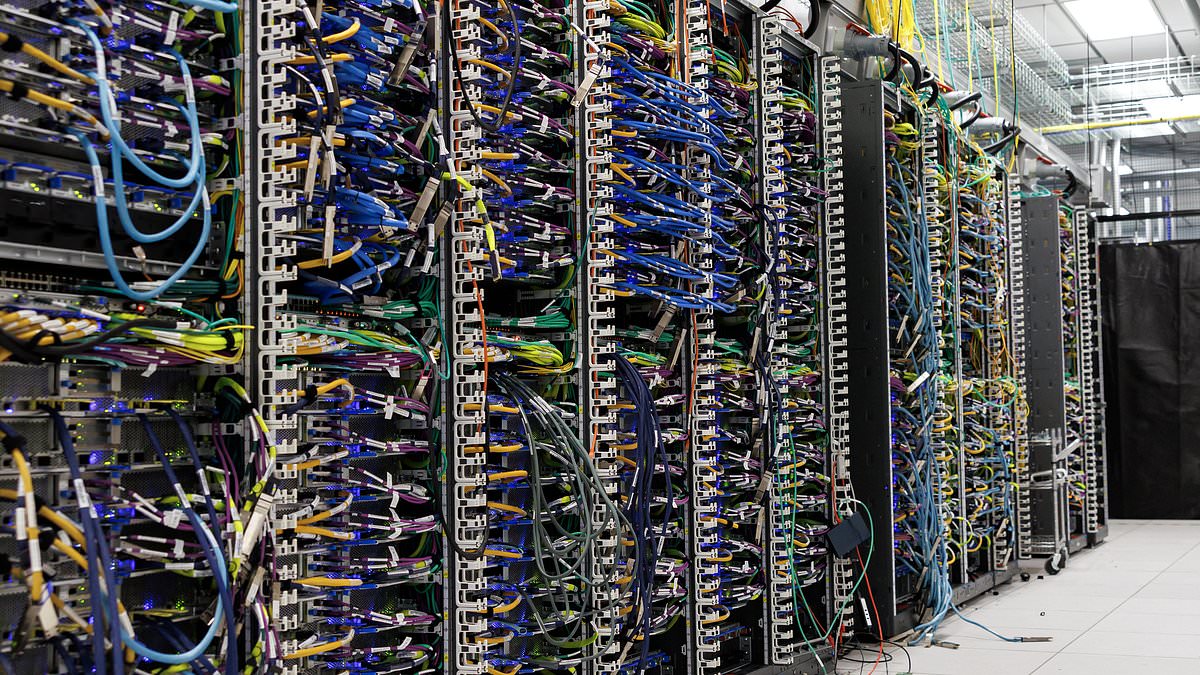
The internet has been left reeling after yet another wave of cyberattacks and outages rocked some of the world's biggest websites.Cybercriminals hijacked 178 companies, including Zoom, the BBC, and IKEA, stealing cryptocurrency or credit card details and infecting users' iPhones.Just hours later, thousands of people reported disruptions to Apple's iPhone apps, such as Apple Pay and iCloud, as well as Google's Gmail.Now, as websites scramble to restore services and patch security flaws, experts have warned that the web is more vulnerable than ever.The problem isn't just that companies are more exposed to hacks, but that these are far more disruptive when they do occur.Experts say that the world's digital infrastructure has become perilously dependent on a handful of tech giants.And, as the events of the past week clearly illustrate, when one of these services goes down, the consequences can be global.Dr Daniel Thomas, Director of the University of Strathclyde's Academic Centre of Excellence in Cyber Security Research, told the Daily Mail: 'The web has always been vulnerable to disruption, but it has become increasingly concentrated with a few players.' The internet has been left reeling after yet another wave of cyberattacks and outages rocked some of the world's biggest websites. Pictured: Servers at an Amazon Web Services data centreWhat tech disruptions has the world faced in the last week?The week of internet chaos began on Thursday night, when Microsoft users began experiencing problems with Outlook email services.By 6pm UK time, Microsoft users had logged nearly 140,000 reports of issues with Outlook, more than 2,000 times normal levels.The issue was soon apparent in more than 70 countries, where 430 million users rely on the affected products.Although some services began returning on Friday afternoon, it wasn't until Saturday morning that the tech firm announced that efforts to address the underlying problem had been completed.On Friday, the US Federal Aviation Administration issued a rare nationwide 'ground stop', bringing all flights to a halt, after a telecommunications failure.The root cause of the issue is still being investigated, but Transportation Secretary Sean Duffy claimed it was triggered after a computer router installed as part of an upgrade from copper wire to fibre started sending out faulty signals.Then, on Monday, United Airlines experienced service outages that led to even more flights being grounded, and Chase Bank customers reported experiencing issues.Just a day later, it was reported that the US National Security Agency was experiencing network issues after NSANet, a highly classified network used for internal communications, was down.And, to top it all off, both Apple and Google began reporting service disruptions on Tuesday night, leaving thousands of users unable to access email and other services. On Monday, United Airlines experienced service outages that led to flights being grounded, days after the FAA issued a rare nationwide 'ground stop'. Pictured: United Airlines customers queueing on Monday Are any of these related to cyberattacks?Currently, it is not believed that any of the recent service disruptions are related to a cyberattack.In a statement issued on Monday, JPMorganChase said it had 'experienced a temporary issue related to a software bug in an on-premises hardware system' and that there was 'no evidence this is cyber-related'.Likewise, experts say that Apple's description of a faulty internal update as the cause of its recent outages matches the evidence.Mantas Sasnauskas, cybersecurity researcher and editor-in-chief of Ransomnews.com, told the Daily Mail: 'Sign-in failed for everyone at once, including the tills in Apple's own shops, and most services were back within hours.'That is what a bad update looks like. Criminals with that level of access steal data or demand money. They don't log people out for an afternoon.'While Apple is yet to release a full technical explanation, Mr Sasnauskas says that cybersecurity professionals are 'taking its word' for now.Which companies have been hacked?In addition to the recent service outages, the digital world has also been rocked by a massive hack affecting 178 companies.The attack, detected Monday evening, targeted Optimizely, a service companies use to test different website layouts and features. On Friday, the US Federal Aviation Administration issued a rare nationwide 'ground stop', bringing all flights to a halt, after a telecommunications failureHackers used its customisation tool to insert malicious code into webpages. It was delivered alongside genuine software through Optimizely's trusted systems, making the threat harder to detect.The cybercriminals' malicious software was designed to steal cryptocurrency payments, capture credit card details entered into certain online forms and hack iPhones and iPads with security weaknesses.In a statement, Optimizely said: 'We've fixed the vulnerability and removed the injected code from affected projects. We've also taken steps to secure affected user accounts and put additional protections in place to prevent unauthorised code from being delivered.'However, what makes this Optimizely hack so alarming is that criminals didn't need to break into each company individually, but instead targeted a single supplier.Mr Sasnauskas says: 'Optimizely's code already runs on its customers' web pages, so when attackers found a flaw in its signup process, they slipped their own JavaScript into customer projects.'Why were so many companies vulnerable to this attack?Researchers say that so many companies were exposed to this same attack because they were all dependent on a single third-party supplier.According to Mr Sasnauskas, this is a weakness that extortion gangs frequently exploit.For example, on Monday, a group named 'n0n' claimed to have stolen data from 59 organisations, including Visa.Mr Sasnauskas says Visa subsequently revealed that the incident involved 'a third-party supplier in Asia Pacific'. Thousands of people reported disruptions to Apple's iPhone apps, such as Apple Pay and iCloudHowever, the sheer scale of the Optimizely hack now reveals just how dependent many companies have become on these suppliers.Dray Agha, senior manager of tactical response at cybersecurity firm Huntress, told the Daily Mail: 'This highlights a systemic weakness in our shared digital backbone. Many modern applications rely heavily on open source code and third-party libraries.'A hidden flaw in one of these foundational building blocks instantly exposes every system that trusts it. Businesses must stop assuming their outsourced technologies are completely secure.'Has the internet become more vulnerable to disruption?With so much digital chaos over the last few days, it may seem like the internet itself has become increasingly fragile, but the full picture is somewhat more complex.Steven Watt, Professor of Practice in Cyber Security at the University of St Andrews, told the Daily Mail: 'In some ways, it is less vulnerable than before, because security flaws are being found and fixed all the time.'What has changed is how much we depend on it. More and more systems are connected, so even a routine fix can have knock-on effects.'On one hand, our personal lives have become significantly more dependent on internet services.In the past, even fairly lengthy power cuts wouldn't affect our ability to communicate, work, or pay for things.But now, even a temporary disruption to a particular online service can have serious real-world consequences.Meanwhile, digital services have become increasingly dependent on massive providers, such as Google, Amazon and Microsoft, alongside a small number of third-party systems. Experts say that the internet has become dangerously reliant on a handful of critical providers, such as Microsoft, and is exposed to massive disruption if one failsIf a single one of these critical points fails, the entire system can come down with it.Dr Alexander Taylor, Senior Lecturer in Communications at the University of Exeter, told the Daily Mail: 'The internet is increasingly fragile because, despite being designed around a distributed network, its infrastructure has become increasingly concentrated in the hands of a small number of powerful technology corporations.'It's the sheer scale of our dependence and the interconnectedness of these systems that makes relatively small technical failures capable of cascading across countries, businesses and essential public services.'When a handful of providers underpin such a vast proportion of our digital infrastructure, a single failure can have extraordinary reach.'Are things getting worse?While researchers and professionals are actively working to make the internet more reliable, experts also warn that there are forces which could disrupt the entire system.Most pressing of these is the rapid advancement of AI tools, and companies' growing willingness to use them.Dr Daniel Thomas, Director of the University of Strathclyde's Academic Centre of Excellence in Cyber Security Research, says: 'Generative AI software engineering - known as vibe-coding - and the "ensh*ttification" of online platforms seem to be leading to lower quality and less reliable systems that no human really understands.'This so-called 'ensh*ttification' is a term used to refer to gradual decay in the quality of products on the internet, as providers prioritise profit and rapid development over reliability.According to Dr Thomas, this process has been made even worse by the fact that many computer developers now use AI-powered code-writing tools to produce the bulk of their software. Experts say that companies using AI-powered code-writing tools, such as Anthropic's Claude Code, have made websites less reliable and more prone to failure. Pictured: Anthropic CEO Dario AmodeiHe says: 'The web has always been vulnerable to disruption, but it has become increasingly concentrated with a few players who are ensh*ttifying.'Meanwhile, AI has put increasingly sophisticated hacking tools in the hands of relatively unsophisticated criminals, opening up entire new frontiers of attacks.Professor Muttukrishnan Rajarajan, Director of the Institute for Cyber Security at City, St George's, University of London, told the Daily Mail: 'Today AI is discovering different types of vulnerabilities.'Recently, AI was used to detect vulnerabilities in JavaScript and Java. These are some of the widely used languages in web design.'With the increasing advancement of AI tools, it will become easy to discover existing vulnerabilities that have not been noticed for well over 25 years.'How bad could this become?As the internet shows no signs of becoming less dependent on a handful of key companies and hackers gain access to more powerful tools, experts are worried that this past week is only the beginning.Dr Narmin Nahidi, Assistant Professor of Finance at the University of Exeter, told the Daily Mail: 'The potential consequences extend far beyond temporarily losing access to emails or online meetings.'She adds that the greatest potential risk is a 'cascading failure' when disruption to one part of the digital infrastructure causes failures in connected services.In the worst-case scenario, this could lead to multiple vital service providers going offline at the same time, in a scenario known as a 'black sky event'. Dr Nahidi says: 'For businesses, prolonged disruption can lead to lost revenue, interrupted operations, reduced productivity, and reputational damage.'For critical services such as healthcare, transportation, banking, and emergency response, the consequences could be considerably more serious, particularly if essential systems become unavailable simultaneously.'Experts have previously warned that the UK's critical infrastructure is also at a growing risk of disruption.If the energy grid, water network, or healthcare system were targeted by a hack or affected by an outage, it could trigger a national emergency.However, experts don't think the next major hack will be quite so cinematic.Mr Sasnauskas told the Daily Mail: 'I wouldn't bet on a Hollywood target like the power grid going dark.'My money is on a supplier most people have never heard of: a login provider, a payments processor behind smaller banks, or the remote-management software that IT firms use to run thousands of client networks at once. That is where one break-in spreads furthest, and it is where attackers have been going.'Companies affected by the Optimizely hack Banking and finance: Paychex; Equifax, Equifax Canada and Equifax UK; SmartAsset; SmartAdvisor Match; ABN AMRO; ABN AMRO Lease; TaxAct; NetCredit; Associated Bank; S-Pankki; The Work Number; Funding Circle; CashNetUSA; OnDeck; ICS Cards; Rest Super; Compare Club; Energy Scout; and Hang Seng Investment. The list also includes HSBC operations in the US, Hong Kong, Mexico, Singapore, Australia, the UAE, Malaysia, Taiwan, Vietnam, Egypt and the Philippines. Technology: Zoom, Bitly, Salesforce, GitLab, Optimizely, Mixpanel, Typeform, InMotion Hosting, Wasabi, Perforce/Zend/Puppet, Tableau, Hootsuite, Smartsheet, MuleSoft, Thales/Imperva, Tricentis, Web Hosting Hub, QR Code Generator, ServiceChannel, Brandfolder, Intelex, Enverus and Accruent.Retail and fashion: IKEA¿s online home-design service, ASOS, Mattel, American Eagle, Scheels, Ariat, American Girl, StackSocial, Crocs India, Todd Snyder, Just Russel and Loloi Rugs. Levi¿s operations in Japan, Indonesia, Australia, Malaysia, the Philippines, Singapore, Korea and New Zealand were also listed. Insurance and related services: Asurion/uBreakiFix, Mutual of Omaha, Admiral, Securian Financial, eRenterPlan and Danish unemployment fund AKA.Property and moving services: Buildium¿s managebuilding.com service, Loft Living apartments, Buildium¿s main website, HireAHelper, Flytte.no and MovingPlace.Food and hospitality: Restaurant ordering platform order.online, Heineken, Home Chef, Starbucks Canada and Cinnabon.Home technology: Resideo, Honeywell Home, myQ (Chamberlain), Chamberlain and First Alert.Education: Walden University, Perlego and Chamberlain University. Streaming and entertainment: Peacock, D&D Beyond, Wizards of the Coast, NOW TV, Zattoo, Crave, Starz, SkyShowtime, Bravo, SeaWorld, WOW (Sky Deutschland) and NOW Italia. News and media: CNN, BBC, Fox News, certain NPR legacy and staging sites, CTV News, Fox Sports, BNN Bloomberg/CP24, TSN, Top Gear and BBC Earth.Airlines and travel: Alaska Airlines/Hawaiian Airlines, Transavia, Air France-KLM, KLM Netherlands, Trafalgar, Contiki, Insight Vacations, The Travel Corporation and Costsaver.Healthcare and pharmaceuticals: Invisalign, Takeda, Covetrus, iTero (Align), Covetrus Pharmacy, myCovetrus, RaySafe (Fluke) and Takeda Oncology.Industry and manufacturing: Fluke, eMaint, Fluke Networks, Vaillant Germany, Fluke Process Instruments, Fluke Biomedical, Landauer and Vaillant Spain.Telecommunications: Virgin Media, Virgin Media O2, Vodafone Australia, O2, TPG Telecom, Mint Mobile and TalkTalk.Cryptocurrency and trading: Ledger, IG, OANDA/Coinpass, Interactive Investor, TMS Brokers and Betashares.Charities and civic organizations: Change.org, ASPCA, UNICEF USA and DonorsChoose.Gambling: Betsson, PokerStars, Tombola and Betfred.Professional services: Freshfields, CohnReznick, Baringa and Cro Metrics.Shipping and logistics: ShipStation/ShipEngine, Stamps.com and a separately listed ShipEngine website.Automotive: Lucid Motors, O'Brien Glass and a Chevrolet dealership website associated with Bill Rapp.
Why the internet is more vulnerable than ever, as string of cyberattacks sparks panic
Full Article
Original Source
Read the full article at Dailymail →KhanList aggregates and links to publicly available news content. We do not host full articles from third-party sources. Always verify important information with original sources.