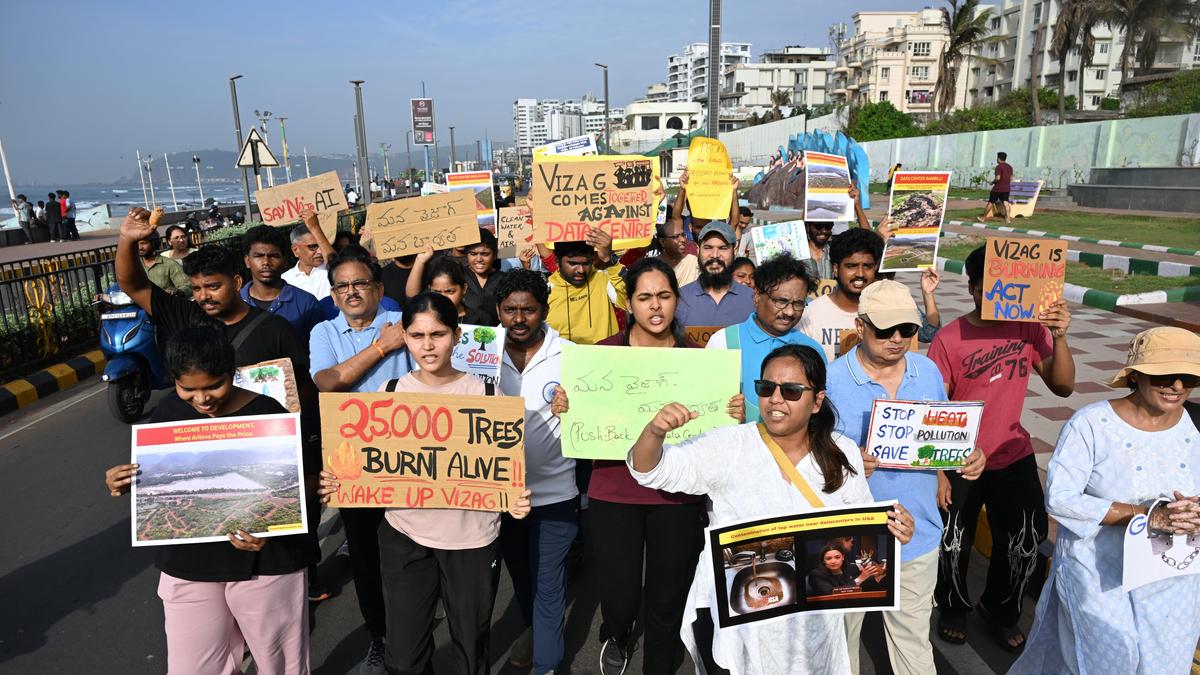
The story so far: This week, people in Andhra Pradesh and Maharashtra took to the streets against proposed mega data centre projects in the States.In Andhra Pradesh, after the government allotted about 601 acres of land in three parcels across three locations in Visakhapatnam and neighbouring Anakapalli district, Raiden Infotech India Pvt. Ltd. — a Google company — began developing a 1GW AI data centre hub, with Adani Infra/AdaniConneX as the notified development partner.In Maharashtra, residents of Thane have been opposing Amazon’s proposed hyperscale data centre project. The ₹7,203.29-crore project spread over 53.73 acres is under construction across the villages of Balkum Pada and Majiwada in Thane. The residents held several protests last week.Why the opposition?Citizens’ groups in Visakhapatnam have opposed the Andhra project, highlighting concerns over the strain on resources such as water and power, as well as its environmental impact. The project is coming up at three locations — Adavivaram-Mudasarlova, Tarluvada, and Rambilli — and campaigners have cited the Super El Niño-like weather pattern that has put considerable strain on water resources across the State to oppose the data centre hub.In Thane, people have cited sketchy details, discrepancies in water usage data, lack of consultation with locals as reasons to rally against the project. Residents represented by the citizen group ‘Wakeup Thanekar’ has demanded clarity on the water usage and a public hearing. It has sought the establishment of baseline noise and air quality measurements, and a clarity on the actual benefit to locals.Are people against technology?The opposition from citizens was not to technology or investment but to a project that offered little in return for its costs, said Sohan Hatangadi, an environmental sustainability campaigner in Visakhapatnam. He cited limited permanent employment and limited ancillary industry, even as the city provides land and incentives.President of Green Visakha Raja Rama Mohan Roy, who led a procession in the city, said the project risked the “reckless exploitation of nature”, with forests cut and hills “razed and flattened”. He said the Kambalakonda Eco-Forest, which he described as “the lungs of Vizag”, and the surroundings of the Rambilli Wildlife Sanctuary faced a threat, along with the Mudasarlova reservoir, a source of drinking water for the city.He said the destruction of pollinators and other species could also affect agriculture and argued that data centres should instead be located in Amaravati, where major industry is yet to come up.In Thane, activists are against “unplanned development”. “We cannot have the data centre in residential area, which are already suffering water shortage, load shedding, and other issues,” said Sadhana Pradhan, convenor of Wake-up Thanekar, adding that they are waiting for a meeting with State government representative.The group plans to file a petition with the National Green Tribunal after the government response. It held a meeting with the Thane municipal commissioner and representatives of Amazon. “We are disappointed as they had no answers to basic question of what will be the source of the water required for cooling,” said Ms. Pradhan.What are the water woes?A more pressing constraint for Visakhapatnam was inadequate storage capacity, a concern that engineers had flagged internally, said D. Murali Krishna, Executive Engineer, Water Supply, of the Greater Visakhapatnam Municipal Corporation. He said roughly 1,000 to 2,000 acres are needed to be set aside for reservoirs, and that around 5 thousand million cubic feet of storage could sustain the city for nearly six months without fresh inflows.The Super El Niño-like pattern behind this year’s delayed monsoon has forced authorities to ration irrigation water in the Krishna delta, drawing even from the Sileru to supplement Godavari flows. Campaigners argue that committing water resources to industrial use, even where current draw is limited, deserves closer scrutiny in a year of acute regional water stress, given the city’s acknowledged shortfall in storage infrastructure.Meanwhile, the Thane project will require 422 MW power and backup of 193 generators. Wakeup Thanekar group said that Amazon and the Thane corporation have given two different figures on water usage. While Amazon claimed 125 kilo litres a day per day usage, the corporation announced that it will provide 12 million litres a day of recycled sewage water at Rs 7.50 per 1,000 litres.Jatin Kothare, a resident in Balkum, said that the city is already “short of 40 MLD water”. “So how you going to fulfil the water requirements of the data centre?”In a blog post last month, Amazon had claimed that its data centre in Thane “will not use any water for cooling”. “In fact, we do not currently use water for cooling in any of our data centres in India, and do not draw from the community’s drinking or potable water for cooling purposes. The approved water supply permit for the Thane data centre is 0.01 million litres per day (MLD) and is strictly for basic human needs, including restrooms and drinking water for Amazon employees,” it had said.But Mr. Kothare sounded sceptical. “They don’t comply on what they commit.”
Why residents are opposing data centres in Andhra Pradesh and Maharashtra? | Explained
Full Article
Original Source
Read the full article at Thehindu →KhanList aggregates and links to publicly available news content. We do not host full articles from third-party sources. Always verify important information with original sources.