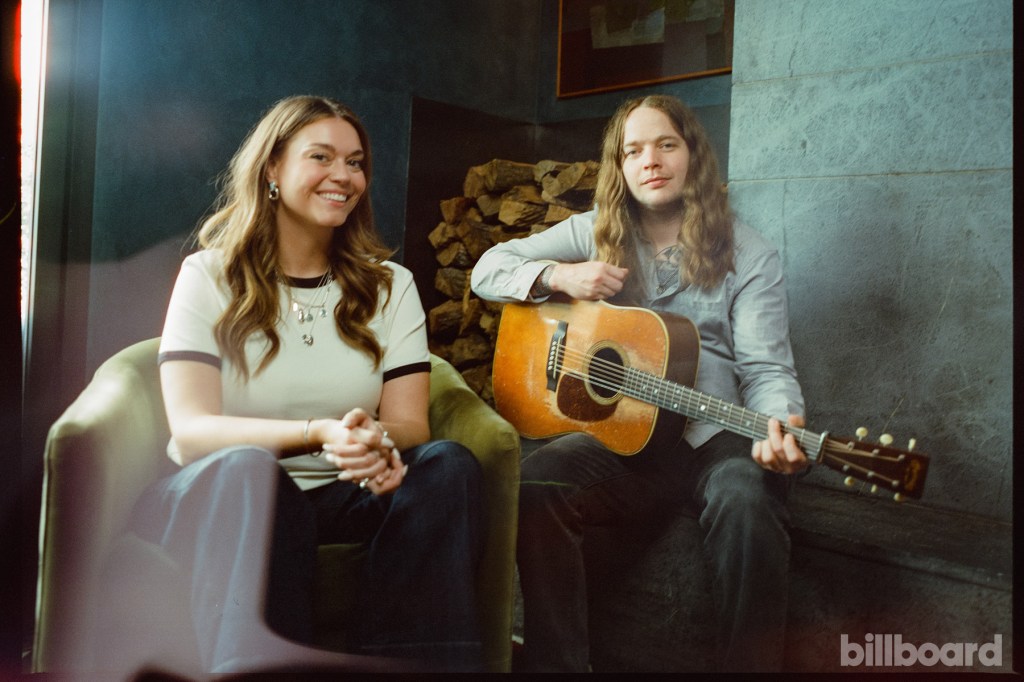
Trending on Billboard When Chappell Roan accepted her best new artist trophy at the Grammy Awards in February 2025, she called on record labels to cover healthcare costs for artists. “We got you, but do you got us?” she questioned. A few days later, Hilary Gleason received a call from her longtime friend, Lisa Hess, who also happened to be Roan’s business manager. The outspoken pop star wanted to make a sizable donation to Gleason’s growing nonprofit, Backline, which she had helped establish in 2019 to support the mental health of artists and music industry professionals. On Super Bowl Sunday, Gleason’s team built a fundraising page; soon after, Roan made a $25,000 donation. (An added bonus: Gleason’s Philadelphia Eagles took home the Lombardi Trophy.) “It was the single largest fundraising moment in Backline’s history,” says Gleason, 36. “It also really motivated corporations to give to Backline in a more serious way.” AEG matched Roan’s donation, as did artists including Noah Kahan, Sabrina Carpenter and Charli xcx as part of a fundraising campaign aptly called “WE GOT YOU!” Related Yet, part of Gleason was hesitant to accept Roan’s charity. Backline was built to support access to mental healthcare specifically, and Roan was calling for access to healthcare more broadly. But, Gleason says, “They really were adamant that they wanted to go with us, because how can you advocate for yourself or sign up for insurance or do anything else if you don’t have your mental health in check? That positioning of Backline and of mental health as a foundational piece toward being able to access any other benefits or rights was, I think, more of a turning point than the money.” Gleason’s professional journey began in global health and nonprofits, not the music business. As a high school senior in Durham, N.C., she helped build a training program in Uganda with a Duke University neurosurgeon, and she then pursued global and Africana studies and community health education at University of Tennessee, Knoxville. Her first music industry-adjacent role came in the mid-2010s on the global policy and advocacy team for action platform Global Citizen. Soon, she began consulting for touring artists, helping to pair them with resources through her own nonprofit, level (which she still runs, with clients including Femme House and that organization’s co-founder, DJ-producer LP Giobbi). At the same time, Gleason, a lover of bluegrass and jam music, became close with that community outside of work (her former partner was a member of Greensky Bluegrass). In October 2019, as it reeled from the deaths that summer of Yonder Mountain String Band’s Jeff Austin and the musician Neal Casal, both from suicide, the call to action was too loud to ignore — and Gleason teamed with eight others, from psychotherapists to music agents, to launch Backline. Its first donor was promoter Peter Shapiro, who is particularly active in the jam space and contributed $10,000. Backline’s first artist supporter quickly followed: the jamgrass star Billy Strings, who had met Gleason in 2015 when he was touring the country in a van playing well over 100 shows a year. “The schedule would just wreck me in so many ways,” he says. “It took a toll on my physical and mental health. Trying to make it in this music business can be a challenging thing to navigate. It can be such an incredible demand on your body and mind. Some of our friends didn’t survive. Hilary was right in the middle of all of that. She noticed the effect this business had on so many of her friends and she decided to do something about it. I know how important Backline is because I’ve lived it.” “Billy needed no explanation,” Gleason says. “He did a warehouse fire sale [in December 2019]: clear out all of their merch, all proceeds to Backline. All of a sudden, we had a bank account.” What the organization didn’t have was a leader. “I initially thought I was going to incubate Backline as part of my consulting firm and then we would find a great executive director,” she says. “The board that I was building at the time was like, ‘That’s great, except for this board doesn’t exist if it’s not you.’ They saw something in me that I didn’t see in myself.” Gleason’s background in global health prepared her for the high-pressure reality of directing a mental health organization. “I’ve been in the operating room with no power and people are doing brain surgery,” she says. “So I feel like I have a good resistance to high stress.” Despite the urgency of Backline’s mission, Gleason tries to maintain perspective, which has helped its success. “I see Backline as hippies taking care of each other,” she says. “The evolution is we’re allowed to do that now in the mainstream, with the major players.” Kahan is one of those major players who has collaborated with Backline since 2023, when he launched his own mental health initiative, The Busyhead Project. He partners with Backline for pre-tour wellness workshops, including ahead of his current stadium outing. “Taking care of your mental health shouldn’t be something anyone has to navigate alone,” Kahan says, adding that Backline “[makes] it easier for people across the music community to find support when they need it most … Our partnership is rooted in a shared belief that artists, crews and everyone within the music community deserve access to quality mental healthcare.” Backline’s suite of services goes well beyond tour support. According to the organization’s 2025 annual report, financial constraints are consistently cited as the most common barrier to mental healthcare in the music industry — so it has worked to provide financial aid for such services to those in need. In 2025, it provided individualized case management care plans to 740 people, a 30% increase from 2024. And through a Spotify partnership, Backline went global, launching the Global Resource Hub that offers services across 29 countries and in 23 languages. Gleason stresses that Backline’s support is very much choose your own adventure-style, with artist teams working with it to create customized programming — and ahead, its challenge is continuing to apply that outside of the touring landscape. “There’s so much visibility now of how to do this,” she says. “I’m hoping that more and more people trust, utilize, spread the word about us — because the differences in my community have been astounding. There’s life on the other side of these harder moments, and I get to see examples of that every single day.” In June, Ariana Grande — whose current tour Backline is supporting — announced her Brighter Days Ahead Foundation to fund small organizations that support vulnerable communities; Backline is a grantee of its Heal & Dream Fund that aims to expand mental healthcare access. Grande’s foundation has helped fund B-LINE, Backline’s 24/7 mental health and crisis support line for music industry personnel and their families that Gleason was instrumental in launching in January. “We’ve had over 400 people use the line since we launched,” Gleason says, tearing up. “I think about 400 people working in music that were having a bad day or a bad week or a bad month, and it really moves me that they know that they can call.” This story appears in the Aug. 1, 2026, issue of Billboard.
Why Noah Kahan, Billy Strings & More Support Backline’s Mission: ‘There’s Life On The Other Side Of These Harder Moments’
Full Article
Original Source
Read the full article at Billboard →KhanList aggregates and links to publicly available news content. We do not host full articles from third-party sources. Always verify important information with original sources.