
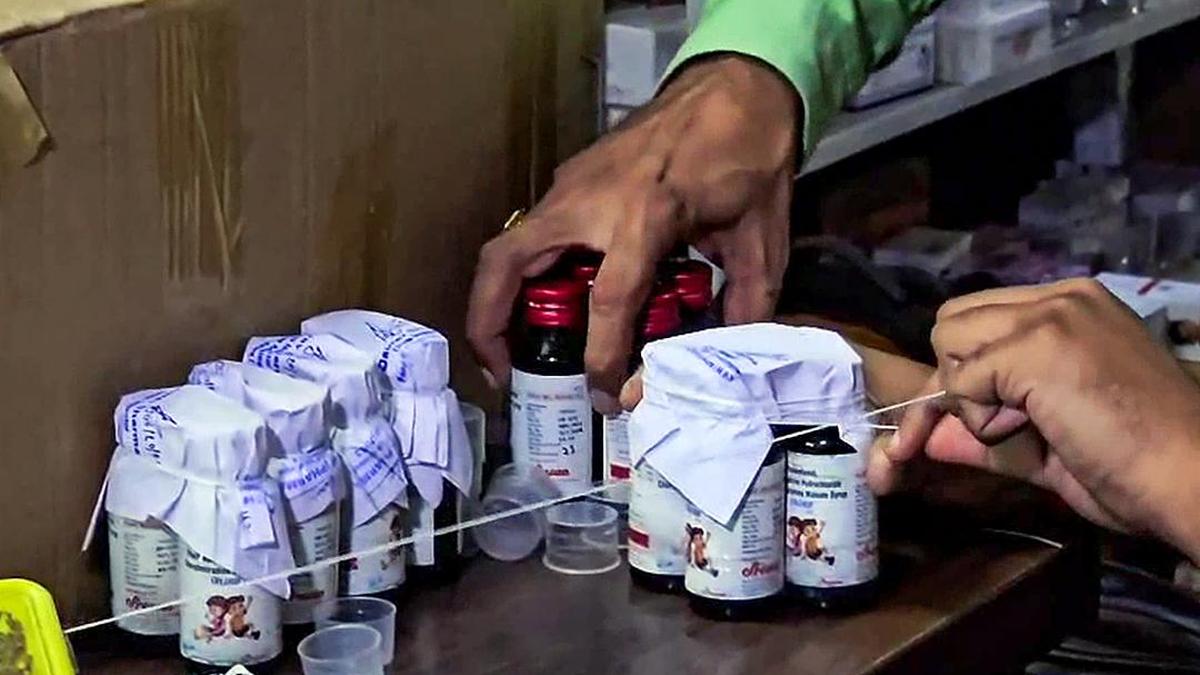
Image for representational purposes only. | Photo Credit: ANI The story so far: The Union Health Ministry this past week tightened controls on all fixed-dose combinations (FDCs) containing chlorpheniramine maleate and phenylephrine hydrochloride, requiring manufacturers to carry a clear warning that they must not be used in children below four years of age.What are these two drugs?Chlorpheniramine is an antihistamine. It can reduce allergy symptoms such as a runny nose and sneezing. Phenylephrine is a decongestant, intended to relieve a blocked nose.An FDC puts both ingredients into one medicine. Such combinations are commonly encountered in cold/allergy preparations.The government’s action does not mean every medicine containing either ingredient individually has been banned. The specific regulatory action concerns FDCs containing the two ingredients together.What has changed now is the rule where manufacturers must put the warning. “Fixed Dose Combination shall not be used in children below four years of age” — on the label, package insert and promotional literature. The restriction covers manufacture, sale and distribution of these FDCs.This expands an earlier action. In 2023, India’s Central Drugs Standard Control Organisation (CDSCO) had already directed manufacturers of a particular chlorpheniramine + phenylephrine formulation to warn against use below four.In April 2025, restrictions were imposed on certain FDCs. The August 2026 notification extends the warning requirement to all such formulations.Why are children under four the focus?Young children are more vulnerable to medication-related adverse effects because their bodies process medicines differently from adults and because dosing errors can have proportionally larger consequences.The government’s Expert Committee and Drugs Technical Advisory Board (DTAB) concluded that these combinations could pose risks to children below four and that safer alternatives are available.There is also a broader international concern around giving young children multi-ingredient cough-and-cold medicines. The US FDA, for example, warns that decongestant- or antihistamine-containing cough/cold products can cause serious adverse effects in very young children and notes the risk of accidental overdose when several ingredients are combined.Does this mean cold medicines don’t work?Not necessarily. These drugs can relieve symptoms, but they don’t cure the underlying viral infection. Most childhood colds resolve on their own. What doctors have been saying is that while parents may understandably want to make a congested or coughing child comfortable, but more medication isn’t automatically better.For nasal congestion, relatively simple measures such as saline nasal drops/spray, fluids and a cool-mist humidifiercan help.The key message is don’t self-medicate a child under four with a chlorpheniramine + phenylephrine combination, even if the product is marketed as a children’s cold medicine.Check the active ingredients, not just the brand name. Many cold preparations contain several ingredients, creating a risk of accidentally giving the same drug twice through different products.For fever or discomfort, parents should use medicines such as paracetamol/acetaminophen or ibuprofen only according to age/weight-appropriate instructions and medical advice. Published - August 24, 2026 12:29 pm IST
Why India has restricted chlorpheniramine, phenylephrine medicines for children under 4 | Explained
Full Article
Original Source
Read the full article at Thehindu →KhanList aggregates and links to publicly available news content. We do not host full articles from third-party sources. Always verify important information with original sources.