
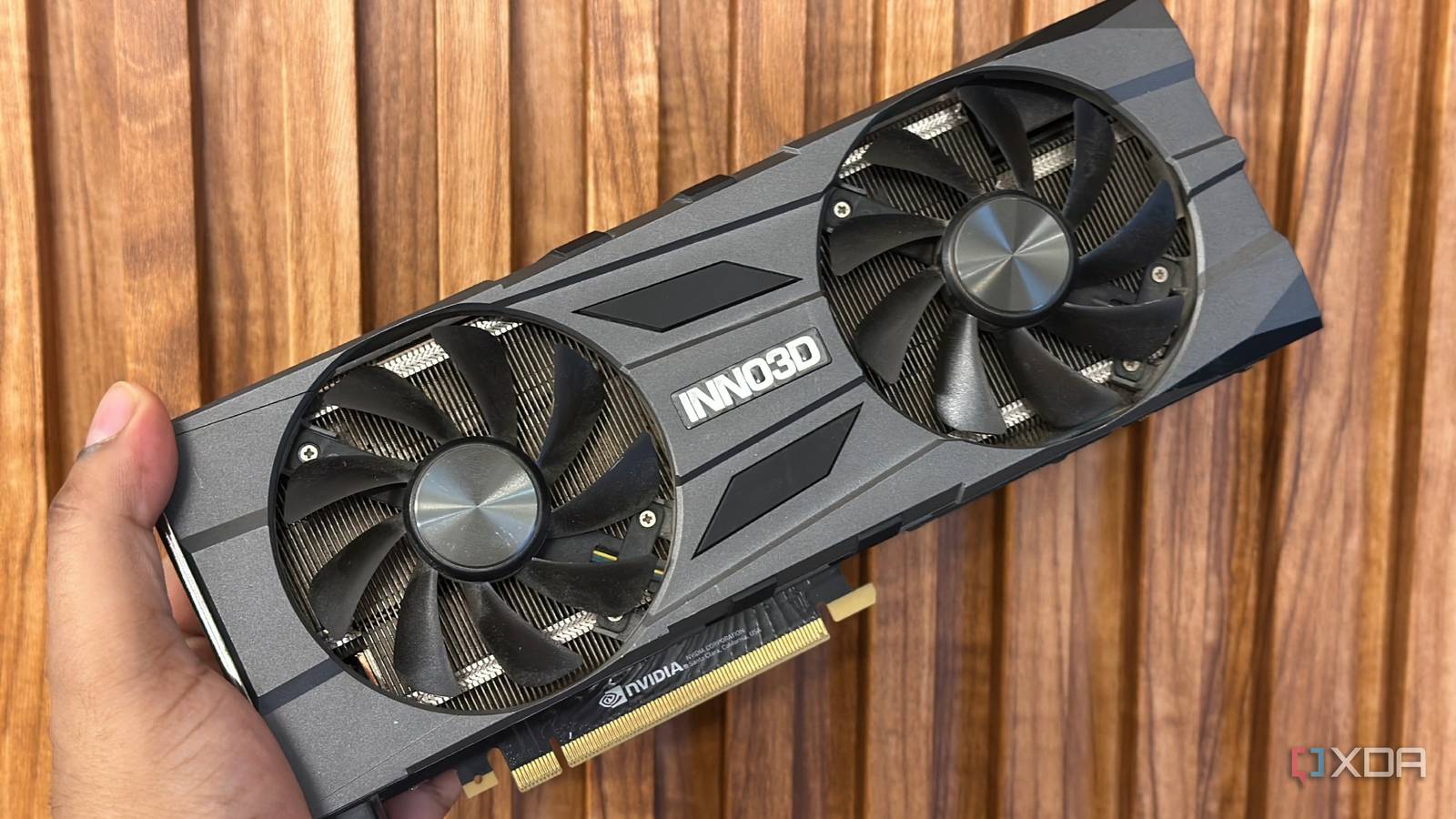
Published Oct 18, 2026, 7:01 AM EDT Anurag is an experienced journalist and author who’s been covering tech for the past 5 years, with a focus on Windows, Android, and Apple. He’s written for sites like Android Police, Neowin, Dexerto, and MakeTechEasier. Anurag’s always pumped about tech and loves getting his hands on the latest gadgets. When he's not procrastinating, you’ll probably find him catching the newest movies in theaters or scrolling through Twitter from his bed. Sign in to your XDA account I’m not spending several hundred dollars on a new graphics card with 8GB of VRAM in 2026. The RTX 5060 Ti still comes in that configuration, and at this price, having to lower texture settings because the manufacturer skimps on memory is unacceptable. If I’m buying a GPU to keep for several years, I expect enough performance and memory to justify the money I’m spending. I’d much rather put that money toward a properly priced RTX 3090 or Radeon RX 6950 XT. These cards are two generations old and still outperform several new mid-range options, with enough VRAM to handle demanding games without the same restrictions as an 8GB card. Older flagships still have the performance advantage If you choose the right one The RTX 3090 still delivers roughly 25% more performance than the RTX 5060 Ti 16GB at 1440p in Tom’s Hardware’s rasterization benchmark suite. It averages 91.5 FPS versus the newer card’s 73.4 FPS, excluding upscaling and frame generation from the comparison. That's a big gap for a GPU released in 2020, especially when you’re choosing a card to drive a high-refresh-rate 1440p monitor. AMD’s older flagship makes an equally strong case. In the same suite, the Radeon RX 6950 XT averages 89.5 FPS at 1440p, compared with 67.3 FPS from the RX 9060 XT 16GB. Both cards have 16GB of memory, so the older card’s roughly 33% lead shows this argument extends beyond avoiding an inadequate VRAM buffer. You’re getting considerably more rendering performance from hardware that sits two generations behind AMD’s current lineup. I put a lot of weight on that performance because it benefits games without depending on support for a particular upscaler or frame-generation feature. Those technologies are useful, and I’m happy to use them, but I want a strong frame rate before I start enabling them. Also, a faster GPU gives you more room to increase settings or play at a higher resolution before you need to make compromises. I expect enough memory to keep the textures Don't trust the average frame rate An average frame rate doesn't tell you whether a game is displaying its textures properly. In TechSpot’s comparison of the RTX 5060 Ti’s 8GB and 16GB variants, both cards delivered similar average performance in Hogwarts Legacy at native 1440p Ultra. The 8GB model still suffered from texture pop-in. You could look at the FPS figures and conclude that the cheaper card delivers the same experience, even though the image on your screen tells a different story. You also shouldn’t assume that enabling upscaling will solve a memory shortage. In Horizon Forbidden West, TechSpot recorded 1% lows of just 18 FPS on the 8GB card at 1440p with DLSS Quality and the Very High preset. Even after reducing the settings to Medium, you’d still get weaker frame-time consistency than on the 16GB version. I’d rather have the 16GB available on a Radeon RX 6950 XT or the 24GB on an RTX 3090. You won’t get extra performance from unused VRAM, but you have more room for demanding textures before you need to reduce their quality. You can buy new mid-range cards with 16GB too, so capacity alone doesn’t settle every comparison. What I won’t accept is paying this much for an 8GB model and immediately having to work around its limitations. The saving has to survive the build You don't want to end up paying more You need to account for the PC you’re putting the card into before calling an older flagship a bargain. If you already have a suitable power supply and enough case clearance, you can put your budget toward the GPU itself. If you need a new PSU to run it, that expense belongs in the comparison. Saving $150 on the card doesn't mean much when you also need to spend $100 to support it. You also need to give higher electricity consumption the same treatment. Assume your older setup draws an additional 150W at the wall during three hours of daily gaming. At an electricity rate of $0.20 per kWh, you’d spend about $33 extra annually. I’d accept that expense for a substantial performance advantage and a worthwhile purchase saving. I’d be much stricter about the card’s condition. You should be able to verify its identity, inspect the connectors and fans, and test it under sustained load. Also, please don't fall for a screenshot showing that it boots into Windows. The seller’s asking price still has to justify all of this. I’m not paying a premium for an RTX 3090 because someone wants to use its 24GB for local AI. For a gaming purchase, I’d set my offer against the performance and total cost of the best new card I can actually buy. Gamers are paying the AI premium The AI boom is driving up hardware prices, and gamers are being asked to spend more without getting enough in return. Manufacturers are chasing AI profits, and I’m not paying inflated prices for a compromised mid-range GPU as a result. I’d rather buy a capable older flagship than keep rewarding an industry that offers consumers increasingly poor value.
Why I'd buy a two-generation-old flagship GPU before any new mid-range card
Full Article
Original Source
Read the full article at Xda-developers →KhanList aggregates and links to publicly available news content. We do not host full articles from third-party sources. Always verify important information with original sources.