
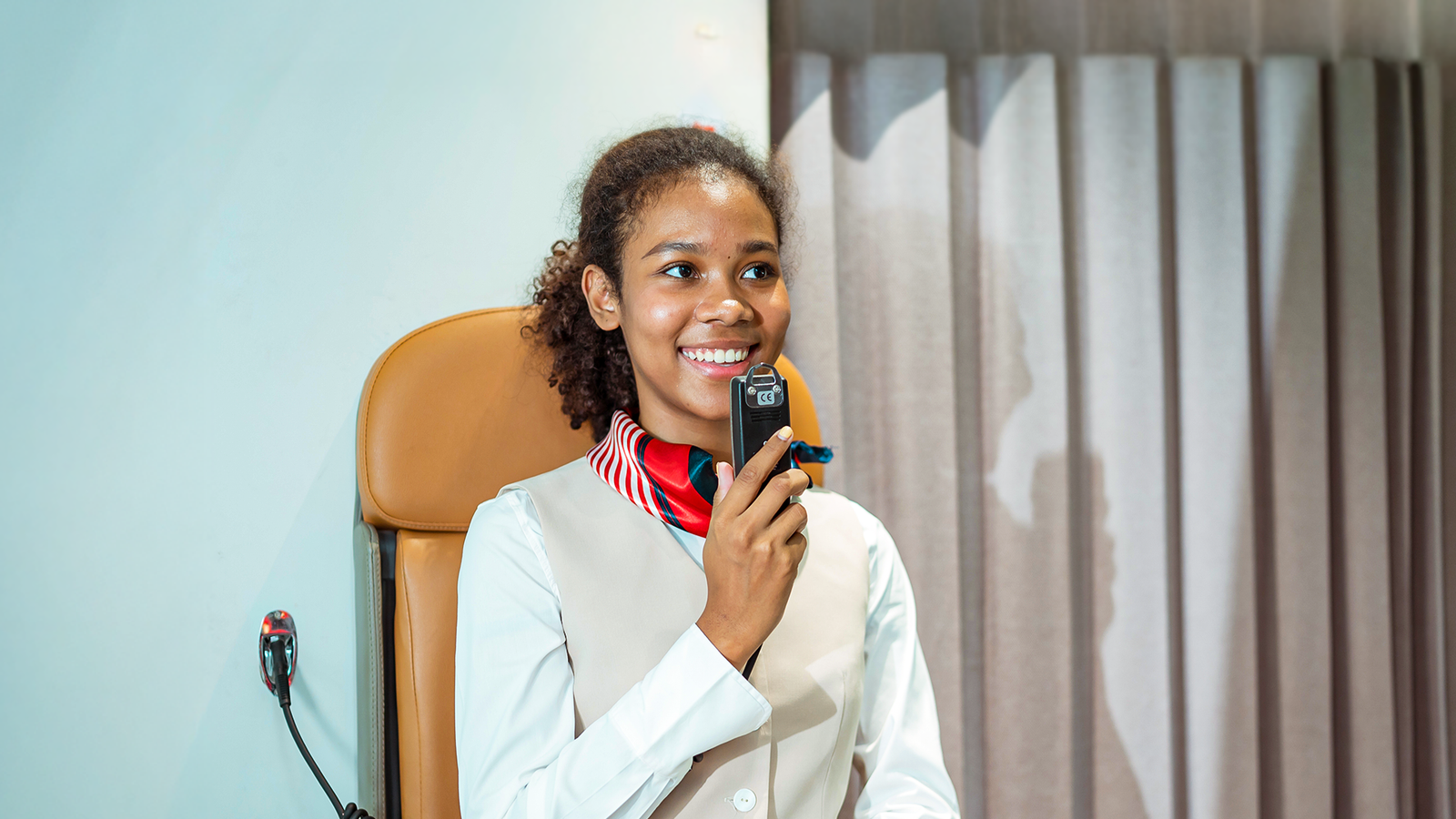
Published Nov 26, 2026, 8:00 PM EST Writer - Patricia joins Simple Flying with over 20 years of experience in aviation. She has served as cabin crew on flights from economy-class through to first-class and on private jets as well as being head of cabin crew and cabin safety focal point. Patricia has a master's level postgraduate diploma in Human Factors in Aviation and has written about aviation since 2010. Based in Dubai/Cyprus. Have you ever noticed that flight attendants sit facing backward during take-off and landing? While most passenger seats are forward-facing, some business-class configurations have rearward-facing seats, which some passengers dislike; therefore, backward-facing seats are rarely used for passengers. The jumpseat is a very important part of an aircraft's safety equipment and is designed to protect the crew members during taxiing, takeoff, and landing, which are critical phases of flight when accidents are more likely to occur. It is important that the crew are protected at these times so that they can evacuate the aircraft if necessary. It's All About Safety Credit: Shutterstock | Simple Flying Flight attendants face backward in their jump seats during takeoff and landing primarily for safety. During a sudden stop or impact, a rear-facing seat backrest absorbs the force across the back, shoulders, and head instead of concentrating it on a strap across the chest, as in a car. The seatback supports the head, neck, and torso during sudden forward deceleration, reducing strain on the spine and neck and improving force distribution. Rearward-facing seats are safer for the upper torso and reduce the impact on the body in landings or emergencies. Crew seats facing backward are designed to allow brace positions during normal or abnormal takeoff and landing and help protect against debris. That is why infants are encouraged to stay in backward-facing car seats for as long as possible. During sudden deceleration, your body naturally wants to keep moving forward. The jumpseat protects the crew from severe injury and helps them stay conscious and mobile in an accident, so that they can direct an evacuation and assist passengers in an emergency. They are always positioned near the emergency exits so that they can respond quickly. In the event of an accident, cabin crew are better protected than passengers in forward-facing seats. The crew member needs to be conscious and uninjured in an emergency for a fast, efficient evacuation and to potentially save lives. Features Of The Jumpseat Credit: KITTIKUN YOKSAP | Shutterstock Cabin crew jumpseats are almost always facing rearwards. While most face backward toward the tail, some jumpseats face forward or sideways depending on the aircraft type, cabin layout, and door position. They can be single or double jumpseats. Double jumpseats are usually found in the aircraft galleys at the main doors, while single jumpseats are often next to emergency exits throughout the cabin. On private jets, jumpseats are commonly forward- or side-facing depending on type, although they differ from those on commercial jets and may have a different harness and no safety equipment underneath. Forward- or sideways-facing seats still meet certification rules and use multipoint harnesses and brace positions to protect the crew. The seat base flips up when the crew member stands, so it doesn’t block the exit during an evacuation. The seats are heavily padded around the back and head area and are next to or inside the galley and adjacent to exit doors. A four-point safety harness secures the crew member firmly during take-off and landing. The lap belt must sit low and tight across the pelvis (not the stomach), with shoulder straps snug and free of twists. It has a single release point. Below each standard crew jumpseat, there is a container that holds the life vest, a torch, and a manual release tool for the oxygen system. An interphone is attached to every seat or double seat for communication with the crew and flight deck. Around the seat and above the seat, there will be a smoke hood, fire gloves, and a fire extinguisher. During the emergency equipment check, crew must ensure the harness is fully functional and fitted correctly. Observing The Cabin Credit: Wizz Air Facing into the cabin allows crew members to observe the passengers and spot hazards during critical phases of flight. It also ensures passengers follow safety instructions and are seated when the seat belt sign is on. They can typically be used only by airline crew, depending on the airline's policy. There are more jumpseats than the minimum working crew onboard. There are also jumpseats in the flight deck, but there are very strict rules on who can use them. These seats are strategically located so that the flight attendants have visibility over different areas of the cabin on take-off, landing and whilst taxiing. There is also the potential to spot unruly passengers or if someone is sick and needs help. They also need to prepare for the silent review in case of evacuation and observe outside conditions through the windows to prepare as needed. However, in the rear or aft galley, this would not be the case as the passengers cannot be seen clearly if the cabin crew are in their harnesses. On some aircraft types, such as the Airbus A320, one cabin crew seat in the aft is stored flat but maneuvered to face forward, and an extra crew member can observe the rear cabin from there if carried. Why Do Passengers Face Forward And Not Back? Credit: Elliott Cowand Jr | Shutterstock While rear-facing seats offer strong impact protection, airlines generally keep passenger seats forward-facing due to passenger preference, motion sickness concerns, and structural or weight factors. Aircraft burn more fuel due to heavy rear-facing seats, making them less popular with airlines. There is also some psychology behind them. Passengers don’t want someone facing opposite them as a rule, as it makes them feel uncomfortable. Some people don't like the sensation of flying backwards, and it could cause motion sickness in some people. It could also be an issue in an evacuation knowing which way to go, as passengers tend to head in the same direction as the door where they entered the aircraft. Although backward-facing seats are more commonly found in military aircraft, some airlines offer seats that face backward. If you do want to try out a rear-facing airplane seat, opt for business class seats with airlines like American Airlines, United Airlines, Qatar Airways, and British Airways. The brace position for passengers in rearward-facing seats is different from that of the standard brace position. The All Important Brace Position Credit: Sorbis | Shutterstock The cabin crew brace position is specifically designed to prevent the body flailing, protect limbs needed for opening emergency exits, and minimize head and neck injuries during an impact. When facing the back of the aircraft, impact forces push the body backward into the seat. The back and head should be firmly against the seatback and headrest to prevent whiplash. Knees are together, and feet are placed flat forward or back depending on the airline and whether facing forward or rearward. Hands should be placed under the thighs with palms facing up or down, depending on airline procedures, or may be placed on the knees and elbows tucked in to avoid fractures. If facing forward, the chin should be placed down towards the chest and feet slightly forward. In an abnormal landing, the brace position is the same apart from placing hands one on top of the other behind the head with elbows brought together in front of the face and not covering ears, so commands can still be heard. This may differ at different airlines. Where there is a side-facing jumpseat, feet should be flat on the floor, hands should be tucked under thighs or placed on the knees. However, extra support is needed, and the head and body should lean against the adjacent bulkhead or headrest on the side toward the direction of impact, securing the shoulder harness tightly. The Bottom Line Credit: Denver International Airport Crew adopt a "semi-brace" or standard brace posture during every normal takeoff and landing. This is often paired with a "silent review" of emergency exit procedures, so they are protected against sudden runway excursions or aborted takeoffs and prepared for any incident or accident. They secure themselves in their jumpseats on the flight crew's command: "Cabin crew seats for take-off" or "Cabin crew seats for landing." On most narrowbody aircraft, both the forward double jumpseat and rear double jumpseat face rearward, apart from the Airbus A320, which has another seat at the rear that faces forward into the cabin. On widebody aircraft, seats can be single at some exits, and the double seats in the rear galley may face forward depending on aircraft type. In the United States, 14 CFR 25.785(h) says a flight attendant seat must be “near a required floor-level emergency exit”, that one must sit adjacent to each Type A or Type B exit, and that the rest must be “evenly distributed among the required floor-level emergency exits to the extent feasible”. The rule requires a flight attendant seat to be forward- or rearward-facing with an energy-absorbing rest supporting the arms, shoulders, head and spine, and to sit near a floor-level emergency exit. The brace position differs depending on which way the seat faces and the airline's safety procedures.
Why Flight Attendants Sit Facing Backward During Takeoff & Landing
Full Article
Original Source
Read the full article at Simpleflying →KhanList aggregates and links to publicly available news content. We do not host full articles from third-party sources. Always verify important information with original sources.