
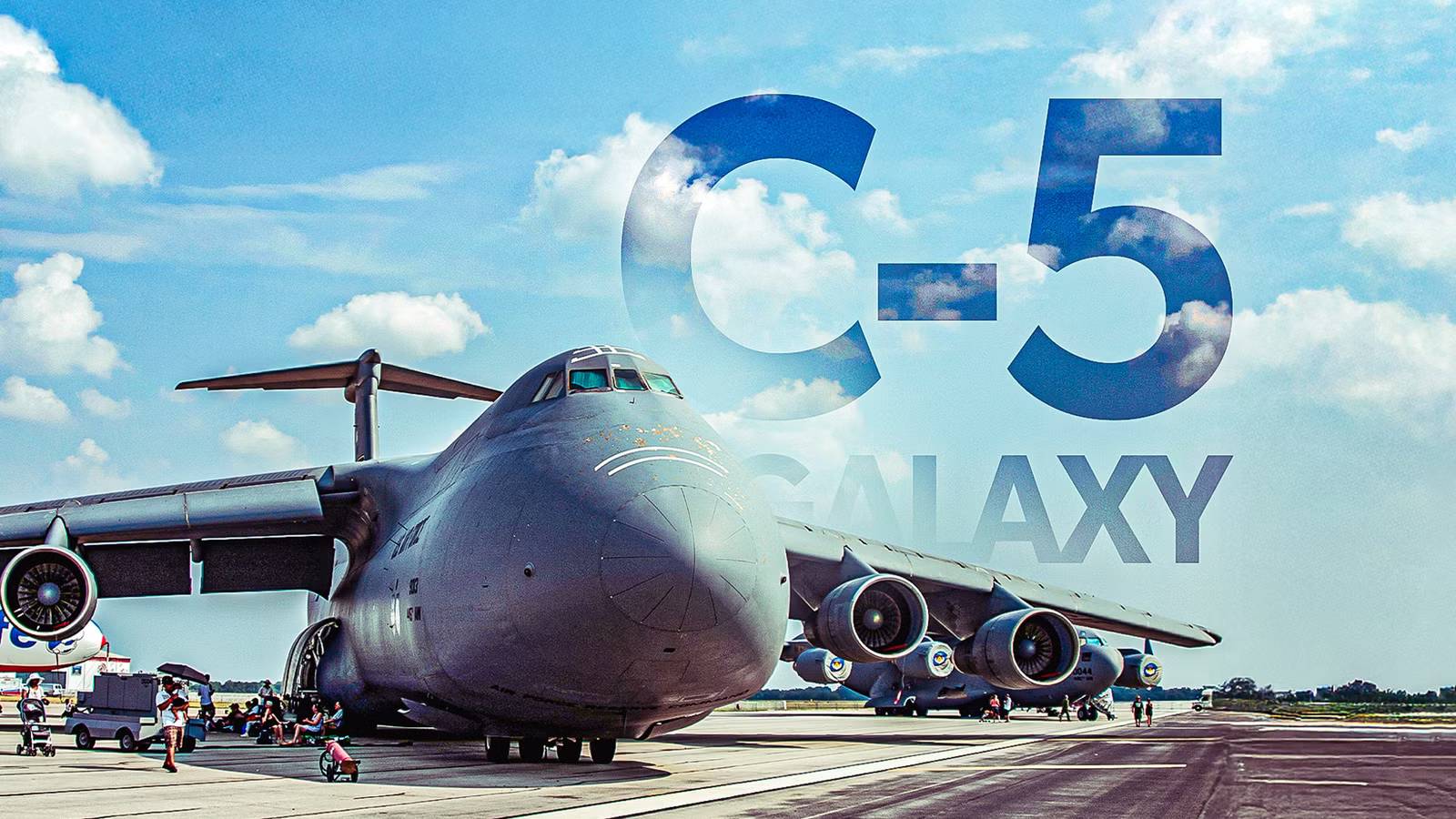
Published Nov 26, 2026, 7:30 PM EST Aaron is an aviation enthusiast and world traveler with a deep interest in aerospace history and technology. He has traveled around the world numerous times, often incorporating visits to aviation museums and historic aircraft collections into his journeys. A native of New Zealand, he is an expert in aviation and maintains a broad interest in a variety of other subjects. The Lockheed C-5M Super Galaxy is the largest military transport aircraft built for the United States Air Force and the third largest in the world (after the now-destroyed Antonov An-225 and the An-124). A total of 52 Super Galaxies remain active, with the rest in storage, scrapped, written off, or cannibalized for parts. Most flying C-5Ms are upgraded C-5Bs, although there are also some upgraded C-5As. The US Air Force is the only C-5M operator, and it now plans to keep the type flying far longer than it once expected. Its Fiscal Year 2027 budget request moves the fleet's retirement to FY2050, five years later than the previous plan, even though only about 37% of the jets were mission capable in FY2025. Here is how many C-5s were built, what happened to them, and how many still exist. The Origin Of The Massive Lockheed C-5 Galaxy Credit: Shutterstock The C-5 Galaxy traces its roots back to 1961, when the US Air Force started looking for a heavy jet-powered aircraft to replace its Douglas C-133 Cargomasters, while also complementing its Lockheed C-141 Starlifters. The US Army also wanted the Air Force to procure a strategic airlifter larger than the Starlifter, able to carry outsized loads. By 1964, the project had led to the 'Heavy Logistics System' program and received proposals from the US's then-existing airplane makers. The companies in question were Boeing, Douglas, General Dynamics, Lockheed, and Martin Marietta, and their proposals came with engine options provided by General Electric, Curtiss-Wright, and Pratt & Whitney. The Air Force selected the Lockheed design with General Electric's TF39 engines (the first high-bypass turbofan to enter service). The USAF liked the Boeing design but rejected it, and Boeing took elements of it to develop the Boeing 747-100 with Pratt & Whitney engines. A total of 131 Lockheed C-5 Galaxies were produced, of which 81 were C-5As. In the 1970s, these were found to have cracks in the wings, forcing the Air Force to drastically reduce allowed payloads until new strengthened wings were installed on 77 remaining C-5As between 1981 and 1987. How Many Lockheed C-5 Galaxies Were Produced? Credit: Shutterstock The Lockheed C-5 Galaxy has been a pivotal air mobility asset for the United States Air Force for decades. It is responsible for the rapid deployment of combat forces to any point in the world at short notice. First delivered in 1970, the Air Force explains that, "the C-5 has seen extensive use in every major global contingency since the Southeast Asia War." The massive airlifter provides range and cargo capacity that greatly exceed the capabilities of the airlifters that came before it. Not only do these aircraft transport soldiers, smaller aircraft, helicopters (including three CH-47 Chinooks), armored vehicles, munitions, and supplies, but they can also accommodate two Minuteman Intercontinental Ballistic Missiles. A standard crew is seven: two pilots, two flight engineers, and three loadmasters (see how many crew members it takes to fly a C-5 Galaxy). Lockheed C-5M Super Galaxy specifications (per the US Air Force) Quantity 52 Maximum take-off weight 840,000 pounds Maximum payload 281,001 pounds Unrefueled Range of the C-5M 4,800 nautical miles with 120,000 pounds of cargo (7,000 nautical miles with no cargo) Thrust 51,250 pounds per engine Powerplant 4x General Electric F138-GE-100 engines One notable operation for the Galaxies came on October 14, 1973. On that day, the C-5s flew the first Operation Nickel Grass mission to resupply Israeli forces during the Yom Kippur War. Operation Nickel Grass saw the United States supply Israel with 22,325 tons of supplies, including tanks, artillery, and ammunition, using C-141 Starlifters and C-5 Galaxies. Examining The C-5 Galaxy's Different Variants Credit: Shutterstock As stated, Lockheed delivered a total of 81 C-5A variant aircraft, as well as producing the improved C-5B variant. Two C-5As were upgraded to the C-5C standard to carry larger cargo, like satellites. Lockheed proposed the improved re-engined C-5D in the 1990s as an alternative to the McDonnell Douglas C-17 Globemaster III strategic airlifter, and, while this didn't happen, design elements of the C-5D were later used for the C-5M Super Galaxy program. Lockheed planned to produce a civilian variant of the Galaxy, called the L-500. The company developed a design for both passenger and cargo versions of the aircraft, with the passenger aircraft being able to carry up to 1,000 passengers (far more than an Airbus A380). While the designs attracted some interest, in the end, no airlines purchased the aircraft, and it wasn't produced. Lockheed Galaxy C-5 variants Number built C-5A 81 C-5B 50 C-5C 2 (modified C-5As) C-5M 52 (mostly modified C-5Bs) In the late 1990s, it was found that 80% of the Galaxy's airframe service life was still remaining, so the USAF embarked on upgrading 52 examples with GE CF6 (General Electric F138-GE-100) engines, the same family of engines that power the Boeing 767. These produced 22% more thrust, provided a 30% shorter takeoff roll, and other improvements. Other aspects, like avionics, were also upgraded. The Air Force received its first upgraded C-5M in 2008, with work concluding in 2018. Where Are They Now? Credit: Shutterstock Of the 131 Galaxies produced, Planespotters.net lists six as having been written off. One (66-8303) was damaged beyond repair after a ground fire during maintenance in one of its 12 fuel cells, and another (67-0172) was destroyed by a fire that broke out in the cargo compartment while taxiing. 68-0218 crashed while attempting an emergency landing amid 'Operation Babylift,' where it would have taken Vietnamese orphans to the US as South Vietnam collapsed and the Fall of Saigon neared. Planespotters.net lists 15 C-5s as scrapped, with another example listed as 'partially scrapped.' These are all older C-5A models built from 1969 to 1972. A further 37 are stored, mostly at Davis-Monthan Air Force Base in Arizona, while one is listed as 'preserved.' That airframe (69-0014) is on display at the Air Mobility Command Museum at Dover Air Force Base. 70-0451 was meant to be displayed at the Travis Air Force Base Heritage Center, but was scrapped after space couldn't be found. Fate of the USAF's Lockheed C-5 Galaxies Number (per Planespotters.net) Active 52 Stored 37 Preserved 1 Scrapped 15+1 Written off 6 Multiple sources confirm that a total of 52 C-5 Galaxies are listed as active. All of these have been upgraded to the C-5M Super Galaxy standard and are newer airframes, with most of them having been built between 1985 and 1989 and originally delivered as examples of the C-5B Galaxy model. The Air Force now plans to keep them in service until FY2050. Why The Super Galaxy Will Now Fly Until 2050 The Air Force's FY2027 budget request pushes the C-5M's retirement back to FY2050, The War Zone reported. Earlier plans had the fleet bowing out around 2045. The jets are also getting harder to keep serviceable: about 37% of the fleet was mission capable in FY2025, down from 49% the year before. Their replacement is still more than a decade away. The Air Force expects the first aircraft from its Next-Generation Airlift (NGAL) program around 2038, according to Air & Space Forces Magazine, and each NGAL aircraft is set to replace one C-5M until the last Super Galaxy retires. The same program is expected to succeed the C-17 eventually, which is why the Air Force believes one aircraft can replace both. There Is Uncertainty Over The C-5s In The Boneyard Credit: Photo: Liner l Shutterstock According to AMARC Experience, the boneyard at Davis–Monthan Air Force Base has a total of 57 Lockheed C-5A Galaxies in storage, well above the 37 stored airframes Planespotters.net lists. While these airframes exist, it is unclear how many have been mothballed in a condition where they could feasibly be reactivated and returned to service, and how many are just being cannibalized for spare parts. The 309th Aerospace Maintenance and Regeneration Group has different 'Type' categories for its aircraft stored at the boneyard. Type 1000 aircraft are placed in long-term storage and are maintained until recalled to active service. These are aircraft that have a high potential to return to flying status, and parts are not permitted to be removed from them. They are 're-preserved' every four years. Meanwhile, Type 1500 includes aircraft that were previously fully preserved, and Type 2000 includes aircraft whose parts are available for reclamation. These are cannibalized. Type 3000 includes aircraft on 'flying hold,' where aircraft are kept in flyable condition in short-term, temporary storage as they are transferred elsewhere. Type 4000 aircraft are in excess of US military needs and may be broken down for scrap, recycled, or have their usable parts reclaimed. It is unclear how the Galaxies at the boneyard are classified, but it is possible that some are Type 2000 and others are Type 1000. There Is No Talk Of Restarting Production Credit: Photo: Markus Mainka l Shutterstock Production of the C-5 Galaxy ended in 1989, while production of the C-17 Globemaster III ended in 2015, and there is now no discussion of putting the C-5 back into production. However, there is chatter at Boeing (which absorbed McDonnell Douglas) to restart production of the comparatively diminutive C-17. The chances of the Globemaster going back into production are unlikely, but if it does, it would likely be for export orders. Few strategic military transports remain in production today. None are in production in the United States, while the smaller Airbus A400M Atlas strategic/tactical airlifter is being produced in Europe, and Russia is producing the Ilyushin Il-76 airlifter in low numbers. The Il-76 is sized between the A400M and the Globemaster. China has also put its Xi'an Y-20 airlifter, which resembles the C-17, into production. With no new C-5s coming, 52 remain in service. Add the stored airframes and the preserved example at Dover, and somewhere between 90 and 110 C-5s still exist, depending on whether you take Planespotters.net's storage count (37) or AMARC Experience's (57). The C-5M is still the Air Force's largest airlifter, although large aircraft are increasingly seen as vulnerable, and the Air Force is looking for more roles to be taken over by smaller S/VTOL aircraft where possible.
How Many Lockheed C-5 Galaxies Are Left In 2026?
Full Article
Original Source
Read the full article at Simpleflying →KhanList aggregates and links to publicly available news content. We do not host full articles from third-party sources. Always verify important information with original sources.