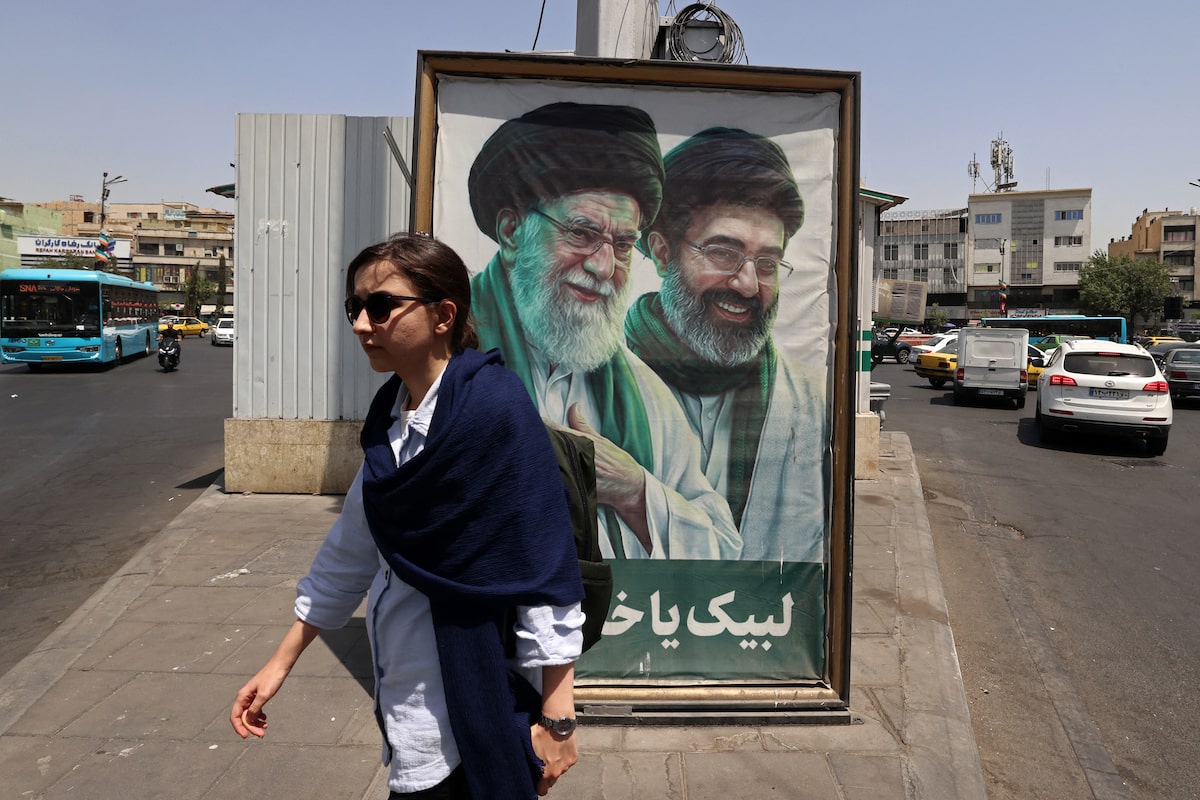
Open this photo in gallery:A woman walks past an image of Iran's slain supreme leader Ali Khamenei and his son, the current supreme leader Mojtaba Khamenei at the Islamic Revolution Square in Tehran. Iran's Revolutionary Guards said on Tuesday it hit U.S. military targets including air defence systems in Bahrain and Kuwait, state news agency IRNA reported.ATTA KENARE/AFP/Getty ImagesThe Iran war has cost the United States at least US$37.5-billion, Defence Secretary Pete Hegseth acknowledged Tuesday under questioning from lawmakers, as the conflict once again spun out of control this month after the collapse of a tentative June ceasefire. With President Donald Trump threatening to strike Iran’s surviving nuclear facilities, including the fortified Pickaxe Mountain, Tehran said any “expansion of the war in the region” would be met by “powerful attacks” against “all U.S. interests, as well as those of its allies and supporters.” Here’s how we got here. What happened to the June ceasefire? Why did fighting restart? On June 17, the U.S. and Iran agreed to the “Islamabad Memorandum of Understanding.” The 14-point document called for an “immediate and permanent termination of military operations on all fronts” and the reopening of the Strait of Hormuz, as well as the removal of U.S. sanctions against Iran and the promise of a US$300-billion reconstruction package in return for Tehran’s pledge to never develop a nuclear weapon. Both sides also agreed to “negotiating and achieving” a final deal to permanently end the war within 60 days.Three weeks later, however, Mr. Trump declared the ceasefire “over,” and the U.S. launched new strikes against Iran after Washington and several Gulf states accused Tehran of attacking ships passing through the Strait of Hormuz using routes that were not approved by the Iranian military. Open this photo in gallery:Vessels at the Strait of Hormuz, as seen from Musandam, Oman, on June 18. Both the U.S. and Iran have imposed a blockade of the vital waterway and exchanged missile and drone fire.Stringer/ReutersSince then, both sides have reimposed a blockade of the vital waterway and exchanged missile and drone fire. At least three U.S. soldiers have been killed in Iranian attacks on bases in the Gulf, while Tehran said 50 people were killed by U.S. strikes in the past three weeks.“The reality is that today the Islamic Republic of Iran is engaged in a full-scale war,” President Masoud Pezeshkian said Monday. So far, neither country seems poised to return to peace talks, though U.S. Secretary of State Marco Rubio said Washington would be willing to negotiate if the conditions were right. “If they’re serious, we’re serious,” Mr. Rubio said. “If they’re not, then we will do what’s necessary to protect our interests and also the interests of our allies.” What is the U.S. strategy behind resuming the war? As described by Mr. Trump and Mr. Hegseth, the current approach is much the same as the original plan for the war: maximum pressure through waves of intense bombing, targeting of key military and nuclear facilities and a blockade of the Strait of Hormuz. The latest high-profile target mooted by Mr. Trump is Pickaxe Mountain, which has been linked to Iran’s nuclear program. But while hitting the fortified, underground base with massive bunker-buster bombs will send a message about U.S. firepower, it will do little beyond what earlier bombings of far more developed nuclear sites did to curtail Iran’s atomic capabilities. Kuh-e Kolang Gaz La, or 'Pickaxe Mountain,' lies on the south side of Iran's Natanz nuclear enrichment site, which was bombed by the United States during Operation Midnight Hammer in 2025's 12-day war between Iran and Israel. But Pickaxe Mountain has remained untouched as Iran continues to dig at the site.The Associated PressTehran has shown itself willing to soak up huge amounts of casualties and destruction, while continuing to play hardball in negotiations − the June MOU was largely a recapitulation of a nuclear agreement signed by the U.S. and Iran during the Obama administration, one Mr. Trump ripped up after taking office. A ground invasion could tip the balance, but so far the U.S. has been unwilling to commit to such an operation, and attempts to spark an internal uprising or support an incursion by Iranian Kurds have come to nothing. “I don’t want to do that,” Mr. Trump said of launching a ground war in an interview with Fox News this month, adding, however, “sometimes you need a ground campaign.” Without a clear path forward, the conflict risks turning into just the type of “forever war” in the Middle East that Mr. Trump came into office promising to avoid. The President appeared to acknowledge such criticism Tuesday, posting a graph on social media contrasting the length and casualties of the current conflict with the far more costly and lengthy U.S. wars in Iraq, Afghanistan, Vietnam and Korea. “These are the real facts,” he wrote. “REPORT THEM!” What is Iran’s strategy? Just as the U.S. is basically rerunning a playbook from earlier in the war, Iran is also adopting an earlier strategy focused on maintaining absolute control over the Strait of Hormuz, through which it can inflict maximum economic pain on the U.S. and its Gulf allies. The Iranian post-MOU strikes on ships occurred after several tankers attempted to pass through Oman’s territorial waters rather than those controlled by Tehran. Were Iran to allow the “Oman route” to emerge as a viable alternative, it would lose some of the leverage that has forced the U.S. to the negotiating table. That seems to be the thinking behind a threatened closure of the Red Sea by the Iranian-backed Houthis in Yemen, blocking an alternative route to global markets for Saudi Arabian and other Gulf energy exports. The U.S. military releases new footage of what it describes as attacks on Iranian military targets. Meanwhile, Yemen's Iran-backed Houthi rebels announced a blockade on Saudi Arabia in the Bab el-Mandeb Strait.ReutersSince U.S. bombing restarted, Iran has also hit targets in Kuwait, Bahrain and Jordan, further rattling regional support for a drawn-out war. “The one point of leverage Iran is not prepared to part with is its claim to the Strait of Hormuz and its ability to control access to it,” Vali Nasr, a professor at Johns Hopkins University and the author of Iran’s Grand Strategy, wrote this week. “Losing dominance in the strait would leave Iran without any leverage in future negotiations. Iran’s leaders have decided that retaining control of the strait is essential to securing future wins at the negotiating table and ensuring that the U.S. implements the deal rather than walking away from it.” What about Israel? While the U.S. war against Iran was launched in co-ordination with Israel, the Jewish state has so far sat out the latest round of hostilities. According to The Wall Street Journal, citing government officials, both the U.S. and its Arab allies want to keep Israel out of the fighting for fear of escalating the conflict. Israel’s ongoing, illegal invasion of Lebanon has already proven a major sticking point in negotiations with Iran, which has repeatedly said that any deal to end the war must also include an Israeli withdrawal. That doesn’t mean Israel isn’t prepared to resume striking Iran, though Finance Minister Bezalel Smotrich said Tuesday that “the current situation works in our favour, and we have no interest in pushing ourselves into it.” What has been the effect of the renewed conflict economically? The war on Iran, and particularly the disruption to shipping through the Strait of Hormuz and strikes on oil and gas fields, has had a devastating effect on the global economy, particularly in developing countries. High fuel prices have led to inflationary spikes in many countries, while a shortage of fertilizer − a key source of which is natural gas − could lead to lower crop yields across much of Southeast Asia, the effects of which will be felt long after the current stage of the conflict. Asia in particular is highly dependent on fuel from the Gulf, and governments across the region will be watching in dismay as the conflict expands to the Red Sea, which has been a key − albeit expensive − means of bypassing the Strait of Hormuz. Any blockade of the Red Sea could force Saudi shipments to be rerouted once again, through the Suez Canal, further delaying delivery and driving up fuel prices.
Why are Iran and the U.S. trading blows again?
Full Article
Original Source
Read the full article at Theglobeandmail →KhanList aggregates and links to publicly available news content. We do not host full articles from third-party sources. Always verify important information with original sources.