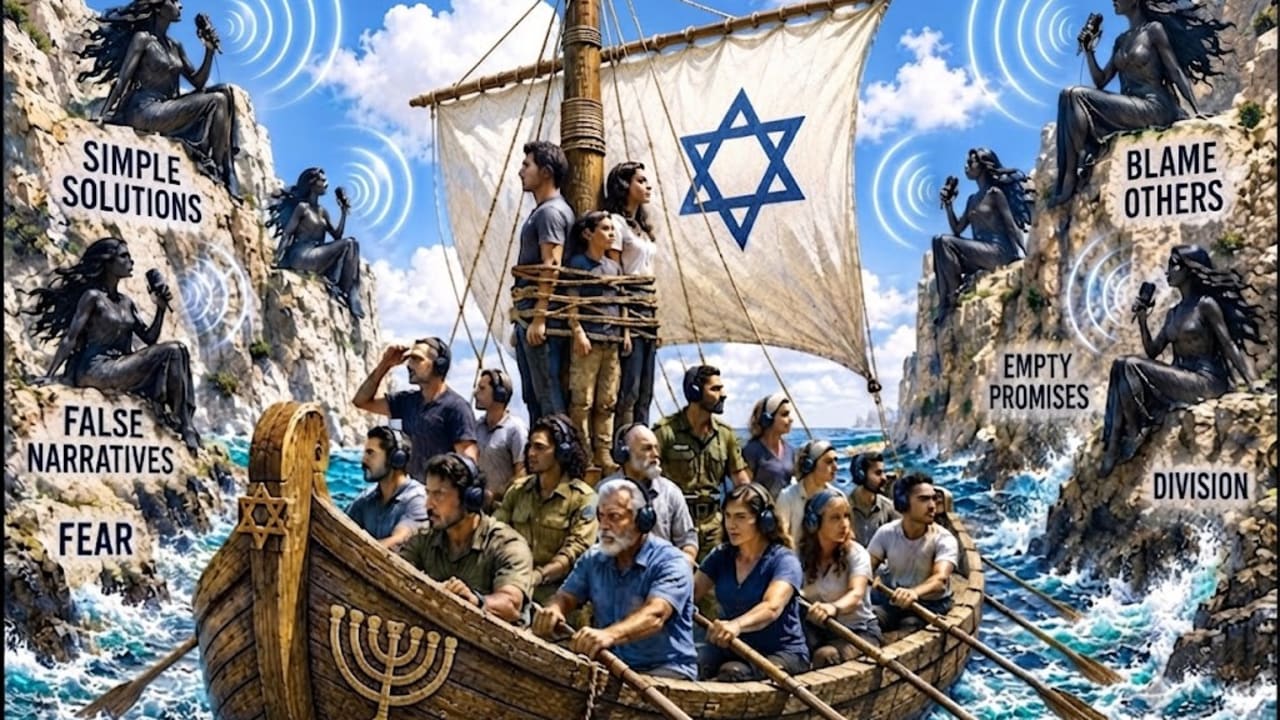
ByJEFFREY KAHNJULY 31, 2026 20:58I owe Homer, the author of The Iliad and The Odyssey, an apology.Millions of people have flocked to Christopher Nolan’s 2026 adaptation of The Odyssey. Within days of its release, it became one of the year’s biggest box office successes, despite running more than three hours. Like so many others, I found myself sitting in the theater expecting to watch the story of Odysseus’s long journey home.Instead, I spent much of the film thinking about Israel.Homer, I suspect, would not have appreciated my divided attention. Then again, tradition tells us he wrote these great works 2,700 years ago, so perhaps I have nothing to worry about. However, if you have never read Homer’s works or seen the movie, then a “spoiler alert” is in order, so maybe I do need to worry.One scene has refused to leave my mind.Matt Damon plays Odysseus in Christopher Nolan's film adaptation of Homer's ''Odyssey.'' (credit: Melinda Sue Gordon/Universal Pictures)As Odysseus, the hero, approaches the island of the sirens, he understands something profound about human nature: the danger is not that his crew lacks courage or intelligence; the danger is that the sirens promise exactly what each sailor most longs to hear. Their songs are irresistible. Ship after ship is drawn off course and smashed against the rocks.The sirens are not merely tempting him toward pleasure. They force him to confront his deepest regrets, his guilt, and his most impossible longings.Odysseus knows that when he hears the voices, he will no longer trust his own judgment.So, he prepares before the temptation arrives.He orders his crew to fill their ears with wax so they cannot hear the songs. He orders them to tie him tightly to the mast. Most importantly, he gives them one final command: no matter what I say, no matter how desperately I beg, no matter how convincingly I plead, do not untie me until we have safely passed through these waters.He knows that his future self cannot be trusted.Watching that scene, I couldn’t help thinking that Israel today is sailing through its own sea of sirens and dangerous waters. How many of us long for peace and simple solutions to the complex realities of our situation here in the Holy Land?I have participated in many TV panels in the last months in which my fellow panelists, very impressive people, have expressed unrealistic, shockingly simplistic views on the highly complex challenges of our situation. Without the needed wax in my ears, I squirm in my chair, and then wonder what life would be like if their view of the world could materialize.Then I snap back to reality and remember that our history has shown that if we accept their analysis, and in a metaphorical sense listen to the sirens, we will be crashing into the rocks rather quickly.Our sirens and pundits of the simple solutions are broadcasting to us constantly while the complexities of the situation would make any international relations professor’s head spin. The songs include tempting, attractive illusions of a new Middle East based on peaceful cooperation backed by paper agreements and new accords.Not to forget that our detractors have manipulated the songs of sirens to include twisted messaging echoed not only abroad, but here in Israel as well.Like many of us, these tempting thoughts are confusing, so I look to the wisdom of our elders for direction, remembering the famous Tractate of Eretz Rabbah of Rabbi Yehoshua: “Always regard people as though they might be robbers, yet honor them as you would Rabban Gamliel.”Answering the real questionThis week alone, Prime Minister Benjamin Netanyahu flew to Washington to discuss Iran, ceasefires, nuclear ambitions, proxies, and an increasingly unstable Middle East. Iranian missiles and drones continue to threaten Israel and our regional partners. Hamas has not disappeared. Hezbollah has not disappeared. The Houthis continue their attacks. The strategic waters and ominous rock formations surrounding Israel are as dangerous as they have been in decades.At the very same time, Israel is entering another election season.Political parties are preparing campaigns. Advertising agencies are crafting emotionally powerful messages. Consultants are testing slogans. Television panels, newspaper headlines, podcasts, social media feeds, and endless commentary compete for our attention every waking hour.Every day Israelis are bombarded with thousands of competing messages.Some tell us to be afraid. Some tell us to be angry. Some tell us whom to blame.Some promise simple solutions to impossibly complex problems.Some insist salvation lies just one election away. Others insist catastrophe is inevitable unless we follow them.Unlike Odysseus’s crew, however, we cannot simply put wax in our ears.We cannot ignore the news when our sons and daughters are serving in the IDF.We cannot ignore missile warnings. We cannot ignore terrorism.We cannot ignore the ominous strains percolating across Israeli society.We cannot simply disconnect from reality.Which leaves us with a different question: If wax in our ears is not a viable alternative... to which mast do we tie ourselves?Every Israeli, consciously or not, has already chosen one.Some tie themselves to faith, believing that whatever storms lie ahead, God remains with the Jewish people.Others tie themselves to a political worldview, convinced they already know who is responsible for every crisis and who alone can solve it.Some tie themselves to their families, deciding that their first and only responsibility is protecting those closest to them.Others tie themselves to Zionism itself, to the conviction that despite every disagreement, the existence and future of the Jewish state transcend today’s political battles.Still others tie themselves to hope, to resilience, military strength, democracy, or to something else entirely.The point is not that every mast is equally strong; they are inherently personal. The point is that none of us can navigate these waters without tying ourselves to one.Perhaps that is why another moment from the film stayed with me.After surviving the sirens, one of Odysseus’s companions asks him what he heard.His answer is haunting: he says that the sirens sang of everything he had ever wanted, everything he had ever dreamed of, everything he thought would finally satisfy him. And perhaps, everything he should never have wanted in the first place.That may be the most timeless lesson of all: the greatest dangers rarely announce themselves as dangers; they arrive disguised as certainty.As validation.As the promise that someone finally accepts our view of the world.As the assurance that every complex problem has a simple answer.This illusion is perhaps the strongest explanation of the mindset our security leadership had on October 6.Israel is navigating extraordinarily dangerous waters. The rocks are real. The currents are strong. The voices calling from every direction are louder than ever.The question is no longer whether we will hear them.We will.The real question is this: When those voices promise us everything we have ever wanted to hear... to which mast will you tie yourself?Because eventually all of us, every Israeli, must answer that question.All of our answers affect our collective future as we are all truly in the same boat, sailing across these challenging waters.What will you choose?The writer is a global strategist and a strategic adviser at the Jerusalem Center for Security and Foreign Affairs. He can be reached at globalstrategist2020@gmail.com.Follow us on Google
Which mast do we tie ourselves to? - opinion
Full Article
Original Source
Read the full article at Jpost →KhanList aggregates and links to publicly available news content. We do not host full articles from third-party sources. Always verify important information with original sources.