
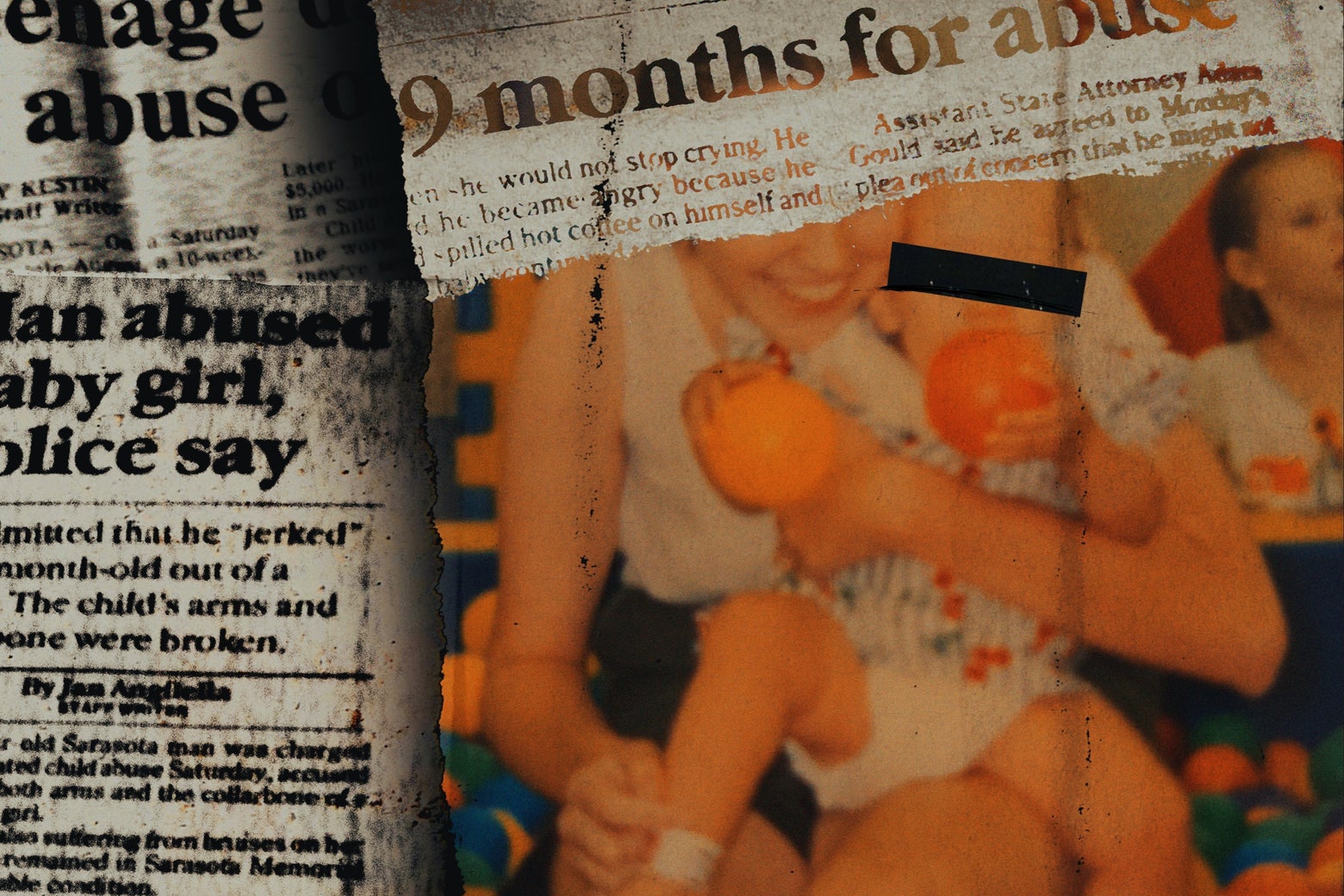
Photo illustration by Slate. Photos courtesy of Emily Smith. Family Million-Dollar Bones Before my arms were broken, I wouldn’t stop crying. According to the police report, my mother was sleeping that morning, and my father had woken up to take care of me. I was 10 weeks old. He was 19. For two long hours on that hot August day in 1994, I had cried relentlessly. My father strapped me into the car and drove around, hoping I’d fall asleep. When I didn’t, we returned home, and he put me in a baby swing. He made coffee. I cried more. He stirred creamer into his coffee. I kept crying. He spilled steaming coffee on his pant leg. Angry at the spill, fatherhood, my crying, or most likely all of the above, he tore me out of the swing, pressed me against his shoulder, and heard a pop. According to an article in the Sarasota Herald-Tribune, my father then laid me in my crib and shut the door so my crying wouldn’t wake my mother. She woke up at 9 anyway and called the pediatrician after she noticed that something was wrong. At 12:15 p.m., my parents took me to the hospital. In documents from the Florida Department of Children and Families, radiology images showed that both of my arms and my collarbone were broken when I arrived. There were also bones that doctors suspected had already healed from previous, unreported injuries. “Upon further examination, it was determined that the infant had sustained ten broken bones over the short span of her life,” the same report reads. At 2 p.m., detectives were called to the hospital. By evening, my dad had been charged with aggravated child abuse and arrested. Until my father’s case, some of the highest bail set in Florida’s Sarasota County included $2 million for a man who’d been charged with raping 10 women, and $3 million for two men operating a cocaine ring. In September 1994, Judge James Whatley set my father’s bail at $3.5 million. It might just be family lore, but I’ve always been told my father was charged a million dollars for each broken bone. It was “probably the highest bail I’ve ever seen in my career,” Lynn Thomson, the lead detective on the case and a former detective with the Sarasota Police Department for the Crimes Against Children Unit, told me recently. That figure lasted all of two weeks before the judge lowered it. After three months, my dad posted bail and got out of jail. For years, my story was covered by newspapers across the state. There are at least 14 stories printed on the case from 1994 to 1997, often on the front page. At first, headlines focused on my father as a teenage parent. “Teen Dad to Be Tried in Abuse of Baby Girl,” one reads. In one clipping, there’s a picture of him looking over his shoulder as though his name had just been called, slack-jawed. Sally Kestin, a journalist who followed my father’s trial, would win a Pulitzer Prize later in her career for her investigations. In one of her articles, child advocates said it was one of the worst cases of child abuse they had ever seen. It’s strange when something that’s happened to you feels more as though it’s happened around you. I didn’t know about the incident, the arrest, or the media blitz surrounding my earliest weeks until I was a teenager. My dad’s name was rarely ever spoken. If the word father was used, it was always preceded by biological. This worked—for a long time, he was a concept more than a person to me. But as I got older and learned more, I found myself consumed with trying to discover one clear, true version of what had happened. Each time my mother told the story of his case, or my grandmother did, or I read a newspaper article about it, I came to a different conclusion. What had really happened that day? Who was telling the full truth? Did my father purposefully hurt me? And then it occurred to me, in my 20s and now my early 30s: I had made a career as a writer and journalist. Maybe I could learn the truth for myself. Over the past decade, I’ve tracked down as much information about that day as I can find. I read every newspaper clipping, every police document, every page of my case file from the Florida Department of Children and Families. I spoke to child protection officers who met me as a baby and people who were at the hospital the day I was brought in. I gathered all the evidence. I even came face-to-face with the one person who was with me when it happened. I don’t think I was fully sure what I was looking for at first. I wouldn’t know until I found it. At 13, I began to learn about my father, one clue at a time. I dug through my mother’s closet and under her bed, looking for more information, watching the clock carefully to make sure I stopped before she got back from work. One day, I found my baby book wrapped in plastic bags under her bed. The family tree inside included my father’s parents’ names—seeing them felt like a revelation. Another time, sifting through the box of my mother’s old costume jewelry one high school morning, I found a gold heart locket. The outside was engraved with my parents’ initials, and the inside held two tiny pictures: one of my mother, and one of my father. For the first time, I saw my father’s square jaw and thick brown hair. That same week, I told my maternal grandmother about the locket, and she shuffled through an old military trunk and removed newspaper clippings from the Herald-Tribune. She’d kept them for me, without my mother’s knowledge, so that one day I might better understand what had happened to me. It was the first time I realized that the case was big enough to warrant attention from outside my family. I confronted my mother then. Why wasn’t I told everything? Why does everyone in our family know more about it than me? What else is there to tell? Despite the circumstances, I felt lucky to have so much media coverage of my father and me. I’ve learned why there was such an abundance of it: In 1989, five years before my father’s case, 2-year-old Bradley McGee was fatally beaten by his stepfather as punishment for soiling his diaper. That case, which unfolded a few hours north of my hometown, changed how the state of Florida handled cases of suspected child abuse or neglect and heightened public interest in child-abuse cases. It changed the way newspapers wrote about those cases, with more attention and arguably more sordid interest. It was also the last robust era for newspapering in the area. The Sarasota Herald-Tribune printed five separate editions in the 1990s and spanned three offices across three counties. The paper was perhaps competing with and thriving on the spawn of true-crime broadcast television, particularly the 1996 emergence of Forensic Files and other shows. I arrived at the paper myself in 2009 as a high school intern. I was so excited by the prospect of entering a newsroom that I didn’t consider that it might make the newspaper clippings about my father’s case more real. But working in that office felt like working in an archive of myself. Here are the phones journalists used to call my paternal grandmother or my father’s boss for a quote; here are the keyboards they used to document what happened to him. It felt as if I were doing something thrillingly wrong when I read the newspaper clippings—the first time, and still now. The articles felt like a twisted version of the innocuous, boring stories parents inevitably repeat about their youth. It was exhilarating learning how my dad took his coffee, or imagining him as a busser at the iconic local Marina Jack yacht club. I stared at the image of his face for a long time, looking for similarities. We share the same chin. These details stuck with me, like clues to who I am. Reading the clippings, I ignored the details about my body. I did read about what happened in his case. Though my mother and other family members insisted that my injuries were an accident—my father’s bail was dramatically reduced until trial, partly because of their testimony—the police, the press, social workers, the Department of Children and Families, forensic photographers, and a slew of ER doctors and pediatricians spent the next two years making a case against my father. On May 20, 1996, the day the trial was scheduled to begin, my dad accepted a plea deal to avoid trying his case in front of a jury. He was sentenced to nine months in the Sarasota County Jail with credit for time served, plus three years’ probation. At the end of his sentence, he left immediately for Louisiana to live with a cousin. No goodbyes. “Don’t believe everything in the newspaper articles,” my mom told me years ago, when she no longer had answers for my increasingly complicated questions. “They don’t know the whole story.” I took her guidance and keep looking for sources of truth. One summer, I found my father’s mother on social media. A month passed before she logged on to Facebook and saw my message. “I can’t tell you how happy I am that you reached out to me,” she wrote, sweet and collected. “I always hoped and prayed you would.” She sent me a link to a Facebook profile for a stepmother I didn’t know I had. We wrote to each other, and she sent me pictures of two little sisters about 10 years my junior. She was still married to my biological father. Eventually, I explained that I’d be in Louisiana, where they live, to visit my college roommate—maybe I could visit them? We agreed on a time and date. It was the first time I would see my father in 20 years. The writer, age 2. Courtesy of Emily Smith My stepmother told me while messaging that she knew that my father had gone to jail, and that he had another daughter. Knowing all of that, I couldn’t understand why she had married him. “On our second date,” she told me later, “your dad got on his knees at the parking lot of a diner and held my hands. He told me everything. And I thought: It sure is new to date a man who tells the truth.” That July, I routed my GPS toward the plastics-factory town of Sulphur, Louisiana, and drove two hours from the nearest airport, through miles of stagnant, green swamp, to get to my dad. I parked in front of his house, which looked to me like a trailer, and the front screen door swung open with a creak. A very tall, bald man with a goofy-looking grin sauntered out. He had tattoos up and down his arms; on his left shoulder was my name in ink. He opened the car door as I get out, and we hugged. I thought I looked like my mother. But I really look like my dad. Inside, the seven of us—my dad, my half sisters, my stepmother, my paternal grandmother, and my college roommate, who kindly inserted herself as a social buffer into this bizarro family lunch—couldn’t think of one thing to say. Hesitantly, my dad asked if I ever received the gifts he had sent during the first years of my life. I hadn’t. They had been returned, apparently. My mother, when I asked her about this later, had never heard about them either. It occurred to me that my father had perhaps never tried to reach me at all. That even though this whole thing was his fault, he had waited on me to see him. “We sent them to your mamaw,” my paternal grandmother said. “That’s the only address we had.” It’s possible she had interfered and returned the gifts—a teddy bear and some cowboy boots, I’m told—in early 1995. It was impossible for my dad to visit. My maternal grandmother had persuaded my mother to sign a restraining order. When I’ve asked about this, my grandmother has said she doesn’t remember any presents. She had previously suspected my father of abuse while we lived with her and had questioned him about an earlier injury, according to one of the state’s documents. My father decided to move us out and refused to let her see me. At the hospital, the doctors comforted my mother by explaining that I’d fully recover because of my age—that there would never be a trace of an injury. But when I wake up some mornings with stiff shoulders or when my wrists crack over the keyboard, I sometimes wonder if she was right about the other injuries that were never caught or reported, as the doctors and officers also speculated. “Cleared as a suspect,” are all the case notes say about my maternal grandmother. Just like every other record or anecdote, I’m frustrated by the fact that no one could agree on who is—and isn’t—at fault. A couple of years later, I woke up with the sun one morning after freshly graduating college, again in my dad’s house. As I stood in front of the coffeepot, waiting for it to brew, he turned the corner into the kitchen with a vape in one hand and his phone in the other. “Awake already?” he said, laughing. “No one around here wakes up before me.” He always laughs in three ascending notes. He took a hit of his grape-flavored vape. As I had learned during my many visits leading up to this point, my dad likes to sit in the sunroom in the morning, vape with his coffee, and watch videos on YouTube. This time stood out in my memory, though, because it was the first time he would ever directly acknowledge our shared past. He waved me into the sunroom, my coffee in tow, to show me “a real-life alien video,” footage that is clearly fake, despite his insistence that “you can’t fake video, man.” He sat, then stood. He messed with the dust-covered lever of a piece of exercise equipment. Then he said it. “You know, we never really talked about what happened. When you were a baby and all that.” I nodded and took a sip of coffee. “Yeah.” “Your mom ever talk to you about that?” “Yeah.” “Yeah,” he repeated and laughed. “And what? Like, what did she tell you?” “That it was an accident.” “Oh, yeah. Well, yeah, it wasn’t on purpose. That’s what I tried to tell them. I got to the hospital to see you, and some police officers were like, ‘You need to come with us.’ ” He laughed, then ballooned his arms at his side in imitation of the cops. “And I go, ‘Whoa, whoa,’ and they kept saying, ‘You need to come with us.’ They wouldn’t let me into the room you and your mom were in. You know?” My chest tightened with anxiety and excitement as I waited for the punch line. For my dad to describe what he had done. I kept my face blank. “They kept saying it was me. But your mom was the one with you. I was coming home from working late or something.” I shuffled my tongue around my teeth and looked at the tile floor. The idea that someone else—my mother—had broken three bones in my body was something I’d never even considered. I felt defensive of my mother, but also skeptical for the first time. When I told my mother this, she laughed freely. Not possible, she said. It was your father. My dad never went to trial. Instead, he accepted a nolo contendere plea deal and was adjudicated guilty. Under Florida law, a plea of nolo contendere means he personally neither accepted nor denied guilt but for legal purposes was found guilty and still received the equivalent sentencing. It also prevented him from facing a potential civil suit—from me, potentially—in the future. The story of what really happened began to open up for me when I got in contact with Hal Hedley, the former head of the Child Protection Center in Sarasota. He remembered my case, and he didn’t share my confusion about whether my father’s actions were purposeful. “We did a lot of research. The chances of breaking a young child’s bone accidentally are slim,” Hedley told me. Hedley had entered the scene at Sarasota Memorial Hospital when the case was first reported, assigning staff to me and monitoring my progress. Lynn Thomson, the detective on the case, was also skeptical it had been an accident. “I don’t remember a lot of compassion and sincerity from your dad, and he left the hospital, which was suspicious,” she said. “Those are the things that would stand out, versus a horrible accident where parents cooperate and have an explanation.” One newspaper article would report that my father left the hospital because didn’t want to see me in pain for something he had done. I do have my father’s words from that day, thanks to a transcript in the police report. When he was brought to the police department and questioned by Thomson and the department’s captain, Paul Sutton, he couldn’t quite get the details right. “When did you first discover the injuries?” Sutton asked. “Um, well, I didn’t—I discovered the left broken, no, wait, was it the left one? No, I discovered the right broken arm about 10 this morning,” my father said. He exaggerated how long it took me to drink an ounce of formula, then amended his answer. “I picked her up a little more rough than I normally would just because I had, I got a bad temper, but I didn’t think I was going to break her arms, let’s put it that way.” As the interview went on, it was clear that my father was willing to admit he had roughly handled me, but not that he knew he’d broken bones. And certainly not that he’d broken something on purpose. Sutton and Thomson drilled him on how he lifted me up, which shoulder he pressed me against. They were looking for intent. “Proving intent would have been extremely difficult,” Adam Gould, the Florida state assistant attorney who prosecuted my father, said in a 1996 Herald-Tribune article. If Gould had been able to do so, my father would have been charged with aggravated child abuse. Whereas a child-abuse charge is a third-degree felony that can result in up to five years in prison under Florida law, aggravated child abuse is a first-degree felony that can result in up to 30 years in prison. In the 41-page police report detailing the incident, there’s an inventory list collected from that day: several Polaroids of my father, a cassette recording of his confession and of my mother’s interview, plus fortysomething color photographs of me and the scene—exteriors of the apartment building, a swing in the living room, and my bedroom. The investigator who wrote the report observed coffee spilled on the counter. I know my dad to be a fibber, but not someone who sets a false scene. From this fact, I have come to believe that whatever he did, it was an accident. At the end of the report is my father’s confession. After 16 pages of interview transcript, he admitted he hurt me. It’s been more than a decade since I met my father, and each time we talk about what happened, he still reveals a little more detail. Just like everyone else. Once, I asked him why he pleaded guilty. He said that the investigators pressured him into a confession. That they looked at him—uneducated, already with a record for shoplifting and speeding—and made a judgment that he was guilty before he ever opened his mouth. He doesn’t blame my mom anymore. He just shrugs uncomfortably at my questions. Reading the transcript of his confession, I could hear his voice perfectly in my mind. As he confesses, it’s as if he’s hearing it all for the first time. As if he had watched someone else commit a crime. After doing all this research, revisiting this time with my other family members, and talking to the professionals who were there, I know now there is no one true version of the story. And ultimately, it wasn’t the “truth” that allowed me to accept the past and my relationship with it. “We had a master therapist named Ruth Shapiro,” Hedley told me of the Child Protection Center. “She would say, ‘Forgive the offender if it’s good for the victim, if it makes them feel better.’ ” That advice probably seems outrageous to some, but it felt right to me. It might not be possible to get the full truth from someone who has never admitted it to their own self. But it’s possible to find some peace and begin to forgive without answering every terrible question about the day meant to define your life. I know, because I have. Children Crime Family Florida Journalism Law
When I Was 10 Weeks Old, My Dad Was Arrested for Breaking Three of My Bones. It Was Front-Page News for Years. Now It’s My Turn to Write the Story.
Full Article
Original Source
Read the full article at Slate →KhanList aggregates and links to publicly available news content. We do not host full articles from third-party sources. Always verify important information with original sources.