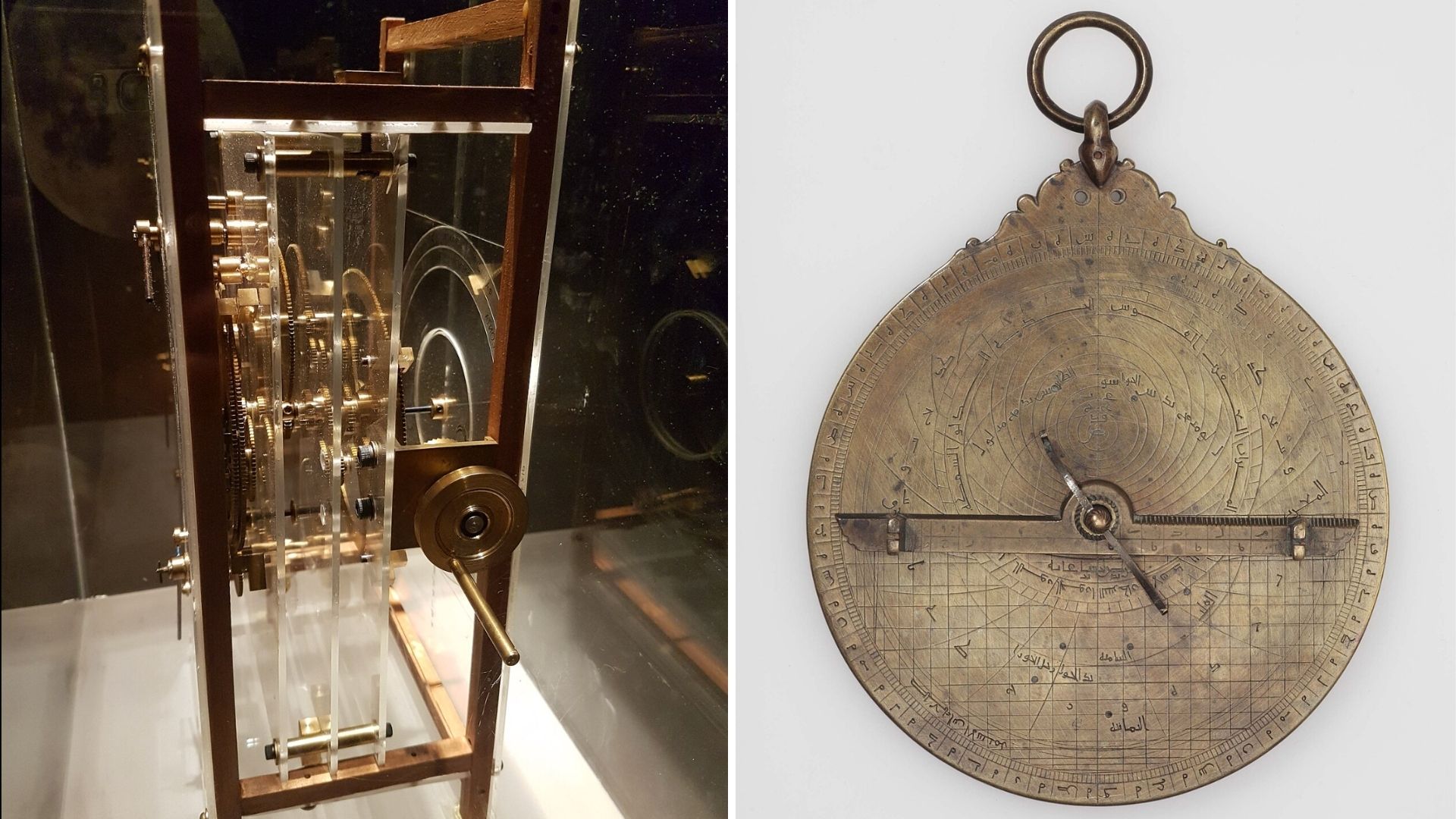
Modern engineering may be filled with computers, automated factories, and advanced materials, but many of its defining principles are thousands of years old. Engineers across ancient civilizations developed machines, structures, and instruments to move heavy objects, transport water, track the heavens, and build settlements capable of surviving hostile environments. These inventions emerged across different regions and periods, yet many relied on ideas still taught in engineering classrooms today. From a geared astronomical calculator to underground water networks, the following 15 innovations reveal how often modern technology begins with an ancient solution. 1. Antikythera mechanism Wikimedia Commons Recovered from a shipwreck near the Greek island of Antikythera, this remarkable device dates to around 100 BCE. Its network of precision-made bronze gears could model astronomical cycles and predict events such as eclipses. Often called the world’s first analog computer, the mechanism demonstrated an understanding of mechanical calculation that would not appear again at a comparable level of complexity for centuries. Its basic concept, representing information through moving mechanical components, later resurfaced in clocks and mechanical computers. 2. Wheel and axle Developed in Mesopotamia around 3500 BCE, the wheel and axle changed how people moved goods, built machines, and organized settlements. Its influence eventually spread far beyond carts and chariots. The arrangement allows a larger wheel and smaller axle to rotate together, reducing the effort required to move or lift loads. Vehicles, turbines, conveyor systems, gears, and industrial robots continue to rely on this fundamental mechanical relationship. 3. Gears and mechanical transmission Ancient Greek and Roman engineers discovered that toothed wheels could transfer motion, alter rotational speed, and change the direction of force. The Antikythera mechanism offers the most sophisticated surviving example, but gears also appeared in mills and other machines. The principle remains largely unchanged. Automotive transmissions, clocks, wind turbines, factory equipment, and robotic joints all use carefully arranged gears to control movement. 4. Pulley systems Wikimedia Commons Ancient builders faced a familiar engineering problem: how to lift enormous loads using limited human and animal power. Pulleys offered a solution by redirecting force and providing mechanical advantage. Combining multiple pulleys allowed workers to raise heavier objects with less effort. Construction cranes, elevators, theater rigging, cable cars, and industrial lifting systems still use the same basic mechanics. 5. The lathe Wikimedia Commons Early forms of the lathe appeared in ancient Egypt and were later refined by Greek and Roman craftspeople. The machine rotated a piece of wood, metal, or another material so that it could be shaped symmetrically with a cutting tool. Modern lathes are faster and more precise, but the underlying process remains recognizable. Computer numerical control machines now automate rotational cutting to manufacture everything from screws to aerospace components. 6. Roman concrete Roman builders created concrete using ingredients that included lime and volcanic ash. The material helped them construct harbors, aqueducts, temples, and large public buildings, some of which have survived for nearly 2,000 years. Researchers continue studying why certain Roman concrete structures have endured seawater and weathering so effectively. Understanding their chemistry could support the development of longer-lasting and potentially more sustainable construction materials. 7. Roman aqueducts Wikimedia Commons Aqueducts transported water from distant sources into cities using gravity rather than mechanical pumps. Engineers maintained extremely gentle gradients across long distances while using tunnels, channels, and arched bridges to cross uneven terrain. These networks supplied homes, fountains, baths, and farms, making dense urban life more practical. Their emphasis on controlled gradients, reliable distribution, and infrastructure maintenance remains relevant to municipal water engineering. 8. Archimedes’ screw Wikimedia Commons Traditionally associated with Archimedes and dated to around the third century BCE, this machine moves water through a rotating helical surface enclosed inside a cylinder. Turning the screw draws water upward from a lower source. Its simplicity has given it extraordinary longevity. Modern versions operate in irrigation networks, drainage projects, wastewater facilities, and low-head hydroelectric installations. 9. Qanat systems Ancient Persian engineers developed qanats to supply communities in dry regions with groundwater. They dug gently sloping underground tunnels that carried water from elevated aquifers to farms and settlements. Because most of the journey occurred below ground, relatively little water was lost to evaporation. The system represents an early form of passive, energy-efficient water management suited to harsh climates. 10. Inca road system Wikimedia Commons The Inca developed a road network stretching roughly 25,000 miles across mountains, valleys, and deserts. They achieved this without widespread use of wheeled vehicles or iron tools. Stone paving, retaining walls, stairways, suspension bridges, and carefully designed drainage allowed the network to cross difficult terrain. Some surviving sections remain usable, illustrating the durability of construction adapted closely to the surrounding landscape. 11. Zhang Heng’s seismoscope Chinese polymath Zhang Heng created his earthquake-detecting instrument in 132 CE. The bronze vessel reportedly contained an internal mechanism capable of indicating the direction from which seismic waves had arrived. Although it did not measure an earthquake like a modern seismograph, it represented an early effort to detect distant geological activity through mechanical motion. Its existence shows that ancient engineers were already designing instruments to convert invisible natural forces into visible signals. 12. The astrolabe Originating in the ancient world and later refined by scholars across the Islamic world, the astrolabe helped users determine the positions of celestial objects. It could support navigation, calculate time, estimate latitude, and solve astronomical problems. The instrument brought complex observations into a portable mechanical form. Its influence can be seen in later sextants, surveying instruments, and navigation technologies. 13. Camera obscura Wikimedia Commons Thinkers in ancient China and Greece observed that light passing through a small opening into a dark space projected an inverted image of the outside scene. This phenomenon became known as the camera obscura. The device helped establish key ideas about straight-line light propagation and image formation. Centuries later, the same principle contributed to the development of photographic cameras, cinema equipment, and optical instruments. 14. Greek fire The Byzantine Empire deployed an incendiary substance known as Greek fire during naval warfare from around the seventh century CE. Historical accounts suggest it could continue burning on water and may have been projected using pressurized equipment. Its precise composition remains unknown, making claims about its formula difficult to verify. Nevertheless, its combination of a combustible material and specialized delivery system anticipated later incendiary weapons and flamethrowers. 15. Baghdad battery The so-called Baghdad battery consists of a clay jar containing a copper cylinder and an iron rod. Some researchers have proposed that, when filled with an acidic liquid, the assembly could generate a small electrical charge. Whether it functioned as a battery is still disputed, and its actual purpose remains unresolved. Even so, the object offers a fascinating example of how an ancient arrangement of materials can resemble the basic structure of a galvanic cell. Conclusion Ancient engineers did not possess modern simulation software, electric machinery, or standardized manufacturing. They relied instead on observation, experimentation, available materials, and a deep practical understanding of how forces behaved. Their solutions were not primitive versions of engineering but sophisticated responses to real constraints. Every time a gear turns, a pump lifts water, or a road survives difficult terrain, part of that ancient engineering legacy continues to work.
Wheels, gears, and batteries: 15 ancient ideas that engineered the modern age
Full Article
Original Source
Read the full article at Interestingengineering →KhanList aggregates and links to publicly available news content. We do not host full articles from third-party sources. Always verify important information with original sources.