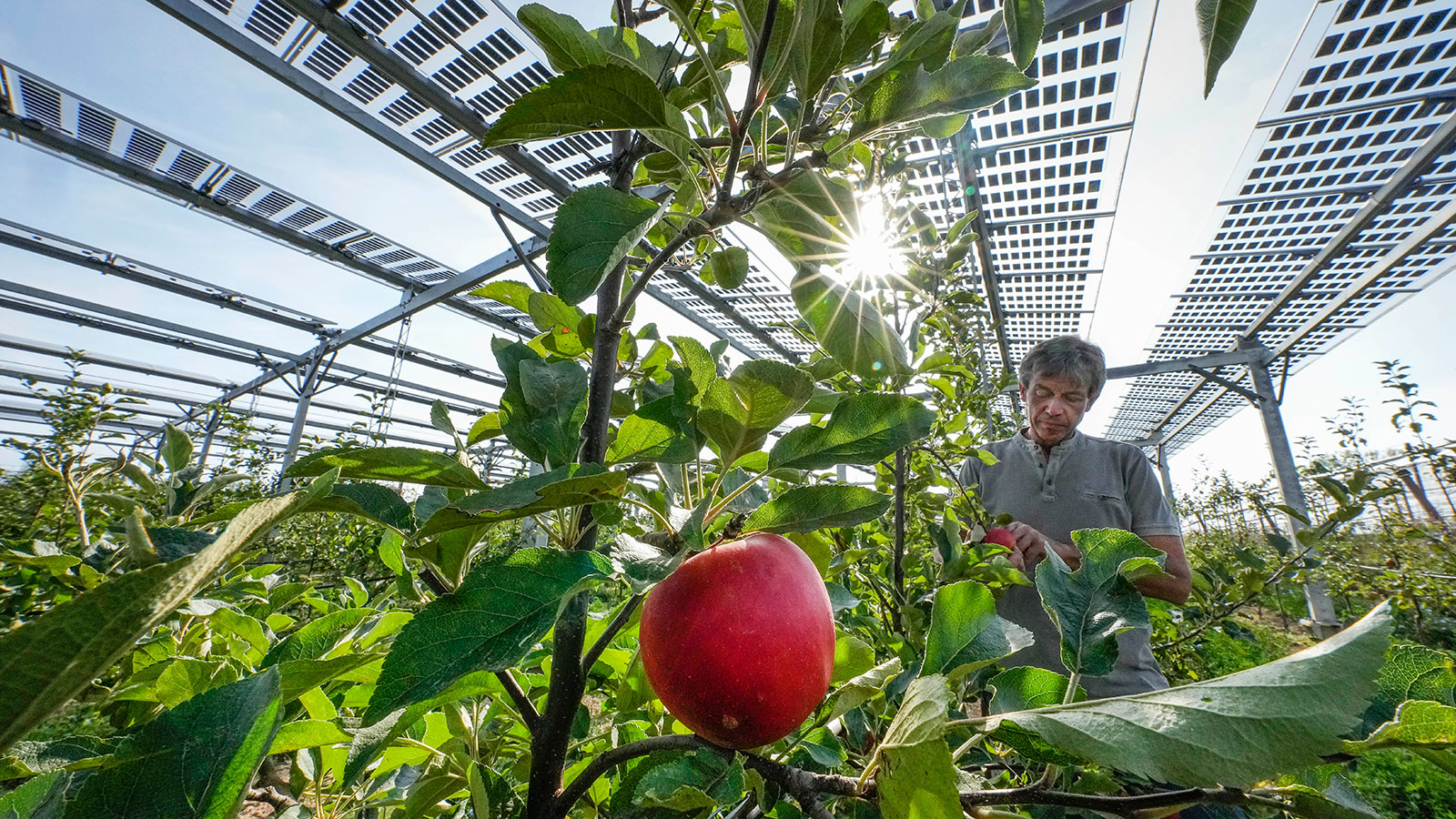
(AP Photo/Martin Meissner) The agrovoltaic concept is simple: growing some kind of food in fields of solar panels. Slowly but surely, both research and successful practices are spreading, the benefits of harvesting clean energy and food together are becoming clearer, and challenges are being met. Pollinator plantings (for beekeeping and biodiversity), the vegetables and fruits sold at farmers’ markets and grocery produce sections, and sheep: these most common uses of the land under solar arrays are proving to be clear win-win set-ups for producers of both food and energy. There are other wins, too, for those of us who like to eat, prefer to avoid food controlled by giant corporations, want more renewable energy, and appreciate the aesthetics and other benefits of open lands. Want to learn more? These readings and resources are a great place to start: Overviews of agrovoltaics AgriSolar Clearinghouse. This “information hub for all things agrisolar” will be useful for current or prospective practitioners, but the home page also features a good film by Seth Warren. “Harvesting the Sun” (13 minutes) addresses what agrisolar is, how it works, its many benefits and opportunities, and how it can be a both/and practice for agriculturalists and solar developers alike. A strongly positive take on the topic. Colorado Agrivoltaic Learning Center. Another significant information hub with another very good — and award-winning — film, “Save the Farm, Save the Future” (directed by Chad Weber). This is an hour-long comprehensive look at challenges for farmers and ranchers, particularly in Colorado but also elsewhere — and at how sometimes agrisolar practices can help meet those challenges. Interesting even for those who grow little or no food. “Agrivoltaics are gaining ground on agricultural land.” Whitney Bauck, Offrange. This well-done overview is from 2022, before the Trump administration shut down the Rural Energy for America Program (REAP), the main source of grants and loans for such systems. But it still offers plenty of good information and links. “Agrivoltaics: Pairing solar power and agriculture in the Northwest.” USDA Northwest Climate Hub. This still-active government site contains another good overview (kinds of systems, help with climate adaptation, potential benefits, challenges) before moving to region-specific information and links. Agrovoltaics in action from Virginia to the Southwest and everywhere in between “Can farmland thrive with solar? This Virginia nonprofit is finding out.” Elizabeth Ouzts, Canary Media. An interesting look at the pressure of renewable energy goals on land use, how growing crops under solar panels may help reduce conflicts, and current research into how that kind of farming will actually work in that location. “Fear of farmland loss slows solar and wind development.” Claire Carlson, Canary Media. An example of successful sheep ranching under solar panels in Texas, set against the mixed attitudes of the wider agriculture community and other barriers. “Grazing between the panels: how sheep are expanding what’s possible for solar and agriculture in Massachusetts.” Lia Raz, American Farmland Trust. A story of research and practice in a place where both food and solar farms are small and spatially separated. “In the sweltering Southwest, planting solar panels in farmland can help both photovoltaics and crops.” Tina Deines, Inside Climate News. How drier parts of the U.S. are prime territory for these farms is clear in this encouraging article. Panels shade plants and preserve water; plants cool solar panels and make them more efficient; everybody benefits. “In Wyoming, sheep may safely graze under solar panels in one of the state’s first ‘agrivoltaics’ projects.” Jake Bolster, Inside Climate News. With a focus on the benefits of solar panel shade to growing sheep, this story also looks at the complicated logistics of getting permits for such a solar farm. Even willing parties and permits in hand don’t guarantee progress: see “$500M Converse County solar project delayed without buyer for its power.” Kate Meadows, Cowboy State Daily. “Can cows and solar power coexist? We’re about to find out.” Dan Gearino, Inside Climate News. Cattle grazing among solar panels is a sort of holy grail for agrivoltaics, given the size of the industries surrounding beef. Often thought to be impractical because cows are large, heavy, and like to scratch on immobile structures, thus damaging solar equipment, this combination might actually be made to work. This informative article centers on an experiment in Kentucky. Farmers face setbacks without federal support “American farmers bet on solar. Then Trump changed the rules.” Ayurella Horn-Muller, Melina Walling, Clayton Aldern, and M.K. Wildeman, Grist. Subhead: “We tracked how the collapse of federal rural energy support is ending solar projects across farm country — and costing some developers millions they’ll never get back.” “In new attack on solar, lawmakers spread myths about potato farms.” Austyn Gaffney, Canary Media. Subhead: “Misinformation about renewable energy fuels local pushback to proposed energy installations and could threaten farmers’ livelihoods.” “Hosting solar can be a lifeline for farmers. But overcoming local opposition is tough.” Joshua A. Bickel, AP News. This is one of many articles about how agrivoltaics have been controversial in Ohio. “Solar Opposites: a standoff over renewable energy in rural America.” Dan Gearino, Inside Climate News. A yearlong project of on-the-spot reporting, with six articles, mostly about Ohio. Informative but dismaying for renewable energy fans. “Ohio blocks big solar farm, despite apparently fake public comments.” Kathiann M. Kowalski, Canary Media. “6,000-acre solar project permit nixed by Ohio Supreme Court, for now at least.” CBS News. “Rural Ohioans oppose solar farms, right? Not so, developer finds.” Kathiann M. Kowalski, Canary Media. Encouraging. Republish our articles for free, online or in print, under a Creative Commons license. SueEllen Campbell created and for over a decade curated the website "100 Views of Climate Change," a multidisciplinary collection of pieces accessible to interested non-specialists. She is especially interested... More by SueEllen Campbell
What’s the deal with agrovoltaics?
Full Article
Original Source
Read the full article at Yaleclimateconnections →KhanList aggregates and links to publicly available news content. We do not host full articles from third-party sources. Always verify important information with original sources.