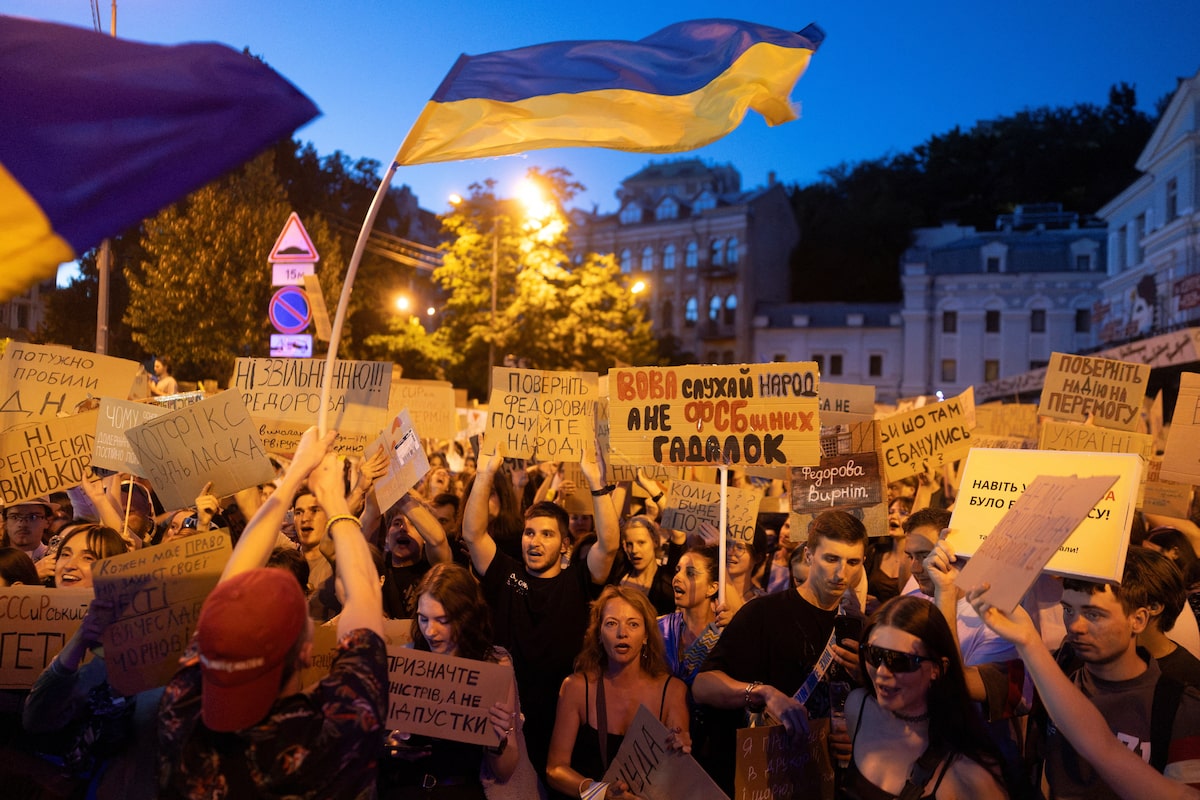
Open this photo in gallery:Ukrainians protest against President Volodymyr Zelensky's decision to replace Mykhailo Fedorov as defence minister in Kyiv on July 18.Thomas Peter/ReutersUkrainian President Volodymyr Zelensky has bowed to days of public protests by replacing his country’s top general, but it remained unclear Wednesday whether that would be enough to end a crisis that has rocked the country’s wartime leadership.In dismissing General Oleksandr Syrski as commander-in-chief of the armed forces and replacing him with the more popular Major General Mykhailo Drapatyi, Mr. Zelensky fulfilled one of the two main demands of the protesters who have taken to the streets of Kyiv and other cities over the past week.But tensions remain over the unsettled fate of former defence minister Mykhailo Fedorov, whose firing on July 15 triggered the crisis, with protesters calling for his reinstatement. There are also questions over what the leadership shake-up will mean for the performance of Ukraine’s military, which in recent months has taken the initiative against the invading Russian army.Open this photo in gallery:Then-defence minister Mykhailo Fedorov speaks at a press conference in Kyiv on July 1.Alina Smutko/ReutersHow did the crisis start?A behind-the-scenes power struggle between Mr. Fedorov and Gen. Syrski – which began almost as soon as Mr. Fedorov took office in January – erupted into public view when Mr. Zelensky fired Mr. Fedorov last week. Mr. Zelensky said relations between his defence minister and his top general had deteriorated to the point where he was forced to choose between them.Thousands of Ukrainians took to the streets to protest the decision, which saw Mr. Zelensky side with a Soviet-trained general over a reformist defence minister who was seen as driving Ukraine’s effort to use drones to compensate for Russia’s large advantages in manpower, artillery and other equipment.Open this photo in gallery:Protesters hold a portrait of Oleksandr Syrskyi demanding his resignation during a rally to in Kyiv on July 18.Efrem Lukatsky/The Associated PressWhy is Syrski so unpopular?While Gen. Syrski became a national hero for organizing the successful defence of Kyiv at the start of the Russian invasion in 2022, he later gained notoriety as “The Butcher” for his adherence to old-fashioned military tactics, which included a willingness to sacrifice his soldiers’ lives in pursuit of mission objectives. Gen. Syrski’s reputation was further sullied by reports in Ukrainian media that more than two dozen soldiers in the 425th Separate Assault Regiment had died, with their bodies showing signs of torture. The unit involved reports directly to the General Staff. The incident further hampered Ukraine’s already-flagging efforts to recruit more soldiers. Before his dismissal, Mr. Fedorov said Ukraine’s mobilization shortfalls could not be fixed “without a new social contract and without real changes in the military.” What about the new commander?Maj-Gen Drapatyi, 43, is nearly two decades younger than Gen. Syrski, and never served in the Soviet army. He’s seen as an ally of Mr. Fedorov, and a supporter of the rapid adaption of new technologies for battlefield use. Maj-Gen Drapatyi is a hero in his own right for leading a 2014 thrust into the city of Mariupol – then under the control of Russian-backed fighters – that became famous after a viral video captured Maj-Gen Drapatyi’s armoured personnel carrier driving at high speed over a blockade. On Wednesday, Ukrainians were resharing that video on Instagram and other platforms in celebration of Maj-Gen Drapatyi’s promotion.“Hopefully his appointment will bring a new hope for the military and society and will boost morale,” said Oleksandr Merezhko, a member of Mr. Zelensky’s Servant of the People party who heads a parliamentary committee on foreign affairs. Open this photo in gallery:Mykhailo Drapatyi attends a meeting in Kyiv on July 20 in this supplied photo from the Ukrainian Presidential Press Service.UKRAINIAN PRESIDENTIAL PRESS SERVICE/ReutersWhere does this leave Fedorov?That’s still to be determined. Ukrainian media have reported that Mr. Zelensky has offered Mr. Fedorov either a spot on the country’s National Security and Defence Council, or the new job of Deputy Prime Minister for technological development – but that Mr. Fedorov was interested only in returning to his previous post.That might be too much for Mr. Zelensky to accept. “Right now, the President is reluctant to reinstate Fedorov and is eager to offer him any position beside defence minister,” Mr. Merezhko said. “But Fedorov seems to decline any alternative offers.”So, will the protests continue?This will be an interesting test of what the demonstrations are really about. While they were initially sparked by Mr. Fedorov’s dismissal, more and more of the signs held aloft at recent protests focused on the need to replace Gen. Syrski.Mr. Fedorov was embraced by the protesters because of his ideas about drone warfare – which decreased the need for Ukrainian men to fight and die on the front line – and for his insistence on scrutinizing every defence-related contract to ensure there were no corrupt side deals involved.Inna Sovsun, an MP from the opposition Holos party, said she expected the protests – which are slated to resume on Friday – would shrink but not stop now that Mr. Zelensky has replaced Gen. Syrski. “A lot depends on what decisions are taken next, and whether Fedorov will agree to the positions that have been offered to him,” Ms. Sovsun said.“For many people who took to the streets, Fedorov has become a symbol of hope – that the situation can develop more positively for Ukraine than it seemed before he was appointed. It’s the taking away of this hope that triggered the protests.”What is the situation on the battlefield?The hope that Mr. Fedorov is credited with introducing is seen in the almost-nightly drone strikes that Ukraine is carrying out deep into Russian territory. Ukrainian drones, as well as the country’s domestically produced Flamingo cruise missiles, have struck hundreds of Russian oil facilities, leading to fuel shortages across the country as well as in Crimea, a Russian-occupied region of Ukraine.Many Ukrainians like the idea that ordinary Russians are finally experiencing a taste of what they’ve been suffering since the full-scale invasion began more than 1,600 days ago.Unmanned robotic systems – such as remotely operated machine guns – are also playing an increasing role in the war on the ground, where Ukraine continues to inflict heavy casualties on the invading Russian army. That said, Russia still controls about 20 per cent of Ukrainian territory, and continues to slowly grind forward in the southeastern Donbas region that has become the war’s main front.
What’s behind the protests in Ukraine?
Full Article
Original Source
Read the full article at Theglobeandmail →KhanList aggregates and links to publicly available news content. We do not host full articles from third-party sources. Always verify important information with original sources.