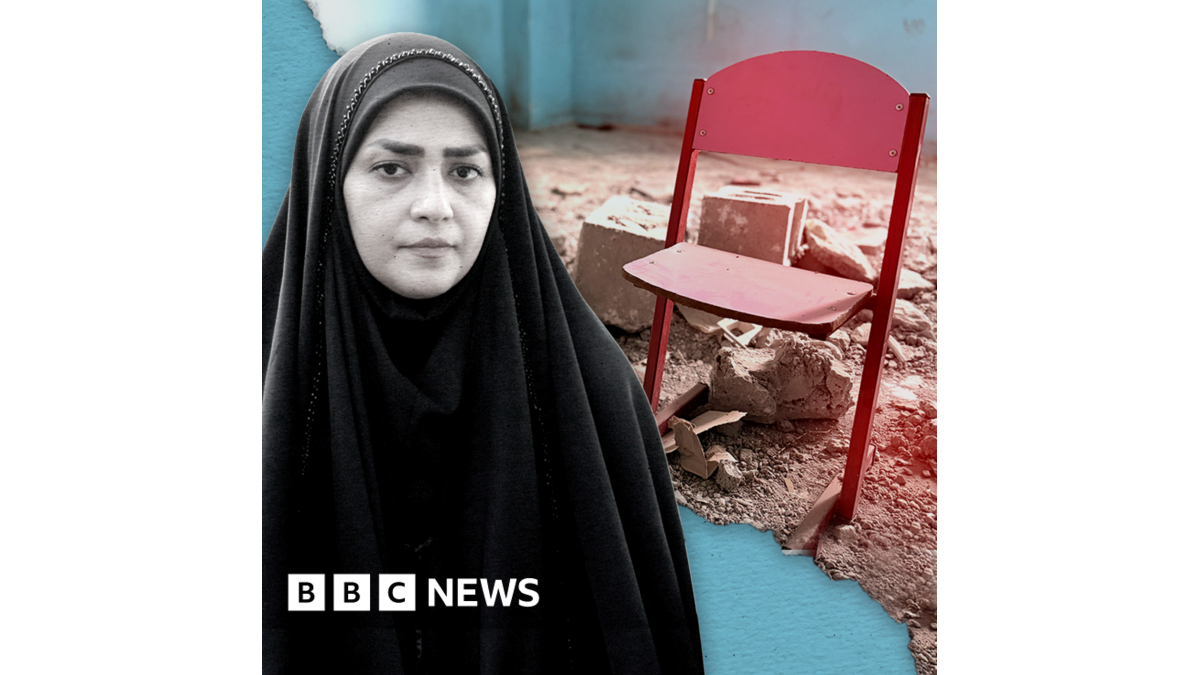
ByNawal Al-MaghafiSenior international investigations correspondentReporting fromMinab, southern IranThis report contains distressing descriptions of the deaths of children.Amaineh Nademi walks carefully through what is left of her old school. Chunks of broken concrete hang precariously from the damaged upper floor. A few classrooms are still standing, their brightly coloured walls decorated with painted balloons and flowers.The 33-year-old teacher knows exactly what was where - the girls' classrooms on the upper floor, the boys' classrooms below, the headteacher's office, the prayer room.Rubble is all that remains of her classroom, where she taught first-grade girls at Shajareh Tayyebeh Primary School in Minab, a small city in southern Iran.Figure caption, Children's chairs and decorated walls can still be seen in the damaged classroomsOn 28 February, in the opening hours of the US-Israeli war with Iran, a strike on the school transformed an ordinary Saturday morning into one of the conflict's defining tragedies - and its deadliest single incident for civilians.In total, 156 people, including 120 children, have been confirmed killed, including a pregnant woman and her unborn child, according to the Minab prosecutor's office.Experts say evidence indicates that US forces hit the school, which is next to an IRGC compound that satellite images show was struck several times.The US has not admitted responsibility, though US media have reported that military investigators believe it is likely that US forces carried out the strike unintentionally.Image caption, Girls were taught on the upper floor of the primary school while the boys' classrooms were belowThe pain of what happened here is still raw. Teachers tell us they pray at the site every day. Rescue workers are still searching for remains of those killed here.Much of the upper floor collapsed into the one below. "You can't call it a school," says Amaineh – just "walls that smell of death, grief and the blood that was shed here".The Iranian authorities were keen for us to visit the school – it is evidence, they say, that a campaign presented by Washington as an attack on Iran's military and security apparatus has instead inflicted a devastating cost on civilians.'We were all sent flying'The school day had begun as usual, Amaineh says.Because it was the Islamic holy month of Ramadan, the children gathered inside the prayer hall to recite the Quran, she recalls, before she began teaching her pupils a new letter of the Persian alphabet.But, as the first attacks of the war unfolded across Iran, she says the headteacher announced the school would be closing, and teachers began contacting parents, urging them to collect their children.Only five of Amaineh's 15 first-grade pupils were left in her classroom on the upper floor, she says, when she first heard an explosion not far from the school. She says she was in the corridor and rushed back for the children."Just as I went to leave, a missile struck the school," says Amaineh. "Something hit my head and my students' heads - we were all sent flying."Then, she says, thick black smoke filled the classroom: "I couldn't even see the pupils I was holding in my arms. We couldn't breathe."She says she remembers hearing another explosion, as well as the sounds of screaming, children crying and then the school itself collapsing – "destroyed all at once"."Blood was pouring from me and the students," she adds.Image caption, Teacher Amaineh Nademi says there was smoke so thick she could not see the children she was holdingWhen the smoke briefly cleared, she says she passed the injured children down to people below and clambered past fire and rubble towards the school gate, where she saw a crowd of parents. Many had rushed to the site without even putting shoes on, she recalls.She says she could not understand why the parents were running towards the school, believing in her shock and confusion that everyone else had already escaped the building: "I didn't know that all of them were under the rubble."Amaineh had taught first grade at the school for six years. She lists the names of students and colleagues killed that day: Adrina from her first grade class, who she says was killed on the stairs with her mother, Fatemeh in second grade, and many others including students in sixth grade she remembers teaching the alphabet to, as well as the headteacher, deputy head, PE teacher and Quran teacher.'Find my son'Within minutes, emergency workers began arriving.Reza Besharati, a worker with the Iranian Red Crescent Society, says he was among the first rescuers on the scene, and found the roads near the school filled with traffic as desperate families rushed to look for their children.Minab is a small city. As Reza made his way through the crowd and into the wreckage, he says he recognised people he knew, including some of his own relatives."We started to find the people, thinking maybe someone would be alive," he says. "But unfortunately, nobody was."Image caption, Reza Besharati says he cannot forget what he saw when searching the collapsed buildingHe says the dead were found grimly disfigured: "Maybe just a hand, maybe just a leg… Nobody had a complete body." Many families recognised their children by their shoes or clothing, he adds.One of Reza's relatives was searching and begging "just find my child, find my son", he says. "I couldn't tell her that her son was not alive. We were all just crying."Reza says the sights he saw while searching the collapsed building have not left him: "I couldn't sleep for a few days," he says. "When I close my eyes… I just remember these things that I have seen here."Strike investigatedAs details of the strike emerged, President Donald Trump first blamed Iran, without providing evidence.Defense Secretary Pete Hegseth said the military was investigating and that US forces "never target civilian targets". He later announced a higher-level investigation, led by an officer from outside US Central Command (Centcom). The Trump administration has still not released the findings.Several US media outlets have reported - citing people familiar with the US military investigation - that preliminary findings concluded it was likely that outdated data supplied by the US Defence Intelligence Agency led to the school being treated as part of a military site.Expert video analysis has shown the IRGC complex next to the school was hit by a precision guided Tomahawk missile - a type of cruise missile that neither Israel nor Iran is known to possess. Satellite imagery showed the school and several buildings in the compound had been hit, and verified videos showed the area was hit by a series of strikes. US military maps also confirm American operations in southern Iran – including the Minab area - at the time.Historical satellite images show the school area was previously part of the IRGC complex, but has been walled off since 2016 and has its own entrances and yards.Also, information indicating the site was a school was publicly available online. Archived snapshots of the websites for the girls' and boys' sections of the school – taken in the months before the attack - include the address of the site.The head of Centcom told a congressional committee in May, without giving further detail, that the investigation was "complex" as the school was "on an active IRGC cruise missile base" – which Iran's foreign ministry rejected as a "baseless fabrication".The IRGC runs some community and medical facilities in addition to its extensive military, security and economic activities. Local residents have told BBC Persian that the site had previously been a base for an IRGC naval brigade, but that they believed its military use had ceased several years ago. Photographs show buildings on the compound included a clinic and a car wash.The BBC approached the Department of Defense and the US military for comment. Officials said the investigation was ongoing and there were no further updates.'Identified by her socks'A short drive from the ruined school is the cemetery where many of the pupils and teachers are buried.Every evening, families gather beside the graves. Mothers wipe dust from photographs of their children. Parents sit and pray long after darkness has fallen.Around them, brothers and sisters play between the headstones of siblings whose lives were cut short.Image caption, Nine-year-old Setayesh wanted to be a teacher, her mother saysMasoumeh Mehran Shekhabadi comes to visit her nine-year-old daughter, Setayesh, every day, often staying long into the night.She was among the parents who ran to the school after the strike. "There was no school," she says, her voice breaking. "There was only smoke, children's hair, a hand on one side, a foot on the other. They had been torn to pieces."Masoumeh adds: "I kept calling out, not only to Setayesh, but to all the children: 'Children, where are you?'"Setayesh's family did not receive confirmation of her death until the early hours of the following morning, Masoumeh says. She remembers being repeatedly asked what colour socks the child had been wearing, and replying that they were cream. Setayesh was then identified by her socks, she says.The nine-year-old had wanted to be a teacher, her mother adds. "She would line up her dolls on the couch and say: 'I am your teacher. I'm in primary school now, so I am a teacher.'"As for many parents here, grief has become intertwined with anger. "May Trump be destroyed, so these children's blood is not wasted," Masoumeh says.Image caption, Masoumeh says she remembers rushing to the school to find it destroyed and children "torn to pieces"'They'd gone to learn'Iran's government has repeatedly invoked Minab in speeches, international forums and state media coverage - even naming a plane carrying negotiators "Minab-168", in reference to the death toll previously given by officials.The attack offers the Islamic Republic a powerful counter-narrative to Washington's description of its campaign.Image caption, Every evening, families visit the graves of loved ones killed in the strikeThe war has divided Iranians. Some celebrated when the air strikes began, angered by the government's history of detaining dissidents and using lethal force during repeated waves of protest. They hoped military pressure from outside might finally weaken or even bring down the regime.Some opponents of the government have told the BBC they saw the strike at Minab as a huge blow. It made the idea of a clean, surgical war impossible to sustain and allowed the authorities to present themselves as the defenders of the Iranian people against foreign attack.In Minab, Amaineh visits the cemetery, walking among the graves of her former pupils.On a nearby memorial wall are the faces of the children, staff and parents who left home that Saturday morning and never returned.Setayesh's mother still sits beside the grave of her little girl."What was these children's crime? Did they carry weapons? A pencil, a book, a notebook and a schoolbag. They had no weapons… They'd gone to learn," she says.Additional reporting by Jasmin DyerNawal Al-Maghafi is reporting from Iran on condition that none of her material is used on the BBC's Persian Service. These restrictions apply to all international media organisations operating in Iran.IranIran warUnited StatesHuman rightsMiddle East
'What was their crime?': BBC visits Iran school where strike killed 120 children
Full Article
Original Source
Read the full article at Bbc →KhanList aggregates and links to publicly available news content. We do not host full articles from third-party sources. Always verify important information with original sources.