
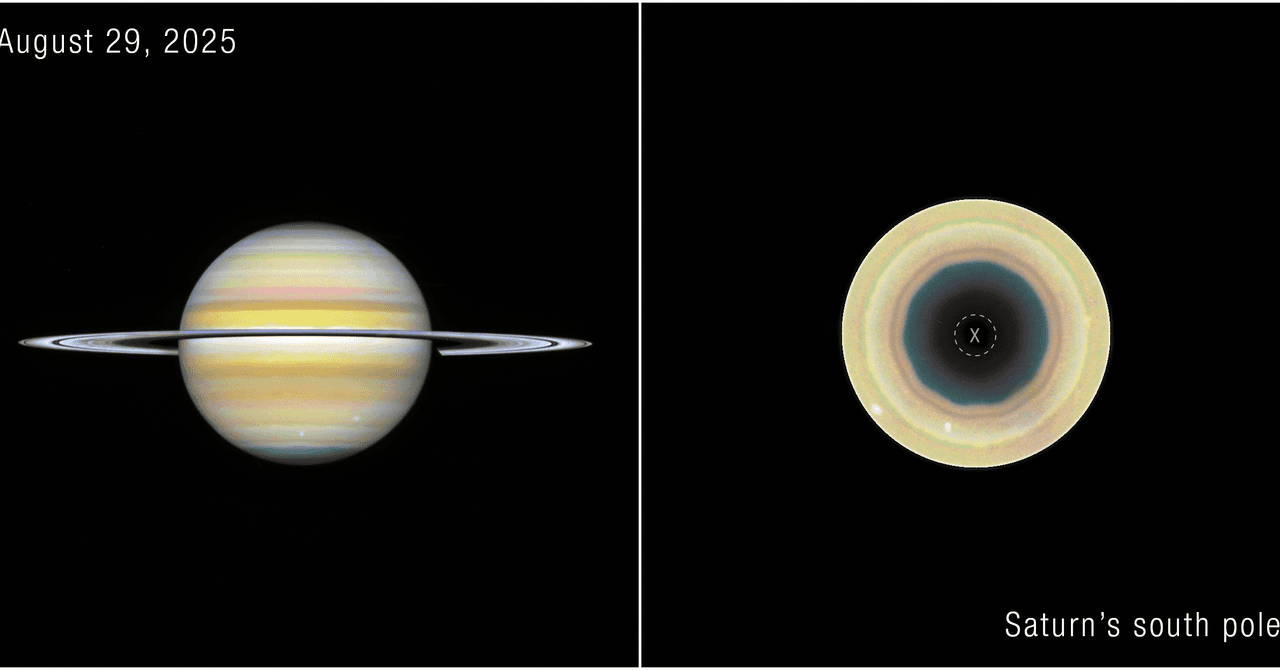
A team of astronomers discovered a strange polygonal atmospheric structure on Saturn near the planet’s south pole. This 10-sided shape, known as a decagon, joins one of the gas giant’s most famous features: a hexagon near the north pole that was first observed 44 years ago. Images of the new decagon were captured by the Hubble Space Telescope, and the discovery was recently published in the journal Science Advances.The formations at both the north and south poles aren’t solid structures, like a wall or a rock formation. Saturn doesn’t even have a defined solid surface like Earth’s crust. If you were to descend through the atmosphere of the ringed planet, the pressure and density would progressively increase, but you would never reach a “ground” on which to land. Instead, what astronomers have witnessed are patterns formed by clouds, albeit very unusual ones.Each side of the decagon measures approximately 16,800 kilometers, which is a few thousand miles longer than the diameter of Earth. Near the feature is a jet stream reaching speeds of 116 meters per second, or nearly 260 miles per hour. By way of comparison, a Category 5 hurricane—the most intense storm level possible on Earth—is defined by winds above 157 miles per hour. Interestingly, although the jet stream circulates at tremendous speed, the decagon pattern shifts at a mere 2.5 meters per second—less than 6 miles per hour.Photograph of the new decagon at Saturn’s south pole Photograph: Courtesy of Space Telescope Science Institute Office of Public OutreachThe south pole feature appears to have formed recently. For decades, scientists have been searching for a counterpart to the famous northern hexagon. However, major missions that observed the planet have previously not been able to find an equivalent, long-lasting structure in the south. The search was further complicated because, due to Saturn’s tilt, its southern hemisphere was not clearly visible from Earth for many years.The first clues of the decagon came from ground-based observations, some by amateur astronomers. As the images accumulated, it became evident that something strange was happening in Saturn’s southern cloud bands. Data from the Hubble Space Telescope made it possible to trace the pattern back to images taken in 2023. Monitoring continued, and by 2025 its 10 vertices had become much more clearly defined, confirming the presence of a new polygonal feature in the ringed planet’s atmosphere. Science, however, hasn’t settled on an explanation for how these structures came to be.Various hypotheses have been proposed since the discovery of the north polar hexagon. One is that the polygons are the visible manifestations of enormous atmospheric waves confined by powerful jet streams. You can think of these as similar to ocean waves, which are not simply objects traveling across the ocean but rather disturbances propagating through the water.A wave’s behavior changes depending on the space in which it moves and the boundaries it encounters. On Saturn, waves of atmospheric gases may be encountering jet streams that confine them, in a sense, like the edge of a beach. Except in this case, the “beach” wraps all the way around the planet.Saturn’s famous hexagon Photograph: Courtesy of NASAVarious other factors, such as Saturn’s rapid rotation, exact wind speeds, and variations in the currents, could all contribute to the distinct geometries of the shapes. A current that coils around the planet six times can form a hexagon; one that does so 10 times, a decagon. This is one of the more likely explanations for how an atmosphere without any solid structure can end up forming something that looks like a gigantic polygon, but there are still many unanswered questions.We don’t know how deep these geometric figures extend, how long the new decagon might last, whether its appearance is related to Saturn’s seasons, and—most importantly—what sparked its formation in the first place. Researchers hope to find some answers by tracking the decagon’s evolution. To do so, they plan to continue observations with the Hubble and James Webb space telescopes and use more advanced atmospheric models to reconstruct possible conditions that could give rise to such a structure.This story originally appeared on WIRED en Español and has been translated from Spanish.
What the Heck? Another Perfect Geometric Shape Has Been Detected on Saturn
Full Article
Original Source
Read the full article at Wired →KhanList aggregates and links to publicly available news content. We do not host full articles from third-party sources. Always verify important information with original sources.