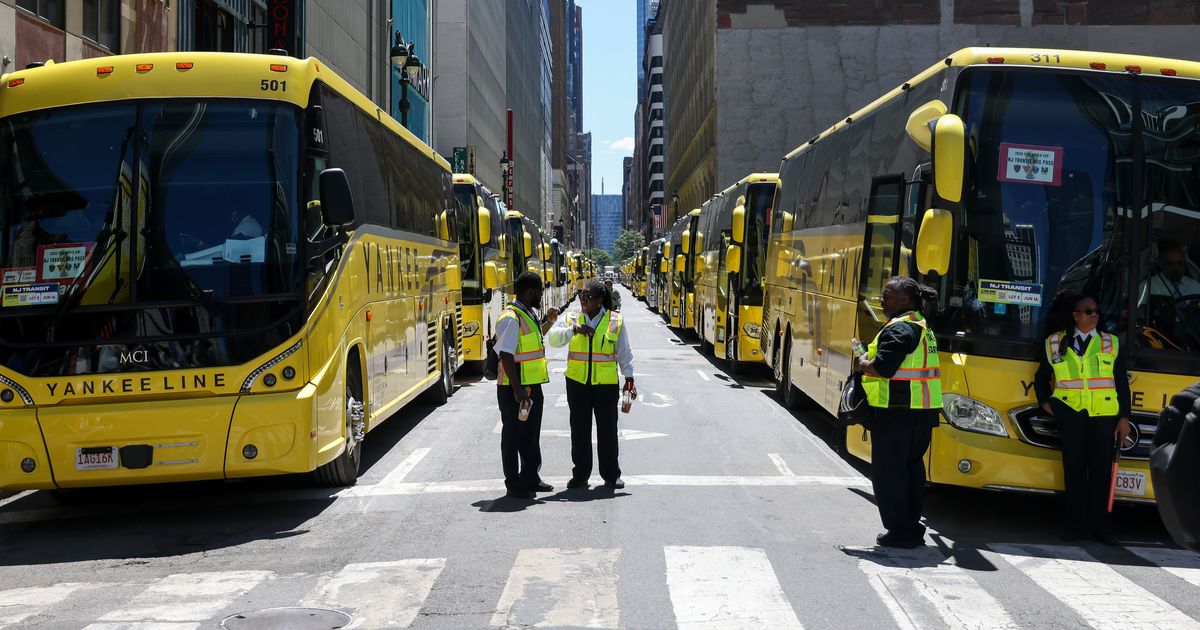
What New York’s World Cup Traffic Experiment Proved Photo: Michael Nagle/Bloomberg/Getty Images On eight separate occasions across June and July, the city tried out something new in midtown. The crosstown corridor of 42nd Street, from First to 12th Avenue, was turned into a dedicated bus-and-shuttle corridor — along with several smaller side streets and swaths of Fifth and Sixth Avenue, too. Streets around Penn Station were closed to vehicular traffic to accommodate crowds. And truck deliveries were banned from 30th to 60th Street, with restrictions lasting as long as 13 hours. The traffic restrictions were put in place for “match days,” when thousands of fans crossed the Hudson to watch FIFA’s 2026 World Cup games at MetLife Stadium, in East Rutherford, New Jersey. Sunday’s final attracted some 80,000 spectators alone. And if many of those who traveled the five miles to the Meadowlands did so by public transit — which was at least half of all visitors, since most vehicles were effectively barred from approaching the arena — chances are they passed through midtown, save for the few die-hards who traversed the New Jersey Turnpike by foot. Before the games kicked off, my colleague Christopher Bonanos hypothesized that if all went swimmingly, this World Cup traffic experiment could be a test for future action. The Mamdani administration had already used the tournament to justify permanently widening bike lanes and sidewalks elsewhere. Couldn’t that same logic apply here? Now, the games are done, the teams have gone home, and the results are in. Let’s start with a focal point: bus riders. Shuttles carried a substantial percentage of Cup-bound commuters from the Port Authority. So its gateway at 42nd Street had to move people much faster than usual; even with a bus lane, the M42 route is still one of the city’s slowest, averaging roughly five miles per hour — the pace of a leisurely stroll. (Last year, it won the Pokey “award” for sluggishness.) At that rate, you would’ve been lucky to catch halftime. But on match days, that wasn’t the case. Videos online showed buses easily gliding through emptied lanes. A Streetsblog reporter made the journey eight minutes faster. “Forty-second Street was a big success,” said Danny Pearlstein, the policy and communications director for Riders Alliance, an advocacy group for straphangers. According to city transit officials, travel times were about 23 percent faster than usual, even with a million more people in town for the tournament. Supporters point to 14th Street as proof: The busway, which has restricted traffic on the thoroughfare to buses, ambulances, trucks, and cabs since 2019, has seen bus speeds go up. Thirty-fourth Street is up next for the same treatment, after City Hall negotiated with the feds. Trying it out on the next major link uptown after 34th seems fitting. “It should stay a busway, especially since the community support has been in place for years, even longer than 34th Street,” said Pearlstein. What’s that again? In recent years, three Manhattan community boards — local bodies not exactly known for taking away street space from cars — have called on City Hall to install a busway on 42nd Street. Transportation Alternatives, an advocacy group that pushes for safer streets citywide, has since led a campaign (“Miracle on 42nd Street“) calling on City Hall to advance a redesign that includes a protected bike lane and wider sidewalks. For Emily Jacobi, the group’s Manhattan organizer, match days gave a glimpse of what was possible. “If you were [in midtown] during any of the games when it was running, it really felt like crystal-clear streets,” Jacobi told me. The Mamdani administration hasn’t announced any plans for a 42nd Street busway. But the new bus blueprint out this month from the New York City Department of Transportation identified a “Midtown Crosstown” almost exactly where 42nd Street is on the map as one of 50 “priority corridors” where the city hopes to raise speeds by 20 percent. For the M42, that pace would equal a light jog, an improvement over the current leisurely stroll. There will certainly be some pushback as with any major street redesign. In an email, Andrew Rigie, the executive director of the NYC Hospitality Alliance, an organization representing the city’s bars and restaurants, said several businesses “expressed frustration” at the restriction on delivery trucks. He cited the inability of restaurants to receive perishables and what he described as last-minute communication that made it hard to plan for no-truck zones — the city’s plan became public in late May, with the first match day happening two weeks later. “They knew the World Cup was coming for years,” Rigie told me. “They could’ve given more than a week’s notice, which forced people to scramble.” Fred Cerullo, the president of the Grand Central Partnership, a local business group, echoed those concerns. “Not a lot of outrage — everyone knew the point — but it was frustrating and really created a lot of burden to get business done.” The street closures, he added, also shuttered the taxi stand outside of Grand Central, which the Partnership manages. “People were coming out expecting to find transportation and found nothing. Not good.” On the ground a few days after the final, the responses were a bit more mixed. A hostess at Pershing Square, just across from Grand Central, said the bistro saw no notable difference in business. “People mostly come right off the train, see our place, and come in,” she said. Similarly, a hot-dog-cart owner farther east, in front of the New York Public Library, said he didn’t notice it. “People just grab and go here.” But for Kirit Prajapati, a newsstand owner at 42nd Street and Madison Avenue, the traffic restrictions were a headache. “Our truck drivers had to park far away and couldn’t get to us,” he told me. “And if they get tickets, we’re the ones who have to pay them.” As we spoke, several buses struggled to turn a corner, causing a din of honking that made our conversation barely audible. Was that something worth fixing? I asked. He didn’t think so. “It should go back to what it was before these bus lanes were here, which made congestion worse,” Prajapati said. “It wasn’t broken; don’t try to fix it.” For Aaliyah Campa, the store manager of Neuhaus Chocolates, at 42nd Street and Park Avenue, the closures affected her business as well. “You stepped outside and it was a ghost town here,” she said. “We definitely slowed down.” But what about the arrangement advocates are pushing — like 14th Street, where private cars are pushed out at each turn? Hearing that, she seemed intrigued. “Oh, that would be nice,” she said. “Because there’s way too much traffic here.” What New York’s World Cup Traffic Experiment Proved Your product is saved! You’ll receive emails when your saved products go on sale. Manage preferences.
What New York’s World Cup Traffic Experiment Proved
Full Article
Original Source
Read the full article at Curbed →KhanList aggregates and links to publicly available news content. We do not host full articles from third-party sources. Always verify important information with original sources.