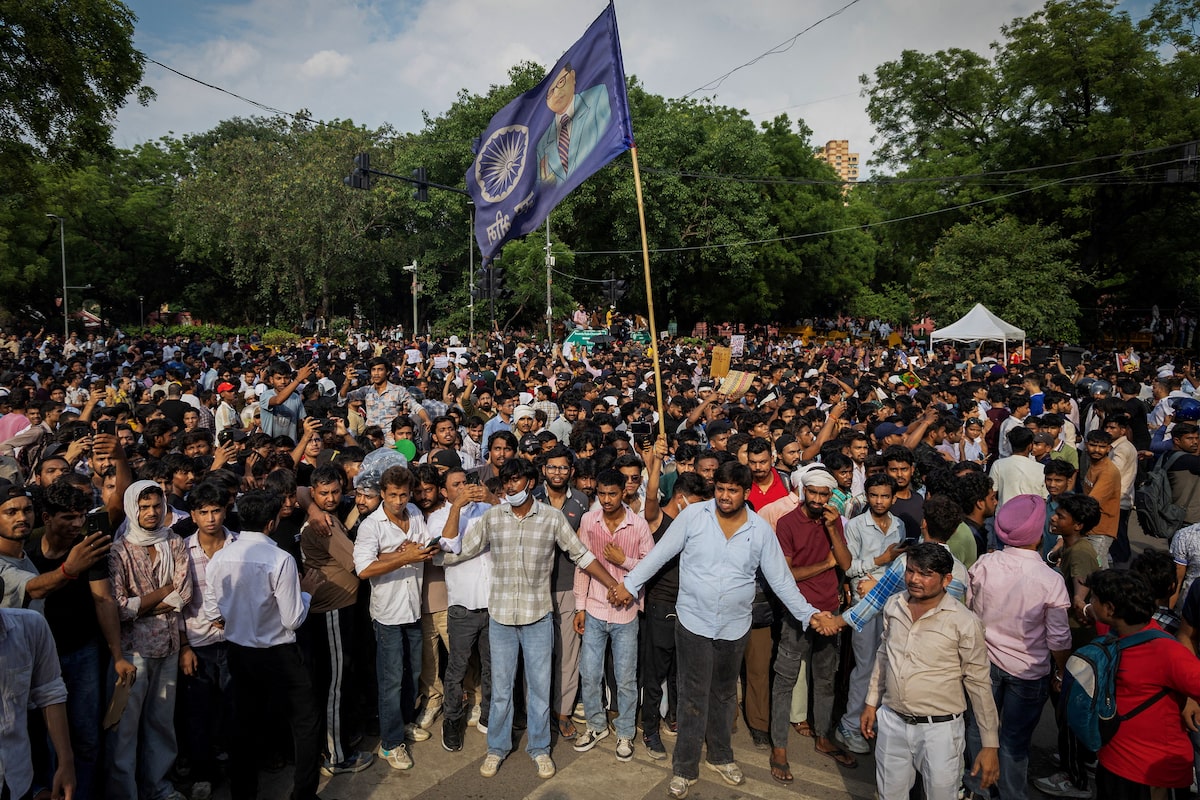
Open this photo in gallery:Supporters of India's Cockroach Janata Party form a human chain to control demonstrators during ongoing protests, two days after thousands marched towards Parliament demanding the resignation of Education Minister Dharmendra Pradhan over examination paper leaks, at Jantar Mantar in New Delhi, on Wednesday.Adnan Abidi/ReutersPolice in New Delhi violently cracked down on supporters of the youth-led Cockroach movement this week, as protesters marched on Parliament in a rare challenge to Prime Minister Narendra Modi. The two-month-old movement has already expanded beyond its initial base of students to attract veteran activists, professionals and families, as well as members of the main opposition Congress party, including leader Rahul Gandhi, who was detained at a sit-in this week. While Mr. Modi’s grip on Indian politics has only strengthened in recent years, the movement echoes the Gen Z protests that resulted in the overthrow of governments in Nepal, Bangladesh and Sri Lanka, making many in the ruling Bharatiya Janata Party (BJP) nervous. Here’s how we got here. What is the Cockroach movement? The Cockroach Janata Party (CJP), or Cockroach People’s Party, began as a satirical online response to comments by Surya Kant, the Chief Justice of India, describing unemployed young people who criticize the government as “cockroaches” and “parasites.” Mr. Kant apologized, claiming he was referring to people using fake degrees to enter the legal profession, rather than Indian youth in general, but it was too late. Abhijeet Dipke, a 30-year-old recent graduate, launched a website urging unity among fellow “cockroaches” frustrated by high youth employment and a government they said was corrupt and overlooked their struggles. It quickly attracted millions of followers. The new “political party for the people the system forgot to count” found its first target in India’s hypercompetitive entrance exam system, which has been dogged by allegations of corruption and other scandals. The CJP launched a five-point manifesto calling for reforms to the system, a students’ rights charter and greater parliamentary oversight. How has it grown? Under Mr. Modi, the BJP − supported by the Rashtriya Swayamsevak Sangh (RSS), a far-right Hindu paramilitary group − has dominated politics in India for more than a decade, marginalizing once-dominant Congress and winning control of state after state through a savvy mix of religious nationalism, big spending and relentless propaganda. The success of the BJP has often masked widespread dissatisfaction with Mr. Modi’s government, however, particularly among young people, many of whom have not benefited from India’s economic growth, struggling to compete in a country that is already the most populous in the world and still growing. With a focus on education and jobs, the Cockroach movement tapped directly into these frustrations and provided an avenue to express them outside traditional opposition parties, many of which are regarded as corrupt or ineffective, even among critics of Mr. Modi. The CJP was initially an online movement, attracting more than 22 million social media followers − more than the BJP or any other party − but has recently taken to the streets. How have the protests escalated? India's youth-led Cockroach Janta Party movement said on Monday a federal minister had promised the government would weigh its demands as thousands of protesters marched on Parliament despite police efforts to scatter them with tear gas.ReutersAfter the results of a medical entrance exam were cancelled in May because of allegations that question papers had been leaked, affecting millions of students, the CJP called for protests in central Delhi demanding government accountability and the resignation of Education Minister Dharmendra Pradhan. Both Mr. Modi and Mr. Pradhan initially refused to engage with the Cockroach movement, with the latter describing its leaders as “the B team of terrorists,” sparking further outrage among CJP supporters. Mr. Dipke, who had been in the U.S., returned to lead the demonstrations, which were also joined by Sonam Wangchuk, a veteran education reformer who announced he would go on a hunger strike until Mr. Pradhan resigned. Hunger strikes have a particular resonance in India, having been a key tactic of Mahatma Gandhi during and after the struggle for independence, and the sight of police forcibly taking Mr. Wangchuk to hospital Saturday, nearly two weeks into his fast, only amplified the movement. The protests this week were the largest anti-government demonstrations in years and were met by a heavy police response, including baton charges and tear gas. At least 150 protesters were injured, according to CJP leaders, and dozens arrested. Police said 118 officers were also injured as a result of “violent protests.” The CJP said that while protests will continue, it will not march on Parliament again for fear of further police brutality. Mr. Modi has still yet to comment publicly on the movement, but a spokesman said Tuesday that the government would punish those who leaked exam papers and make sure such incidents do not happen again. What does this say about Modi’s grip on power? Open this photo in gallery:While Prime Minister Narendra Modi’s grip on Indian politics has only strengthened in recent years, the Cockroach movement echoes the Gen Z protests that resulted in the overthrow of governments in Nepal, Bangladesh and Sri Lanka, making many in the ruling Bharatiya Janata Party nervous.Sanjeev Rastogi/The Associated PressImperious and seemingly all-powerful, Mr. Modi rarely makes concessions. His last major policy retreat followed months of protests by farmers over controversial agricultural reforms. That he would offer even a small olive branch so soon suggests the current demonstrations have rattled the government. In particular, the popularity of the CJP − which is not an official political party, despite its name − and the widespread frustration it has exposed across India have created an opening for the traditional opposition, which has struggled in the face of the relentless BJP election machine. Mr. Modi’s dominance was on display in recent state elections, with the BJP securing a landslide in West Bengal, a former opposition stronghold with a large Muslim majority that was once considered a tough win for the Hindu-majoritarian BJP. About half of India’s 1.42 billion people are under 30, a massive potential constituency − and one the Cockroach movement suggests is less than happy with Mr. Modi. State elections in February in Punjab and Uttarakhand could prove a key test of the BJP’s ongoing popularity. Certainly, the show of solidarity by Mr. Gandhi and senior Congress figures, along with leaders of other opposition parties, suggests they have recognized the opportunity presented by the Cockroach movement.“An attack on students is an attack on every Indian family,” Mr. Gandhi said Tuesday. “PM Modi believes he can get away without answers, without consequences. He cannot. Not this time. The voice of India’s students will not be ignored.”With files from Reuters
What is the Cockroach movement behind the protests in India?
Full Article
Original Source
Read the full article at Theglobeandmail →KhanList aggregates and links to publicly available news content. We do not host full articles from third-party sources. Always verify important information with original sources.