
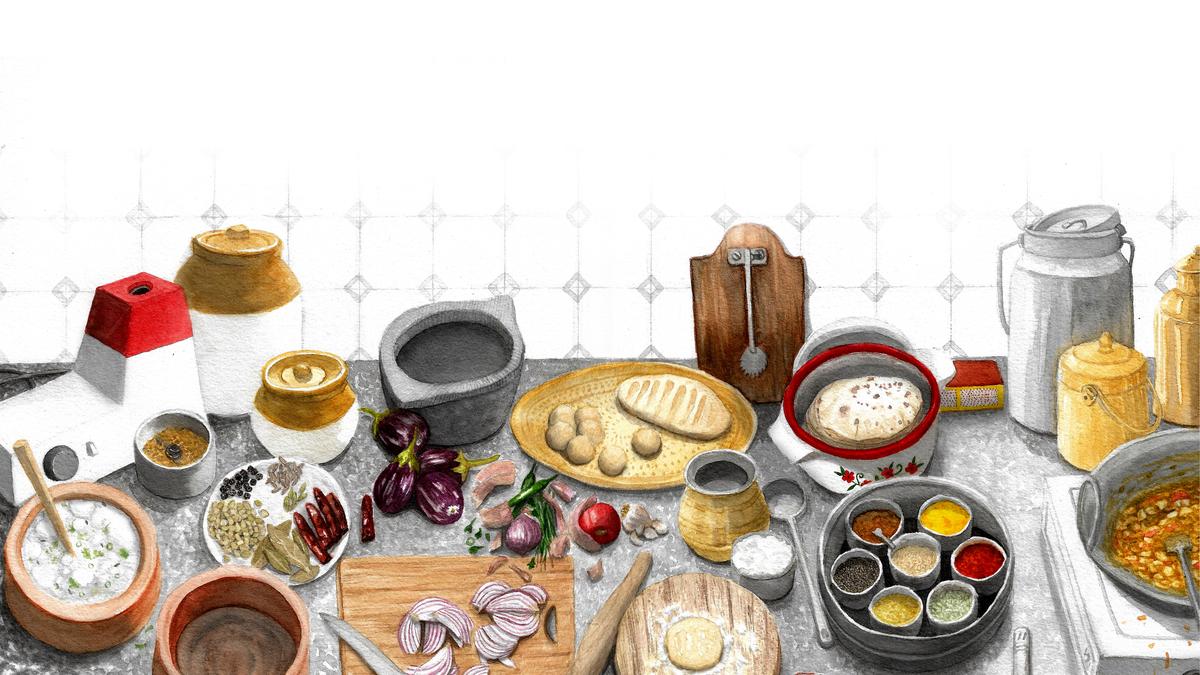
Growing up, I vividly recall my paternal grandmother making seviyan by hand. In a matter of minutes, the simple dough made with refined flour and water would turn into fine, thread-like strands of vermicelli. She would fill paraats (large, shallow steel platters) with them and lay them across the hall, left to dry under the slow turn of the fan. These delicate strands would go into her much-loved dessert, meethi (sweet) seviyan. Years after she passed, my mother preserved a few boxes of these handmade treasures in the freezer, then used them to recreate her dish one last time. No one in the family had learnt the art from her, and thus we have never eaten meethi seviyan with handmade vermicelli again. Read more |‘Salt: A World History’ and seven other food history books you should read Meethi seviyan made with roasted vermicelli, sugar, ghee, and dried fruits In an online interview, culinary anthropologist Kurush Dalal once said, “Food is all about memories one has made, is making, or will make”. Like the meethi seviyan, these culinary memories have become central to many families and have extended into the food experiences we share outside our family tables. Taste your childhoodA community potluck spotlights heirloom dishes; dining out is slowly turning intimate, with immersive, story-driven meals around the Partition, for instance; and documenting culinary traditions through cookbooks and podcasts has become something families are taking note of. Is this growing interest in nostalgia-driven culinary experiences a passing trend, or does it reflect our society’s desire to reconnect with its roots? “People are growing up now and realising food is much more than what we eat; it is a strong mnemonic,” says Mumbai-based Kurush, an archaeologist and historian.Read more |The Orissan tells the story of Odisha through history, culture, and food A woman grinding spices on the traditional sil battaGiven that larger family units were common in India, he candidly admits that “sadly the onus was on women to be the custodians of our food history”. “Men entered this space only in the last 10 years, and the rise in nuclear families has led to people missing their family food and therefore learning how to make these traditional dishes. They look for recipes and cook them more often.”Kurush, who also runs Katy’s Kitchen and caters Parsi cuisine across Maximum City, adds, “We’ve had Parsi NRI clients visiting India often asking for dishes that aren’t common today, such as chora ma paya (trotters cooked with black eyed peas), vaal (bitter beans), and masoor ma jeebh (goat tongue cooked with whole masoor dal),” he says.Read more |The rise of queer food books in India: how kitchens shape identity and belonging Recipes from an heirloom cookbook When asked for his fondest childhood food memories, Kurush returns to his maternal grandmother’s stewed apples, made only when a child was unwell. “Belonging to a middle-class family meant apples were not common at the table and were bought only when we were sick. She would slow cook the apples with cinnamon, sugar, lime, and occasionally throw in some extra raisins if she found them lying around,” he says of the dish that was “one of the most delicious things I ate as a child”. “I would feign a bad stomach to have it! Years later, my wife recreated the dish, and I had tears in my eyes. It brought back childhood, my grandparents...”Hunger, grief, and dinnerThree years ago, when culinary consultant and educator Prachi Grover started From Words to Wok, a food-in-literature club in Bengaluru, people did not quite know what to make of it. “Initially, people did not understand and thought it was about cookbooks.”What she was offering was far more impactful: a community that explores the intersections of food, literature, culture, and society through book discussions, workshops, and events. A snapshot of Words to Wok, a food-in-literature club in Bengaluru | Photo Credit: Special Arrangement Prachi always tells people to “just come, sit through the book reading, and buy the book once you get a taste of it” at the club that meets on a Saturday every month. “Most of our members started this way,” she says of From Works to Wok — which turned three this August — that began with three members and is now a 100-plus member community.“Nostalgia has probably been one of the strongest recurring themes, but it has never been purely sentimental or just joyful. More often than not, it has simply been a starting point. It has opened the door to conversations about identity, migration, hunger, grief, and sometimes even the memory of a memory,” says Prachi, adding that many of the books discussed, such as Climbing the Mango Trees by Madhur Jaffrey and A Taste of My Life by Chitrita Banerji, have used food as a way to remember people, places, and moments that might otherwise have been lost over time. “Books like Eating Women, Telling Tales by Bulbul Sharma have pushed that further, prompting us to ask whose labour sustains that nostalgia, and how the responsibility of preserving recipes, festivals, and family traditions so often falls on women,” she says. A publication by Nivaala | Photo Credit: Special Arrangement Preserve your family’s culinary memories in six easy steps1. Engrave utensils and dinnerware. Shruti uses spoons engraved with her grandfather’s initials, and her grandmother’s brass paraat to knead atta every day. Objects carry memory just as much as recipes do.2. Document the kitchen tools: Photograph and write down the history of the heavy iron kadai, the worn-down wooden rolling pin, the traditional stone pestle, the copper plate or the kansa bowl that came with grandmother’s trousseau, says Samrata.3. Record the ‘unwritten’ metrics: Traditional cooks rarely use grams or teaspoons; they use ‘a handful, ‘a pinch,’ or cook until the mixture ‘looks right.’ Samrata advises sitting down with your family elders and recording them explaining these intuitive measurements.4. Create audio recordings: Shruti says even 30 seconds of a grandparent describing how they make something, in their own voice and their own words, preserves something a written recipe never can.5. Note down remedies: Traditional remedies survive almost entirely through oral memory. The knowledge of which herbs to use, how to use them, and what they can cure are passed down by word of mouth rather than written record.6. Preserve the language around food: Samrata says we must look for the specific words an elder used for a dish or technique that don’t quite translate, since those words often disappear before the recipe does.Your grandmother’s voiceWhile Prachi’s initiative uses written verse to segue into conversations on food, memory, and even topics such as domesticity and parental roles, Nivaala is turning culinary memories into tangible keepsakes.Founded by Shruti Taneja in 2000 after losing her mother, the culinary heritage preservation platform started as a simple recipe journal. “Over time, we realised the thing we actually needed to preserve was something even more analog: oral tradition. So we began using technology and started independently publishing family cookbooks with QR codes linked to voice notes for each recipe. This didn’t just make the process easier; it made it more emotional,” she shares. Shruti of Nivaala says there’s already a 30% to 40% intergenerational loss of recipes | Photo Credit: Aparna Patidar Shruti recalls how one family created their family recipe book across three generations, with each member’s favourite food paired with a memory and the recipe. Memories on a Plate, a book she co-created with The Alipore Post, compiled food memories in a way that resonated widely enough to win the Gourmand World Cookbook Award in 2024. “Post-COVID, people are confronting the reality of mortality in a way they weren’t before. The oldest generation alive today is probably the last holder of real culinary knowledge, and there’s already a 30% to 40% intergenerational loss of recipes. If we don’t document them now, while that generation is still with us, we lose a significant body of culinary knowledge that exists only in people’s minds and hands,” says Shruti. Family Fables started in 2017 as a personal passion project | Photo Credit: Special Arrangement At New Delhi-based Family Fables, founder Samrata Salwan Diwan has been helping individuals, families, and companies document their stories into books. “Family Fables started in 2017 as a passion project to document my own family’s history. Nine years on, it’s grown into a publishing house, and we’ve brought out over 65 books including family memoirs like Thalayam, business and institutional histories, cookbooks, and city-level titles like Table for Four: Delhi’s Dining Legacy that maps the city’s food culture over decades,” she says, adding that food finds its way into almost every book they do, even when it is not the main subject. Old recipe books at Family Fables | Photo Credit: Special Arrangement Building an archive Taking a rather scientific approach to documentation is the Indian Community Cookbook Project (ICCP), founded by researchers Ananya Pujary, Khushi Gupta, and Muskaan Pal in 2019 when they were undergraduate students. For their final project, the team created a website documenting the food traditions of the Tuluva community, where much of their culinary knowledge was being passed down orally. “Some of our earliest work involved looking at food traditions from coastal Karnataka and the wider Mangalorean region. One dish that stands out is gendada adde, which Ananya grew up eating, and is traditionally cooked over hot coals. We also documented the late SM Joshua’s (Ananya’s neighbour) family recipe book, which contains handwritten recipes including Joyce’s masala, mango sweet pickle and dahimachli,” adds Khushi, currently pursuing her Master’s at the University of New South Wales, Australia, specialising in Marketing Analytics and Digital Transformation. A recipe from SM Joshua’s family recipe book | Photo Credit: Special Arrangement While working on it, the trio started realising that this was not limited to just one community, and this grew into ICCP. “A lot can get lost when something is simply translated or rewritten, so we try to preserve food stories in the form they come to us. That could be a handwritten recipe, an audio recording, a video, or even something that has been passed down through phone calls and conversations in the kitchen,” says Khushi, reminiscing her family cook’s pachai manga (raw mango) pachadi that she later adapted to an apple pachadi when she moved abroad. An illustration of makki di roti, sarson da saag, and gur | Photo Credit: Shradha Parakkal At ICCP, out-of-print community cookbooks, tattered handwritten kitchen diaries, and oral histories across regions are tracked to build public timelines and spatial maps to visually preserve how local flavours evolved. “Our project aims to be a multilingual open-access online archive of Indian culinary heritage,” says Ananya, an institutional research analyst at the University of Rhode Island, USA. “We rely heavily on cookbook metadata and crowdsourced public knowledge, since there has been limited comprehensive documentation of India’s diverse culinary landscape,” adds Ananya.With the emergence of AI tools, the team is now trying to use AI APIs to create a more robust data archive of post-1900s published Indian cookbooks. “We hope this will be a first step towards scoping out what public knowledge on Indian food looks like spatially; what regions are overrepresented or underrepresented in publication,” says Muskaan, a behavioural science researcher at the University of Nottingham, UK. Khushi says they are also exploring ways to make ICCP more community-led by allowing contributors to directly add their own recipes, food memories and related material to the archive. At ICCP, out-of-print community cookbooks, tattered handwritten kitchen diaries, and oral histories across regions are tracked Struggling with memories of dinnerKurush says that not all food memories are comforting. One such is the bread halwa. ‘No dish talks about the tragedy of the Partition like bread halwa does. Refugee camps were getting aid packets that contained alien ingredients such as bread and butter. People would cook down the butter, crumble the bread, add sugar, and let it caramelise until it all came together. It was created at a time to get a little happiness in a time of great darkness, and the dish continues to be part of the story of families that crossed over,’ he said, in an interview with Kunal Vijaykar as a part of the YouTube series, A Century of Stories. Several such dishes rose from such times, like the Sindhi mac and cheese. “The Sindhis in refugee camps in Bombay received macaroni. They pressure-cooked it with potatoes and masala, and youngsters today still can’t fathom what this dish is! But Sindhi mac and cheese is comfort food for many,” adds Kurush. It’s around a shared table that oral traditions get passed on | Photo Credit: Shradha Parakkal Even at her Literature Club, Prachi has had books that did not sit easily with everyone. “Hooked: A Novel of Obsession by Asako Yuzuki delves into womanhood and the complexities of domesticity. Dalit Kitchens of Marathwada, and Beef, Brahmins and Broken Men have led to conversations around caste, exclusion, and dignity. House Spirit opened up discussions many members hadn’t anticipated: about addiction, family silences, and the stigma surrounding alcohol within homes. Hungry Bengal prompted conversations about colonial policies, engineered scarcity, and the memories that some members had inherited from older generations in their families. These have also been some of our most meaningful discussions because they remind us that food can carry grief, inequality, shame, and loneliness just as powerfully as it carries comfort, abundance, and belonging,” explains Prachi. At Nivaala, Shruti publishes family cookbooks with QR codes linked to voice notes for each recipe The power of memory As on-ground food nostalgia experiences become immersive, Samrata feels the shift is “completely natural”. “The food industry has finally caught up to something publishing figured out long ago: a dish without its story is just food on a plate. Food was always about memory, but people are now actively looking for ways to access that memory, not just taste it. A meal reminds you of something; an experience lets you sit inside it for a while: the sounds, the setting, the stories being told around the table,” she explains. Prachi addresses how we are living in a time when families are more dispersed than ever, and therefore food is one of the easiest ways to hold on to identity and a sense of belonging. “Readers are increasingly drawn to stories that feel personal. Food memoirs and narratives offer an intimate way of understanding history through kitchens and shared meals,” she shares. Food is one of the easiest ways to hold onto identity and a sense of belonging | Photo Credit: Aparna Patidar Perhaps why it has become all the more important to not just revisit these traditions but document them. “Our lives have become so fast-paced that we rarely sit down together to eat anymore, and that matters more than it seems, because it’s around a shared table that oral traditions get passed on. It could be the labour of making winter pickles as a family, or mithai for festivals or weddings, or a simple family lunch,” says Samrata. As Kurush says, “Talk to your grandparents, parents and their generations in great detail: about what they remember as children, what they ate on special occasions, and what was in their kitchens.” Things that are on my to-do list for this festive season, lest I lose another gem like the meethi seviyan.
What happens when the last person who knows the recipe is gone?
Full Article
Original Source
Read the full article at Thehindu →KhanList aggregates and links to publicly available news content. We do not host full articles from third-party sources. Always verify important information with original sources.