
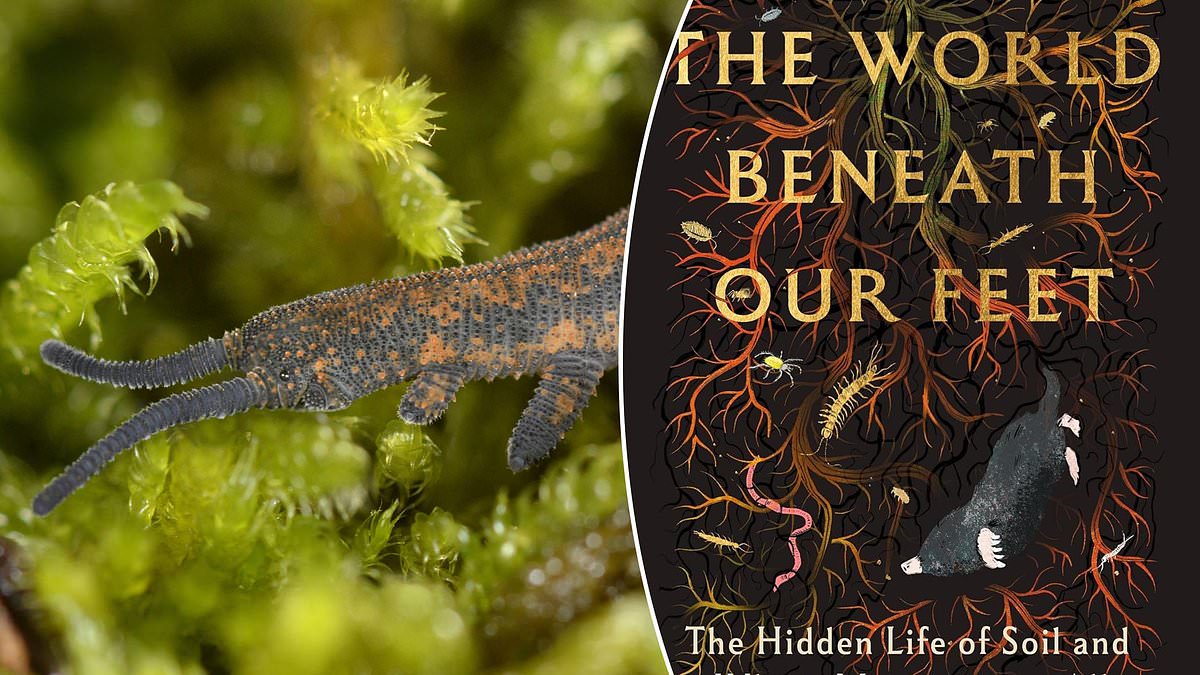
The World Beneath Our Feet by Fran Ashwood (Hodder Press £25, 288pp) is available now from the Mail Bookshop Published: 04:00 EDT, 28 August 2026 | Updated: 04:09 EDT, 28 August 2026 So WHAT does soil sound like? This seems like one of those tricky Zen riddles meant to open your mind.But, in fact, we know very well what the answer is.‘A sustained low rumbling sound . . . the noise made by plants’ roots as they slowly push through’; then a noise like someone raking sand, and ‘creaking, like a wooden house settling at night-time,’ and ‘a series of clicks’.This is the ‘underground orchestra of invertebrates – ants, beetles, springtails, fly larvae, centipedes, woodlice, and even spiders – as they manoeuvre through their light-less world’.Such recordings are made by soil scientists, and they can judge how healthy a soil it is from the amount of noisy bustle and activity it contains: the more the better.Frank Ashwood is one such scientist, with a lifelong love of the material itself and the myriad creatures that live in it. ‘Soil is the last great unexplored frontier on our planet,’ he says. Sticky: The velvet worm has two tiny ‘glue-firing cannons’ on its headHe has a special fondness for springtails, tiny insects and busy recyclers, crucial to soil health. They’re good at the high jump, too, able to ping up to 100 times their own body length, equivalent to us jumping over a 45-storey building.Fortunately for springtails they weigh rather less than us, so enjoy a softer landing.One key to healthy soil, and indeed to healthy forests, is dead and rotting wood.Until the 1970s, Ashwood reminds us, most fallen wood was cleared away tidily. Thank goodness we’ve learned. Dead wood supports as many as 40 per cent of all forest organisms, and many green-fingered gardeners now create damp log piles in neglected corners deliberately.Other memorable creatures we are introduced to here include a mite that has been exclusively female now for 100 million years, reproducing perfectly well without males by ‘parthenogenesis’ – literally, virgin birth. A feminist icon for our times.Then there’s the aggressive Asian jumping worm, and a terrifying creature called a trigonotarbid, a now-extinct ancestor of today’s spiders. Not forgetting the velvet worm, with two tiny ‘glue-firing cannons’ on its head, and the magnificently named Badischer Riesenregenwurm, a giant earthworm only found in the Black Forest, Germany, that grows up to 2ft long. The World Beneath Our Feet is available now from the Mail BookshopSome of the richest soils aren’t in forests, but grasslands, which, if ancient, unsprayed and moderately grazed, can contain a mind-boggling ‘100 tonnes of living biomass per hectare’ underground. Hard to picture? Then imagine, he suggests, some 15 African bull elephants living under a standard rugby pitch.For most of human existence the Earth was at least 80 per cent forested. Today that’s down to 32 per cent, and we have greatly increased other habitats, but this isn’t necessarily a problem, nor is planting trees necessarily the answer.Ashwood argues strongly for ‘agroforestry’, or what could be called ‘wood pasture’: grasslands or crops interspersed with trees and thickets. Much old, ‘unimproved’ British and European farmland looks like this. Long may it flourish!But with at least a third of the planet’s soils moderately to severely degraded, we need to value them as never before – if we value nature, wildlife and our own future.
What do a 100 million-year-old feminist, a 2 ft long worm and a glue shooting sniper all have in common? They live in your soil
Full Article
Original Source
Read the full article at Dailymail →KhanList aggregates and links to publicly available news content. We do not host full articles from third-party sources. Always verify important information with original sources.